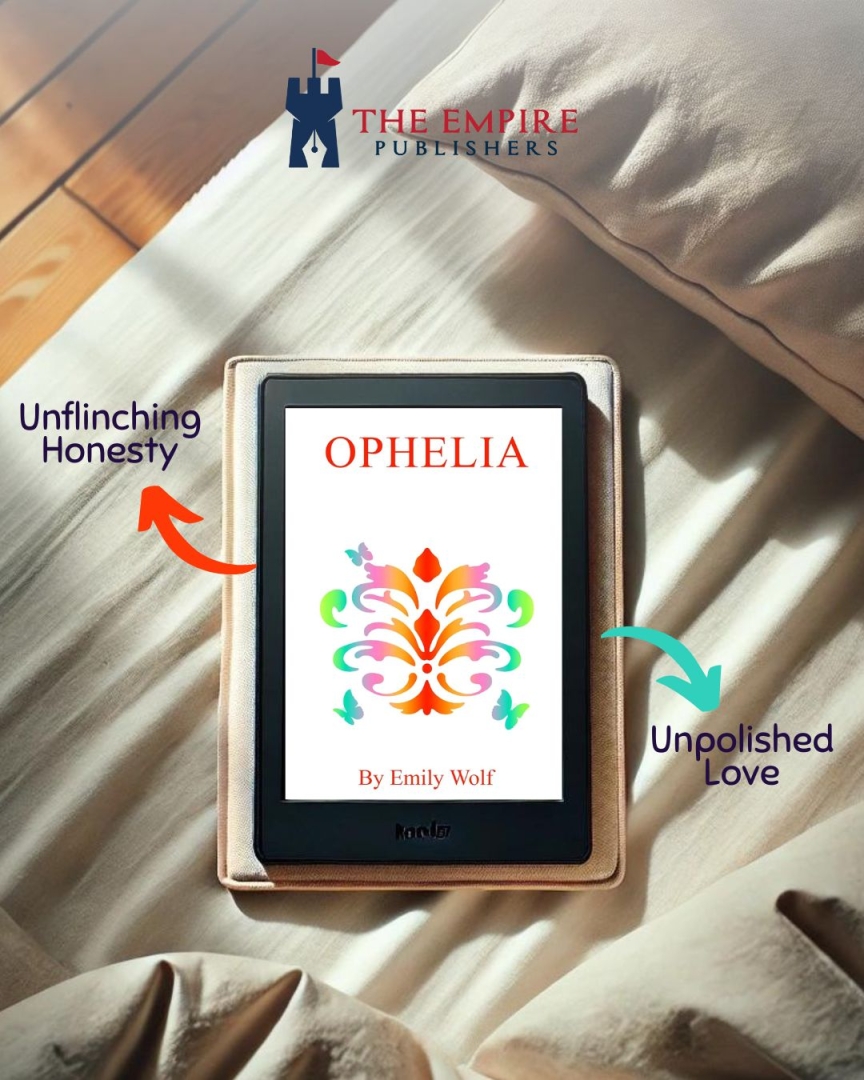
Some poetry does not ask to be admired. It asks to be endured. It tells its story without polish or permission, and it stays with the reader long after the page is turned. That is the nature of Ophelia, the debut poetry collection by Emily Wolf. These poems move through desire, grief, addiction, and memory with a sharp honesty that refuses comfort or distance.
Written in the voice of someone who has lived through too much too early, Ophelia does not present a character or a concept. It presents a life in fragments. At just 22 years old, Wolf writes from experience shaped by intense love, fractured friendships, and nights where survival felt uncertain. The title Ophelia is not symbolic. It is the name of a lover, someone real, someone who left a lasting mark. This is not a book about heartbreak from afar. It is about being inside it.
Poems Born from Love and Collapse
The poems in Opheliaare immediate. They do not linger on explanations or metaphors for safety. Instead, they move straight into feeling, often without warning. In “Bodies,” Wolf writes of intimacy through the lens of mortality, describing lovers as “perfect corpses / dead and flawless,” capturing how closeness can feel both sacred and fragile at once. Love, in her work, is never without consequence.
In “Water,” affection becomes sustenance and weight at the same time. It keeps you alive, but it also pulls you under. This tension runs throughout the collection. Desire feeds the speaker, even as it exhausts her.
Wolf writes about drug use alongside tenderness, about loyalty alongside loss. These poems unfold like journal entries written in moments that could not wait. A piece such as “I Miss You, My Best Friend,” dedicated to William Lowther, who died in 2022, speaks with restraint rather than drama. There is no attempt to dress grief up. The simplicity makes it heavier. The absence becomes the point.
Why Ophelia Matters Right Now
Ophelia arrives during a time when conversations about mental health, addiction, and destructive relationships are becoming more visible, yet often remain distant or clinical. Wolf does not analyse these experiences. She lives them on the page.
Her poems show what it feels like to love someone who is dangerous to you. To lose friends to overdose. To wake up unsure whether you are moving forward or simply surviving another night. There is chaos here, but it is familiar chaos. Readers who have experienced depression, dependency, or all-consuming love will recognise the emotional landscape immediately.
For others, the book offers a rare entry point into lives often hidden behind ordinary routines. These poems give shape to thoughts people rarely say out loud.
A Voice that Refuses Distance or Disguise
What sets Wolf’s debut apart is not technical perfection, but refusal to hide. Her language is stripped back. Sometimes harsh. Sometimes soft enough to bruise. She writes as if time is limited, as if the truth must come out before it disappears.
There is no excess. No filler. In “Suicide, Girl 20-12-22,” love is bound to death, linked through hospital radios and waiting rooms. In the poem “Ophelia,” Wolf predicts her own ending: “I won’t make it till 24, I have a funny feeling, the voices won this war.” These lines are unsettling because they do not perform despair. They state it plainly. The effect is not shocking. It is closeness.
Emily Wolf at the Beginning of Her Story
Wolf began writing at sixteen, not with plans for publication, but from a need to survive her own thoughts. Growing up around instability and substance use, she found in writing a way to hold meaning when everything else felt unreliable. Poetry became a place to put what could not be spoken.
With Ophelia, she steps into public view without softening her edges. She does not present herself as healed or resolved. She presents herself as honest. That honesty gives the collection its strength.
The book is dedicated to Will, Scarlett, and Natalia, names that echo through the work as reminders of love and loss. Their presence turns the collection into both record and tribute. Memory, here, becomes an act of defiance.
For Readers Willing to Sit with the Truth
Ophelia is not a comforting book, and it does not aim to be. Readers drawn to confessional poetry, in the tradition of Sylvia Plath or Charles Bukowski, will find echoes here, though Wolf’s voice remains distinctly her own and rooted in the present moment.
This collection speaks to those who have questioned what it means to keep going when everything feels heavy. It does not offer solutions. It offers recognition. These poems linger because they feel lived, not constructed.
Ophelia is a book for readers who understand that sometimes survival itself is the story.
Availability
Ophelia by Emily Wolf is available now on Amazon UK in paperback and Kindle editions.
Media Contact
Company Name: The Empire Publishers UK
Contact Person: Iris Williams
Email: Send Email
Country: United Kingdom
Website: https://www.theempirepublishers.co.uk/