FORT WORTH, TX / ACCESS Newswire / September 25, 2026 / Vadzo Imaging, a provider of embedded vision camera products for OEMs and system integrators, today announces validation of the Bolt-821CRS 8MP AR0821 HDR MIPI Camera, an 8MP color camera built on the Onsemi AR0821 sensor and confirmed for direct integration with the NVIDIA Jetson AGX Orin platform. Part of Vadzo's MIPI camera portfolio, the Bolt-821CRS pairs the AR0821's high dynamic range pixel architecture with validated ISP tuning for NVIDIA's Argus camera framework, giving edge AI developers a camera whose HDR output is properly calibrated for the same software stack their GStreamer and DeepStream pipelines already use. With this validation, Vadzo delivers an AR0821 MIPI Camera that ships with confirmed device tree overlays, ISP tuning files, and Linux driver packages for Jetson AGX Orin, giving robotics engineers, drone platform integrators, and machine vision developers a camera module ready for direct integration into AI vision products without independent tuning file development.
Technical Problem Definition
Many camera modules marketed as Jetson-compatible have only been confirmed to produce a raw Bayer frame over a basic V4L2 capture path, which is a meaningfully lower bar than what most Jetson AGX Orin AI applications actually require. NVIDIA's Argus camera framework, accessed through the nvarguscamerasrc GStreamer element and used throughout DeepStream pipelines, sits between the raw sensor output and the application, applying hardware-accelerated ISP processing including tone mapping, noise reduction, and HDR combination. A camera without ISP tuning files calibrated specifically for its own HDR pixel architecture produces a poorly tone-mapped, washed-out, or noisy image once that frame passes through Argus, even if the same raw frame looked reasonable when pulled directly off a bypassed V4L2 device node during a bench test. This creates a validation gap that a quick bring-up test does not reveal. An OEM can confirm basic frame capture in a lab in an afternoon, only to discover months later, once the camera is integrated into an actual DeepStream inference pipeline, that the HDR image quality through Argus does not match what the sensor datasheet promised. Rediscovering this gap that late in a product program typically forces a choice between an expensive tuning file development effort under schedule pressure or shipping a product with visibly degraded HDR performance, neither of which an OEM wants to face after committing to a bill of materials. The alternative many integrators fall back on, bypassing Argus entirely and pulling raw frames directly, forfeits the hardware-accelerated ISP processing, the multi-stream pipeline support, and the broader NVIDIA software ecosystem that Jetson AGX Orin was specifically designed around, undermining much of the reason an OEM chose Jetson silicon in the first place. A module marketed broadly as an HDR MIPI CSI-2 Camera without this specific Argus validation behind it leaves this exact gap unaddressed, and an AR0821 eHDR MIPI Sensor that has only been characterized through raw V4L2 capture provides no real assurance about how its enhanced dynamic range will actually render once an application accesses it the way Jetson's own tooling expects.
Engineering Explanation
The Bolt-821CRS addresses this gap by validating the Onsemi AR0821 sensor's complete HDR pipeline through NVIDIA's Argus camera framework on Jetson AGX Orin, rather than confirming only a basic V4L2 capture path. The AR0821 is an 8MP color sensor with native 4K (3840 x 2160) resolution and a high dynamic range pixel architecture that captures a wide brightness range within a single frame interval. Vadzo develops and validates ISP tuning files specific to this sensor's HDR output, confirming that tone mapping, noise reduction, and color reproduction behave correctly once the frame passes through Jetson AGX Orin's hardware ISP and the Argus daemon, rather than leaving that calibration work for the OEM to discover is missing after their own application integration is already underway. This makes the camera a genuine Wide Dynamic MIPI Sensor platform when accessed through nvarguscamerasrc, since the wide dynamic range the sensor captures at the pixel level actually survives the full processing pipeline an application developer will use in production. Vadzo confirms the complete MIPI CSI-2 pad chain from the AR0821 sensor subdevice, through Jetson AGX Orin's CSI-2 receiver, into the hardware ISP, and out through the Argus daemon to the application layer, validating an HDR MIPI Sensor Module that OEMs can rely on rather than assembling from a generic MIPI CSI-2 datasheet and a hope that Argus tuning will work itself out. The camera connects over a 4-lane MIPI CSI-2 interface, providing sufficient bandwidth for full 4K capture as well as 1080p and 720p downsampled modes for higher frame rate operation, functioning as a 4K HDR MIPI Sensor suited to both archival capture and real-time inference workloads. Vadzo supplies confirmed device tree overlays and Linux kernel driver packages specific to Jetson AGX Orin, covering the sensor node, the CSI-2 endpoint configuration, and the ISP tuning file set, so integrators start from a validated reference configuration rather than deriving lane mapping, endpoint properties, and HDR tuning parameters independently. The camera is rated across a -30 degree C to 70 degree C operating range, matching the thermal envelope typical of enclosed robotics payload bays, drone camera housings, and industrial inspection enclosures. Vadzo validates each ISP tuning parameter against recorded footage from representative scenes rather than a synthetic test chart alone, since a tuning pass that only satisfies a lab chart can still leave the tone mapping gaps in real-world HDR performance that the underlying validation problem describes.
Product Overview
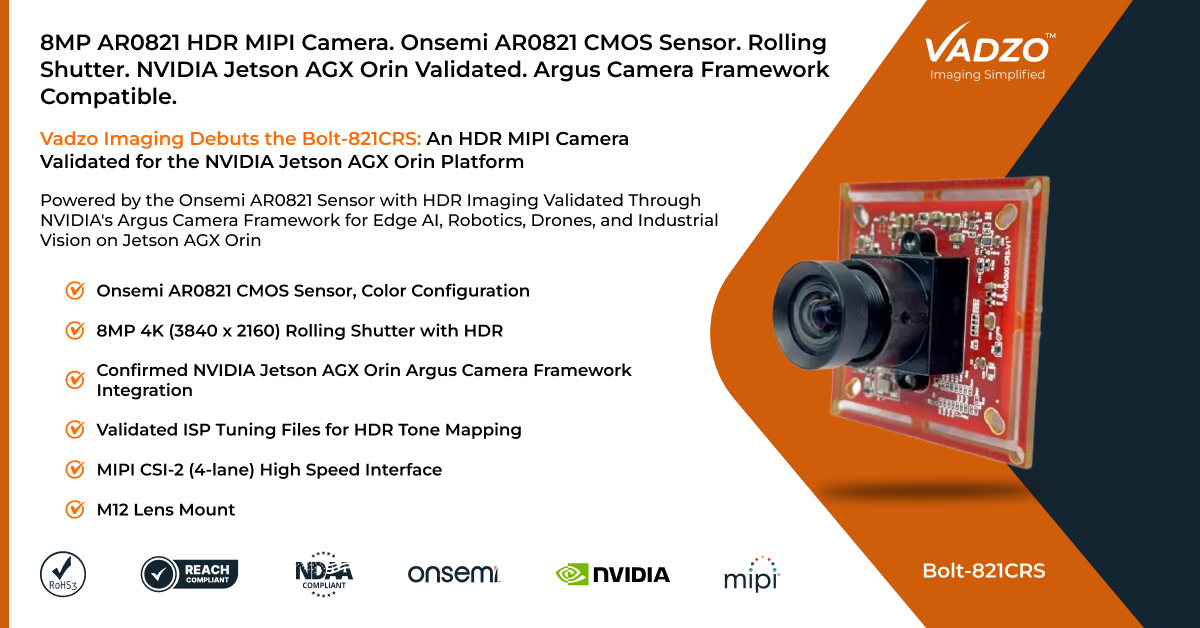
The Bolt-821CRS is an 8MP AR0821 HDR MIPI Camera built on the Onsemi AR0821 sensor and validated specifically for the NVIDIA Jetson AGX Orin platform. As an 8MP HDR MIPI Camera, it is purpose-built for OEMs who need confirmed HDR image quality through NVIDIA's Argus camera framework rather than a generic Jetson compatibility claim that leaves the actual tuning question unanswered. The AR0821 NVIDIA Orin MIPI Camera designation reflects Vadzo's validation process, which confirms ISP tuning, pad format negotiation, and Argus integration directly on Jetson AGX Orin hardware before the module reaches OEM customers. The camera module houses the AR0821 sensor, ISP, and MIPI CSI-2 interface in a compact form factor with a standard M12 lens holder. As an 8MP NVIDIA Jetson MIPI Camera, output modes include full 4K, 1080p, and 720p, selectable to balance resolution against frame rate and CSI-2 bandwidth for the target inference workload, and the AR0821 HDR MIPI CSI-2 Camera designation specifically confirms this behavior on Jetson AGX Orin hardware. As a MIPI HDR Vision Sensor, the camera integrates with Jetson AGX Orin's Linux camera stack through confirmed device tree overlays and ISP tuning files, requiring no independent calibration effort for basic HDR capture.
Key specs: 8MP 4K (3848 x 2168) | Onsemi AR0821 CMOS Sensor | Color (Bayer RGB/YUV422) | Rolling Shutter with HDR | MIPI CSI-2 (4-lane) | NVIDIA Jetson AGX Orin Validated | M12 Lens S Mount
Key Capabilities of the Onsemi AR0821 Onsemi AR0821 MIPI Camera
8MP 4K HDR Resolution Validated for Jetson AGX Orin: Many camera modules paired with Jetson silicon are validated only against a lower-resolution reference sensor, leaving OEMs to discover bandwidth or ISP configuration gaps once they specify an 8MP sensor for their own product. The Bolt-821CRS, positioned as a 4K CSI-2 HDR Camera, is validated to deliver its full 8MP 4K (3840 x 2160) HDR frame directly through Jetson AGX Orin's ISP and Argus pipeline at practical frame rates for both still capture and real-time inference. This makes it a genuine 4K MIPI HDR Camera that OEMs can specify with confidence when an application depends on both full sensor resolution and properly tone-mapped dynamic range, and an 8MP MIPI Sensor Module that ships as a complete validated unit rather than a bare sensor requiring independent characterization.
NVIDIA Jetson AGX Orin Platform Validation: A camera module that lists Jetson compatibility in its datasheet has not necessarily been validated against the specific ISP tuning and Argus integration that Jetson AGX Orin's camera subsystem requires for correct HDR output. The Bolt-821CRS is validated specifically as an 8MP CSI-2 HDR Sensor, with Vadzo confirming pad format negotiation, ISP tuning file accuracy, and Argus daemon integration directly on Jetson AGX Orin hardware before release. This makes the AGX Orin AR0821 Sensor pairing a confirmed reference design rather than a generic MIPI sensor breakout board, giving OEMs a validated foundation for products that specifically require Jetson AGX Orin's camera subsystem and AI processing capacity.
HDR Imaging Through NVIDIA's Argus Camera Framework: A sensor's HDR capability only matters to an application if that dynamic range survives the processing pipeline standing between the sensor and the software actually consuming the frame. The Bolt-821CRS's HDR output is validated specifically through NVIDIA's Argus camera framework, confirming that tone mapping, noise reduction, and color reproduction hold up correctly when accessed through nvarguscamerasrc rather than only when pulled as a raw frame directly off the sensor. This distinction matters directly for OEMs building DeepStream-based inference pipelines, since Argus is the path most Jetson AI applications actually use, and a camera validated only against raw V4L2 capture provides no assurance about how its HDR output will actually look once it reaches an application built the way NVIDIA's own tooling expects.
MIPI CSI-2 Direct Integration for Low Latency Edge AI Inference: Real-time robotics, drone, and inspection applications depend on predictable, low-latency frame delivery from sensor to inference engine. The Bolt-821CRS connects over a 4-lane MIPI CSI-2 interface directly to Jetson AGX Orin's CSI-2 receiver and hardware ISP, avoiding the enumeration overhead and host driver stack that an intermediate USB bridge would introduce. Vadzo confirms the complete media controller pad chain from the AR0821 sensor subdevice through the CSI-2 host to the video device node, so an integration effort starts from validated pipeline configuration rather than trial-and-error pad format negotiation on a new platform.
GStreamer and DeepStream Pipeline Compatibility for AI Application Development: Application developers building on Jetson AGX Orin typically construct their vision pipeline using GStreamer elements, often within an NVIDIA DeepStream application that expects a properly configured Argus source. The Bolt-821CRS functions as a MIPI HDR Embedded Vision platform in this context, since its validated ISP tuning and confirmed Argus integration mean the camera drops directly into an existing pipeline without requiring the application developer to debug tuning file gaps before their actual inference work can begin.
OEM Integration for Jetson AGX Orin Programs: The Bolt-821CRS ships with confirmed device tree overlays, ISP tuning files, and Linux kernel driver packages for Jetson AGX Orin, giving OEMs a validated starting point rather than an open-ended integration project. Available as a MIPI CSI-2 HDR Kit for evaluation, the camera lets engineering teams confirm HDR image quality through Argus on their own Jetson AGX Orin hardware before committing to a production order. For OEMs evaluating Vadzo as an OEM HDR MIPI Module supplier, this means lens matching, firmware customization, and enclosure design support are available alongside the core camera hardware rather than as a separate engagement. As a Plug and Play HDR MIPI camera, the Bolt-821CRS is validated for straightforward integration across Jetson AGX Orin-based development boards and production carrier boards alike. Vadzo's position as an HDR MIPI Camera Supplier extends beyond the camera module itself to include Argus tuning support, while its track record as an HDR MIPI Camera Manufacturer covers production programs spanning multiple sensor families and interface types for OEM customers building edge AI vision products.
"Every OEM building on Jetson AGX Orin has run into the same surprise at some point: a camera that captures a perfectly fine-looking raw frame in a bench test, then produces a washed-out or poorly tone-mapped image the moment it runs through an actual DeepStream pipeline, because nobody validated the ISP tuning for Argus. The Bolt-821CRS was built to close that gap specifically. We validate the Onsemi AR0821's HDR output through NVIDIA's own Argus camera framework, not just through a raw V4L2 capture test, so the dynamic range an OEM sees on our bench is the dynamic range they get in their finished DeepStream application. That is a meaningfully more honest validation bar than a generic Jetson compatibility claim, and it is the bar we hold every camera in this lineup to before it ships." - Alwin Vincent, Product Manager, Vadzo Imaging.
Application Specific Sections
Edge AI Development on Jetson AGX Orin: Engineering teams building a new edge AI vision product on Jetson AGX Orin often start from a development kit before committing to a custom carrier design, and the camera they prototype with needs to behave through Argus the same way the production camera eventually will. The Bolt-821CRS works as an AGX Orin HDR MIPI Camera for exactly this evaluation stage, connecting directly to standard Jetson AGX Orin development kit camera connectors with confirmed driver and ISP tuning support, so engineering teams can validate HDR image quality and DeepStream pipeline compatibility before finalizing a production design. Prototyping against confirmed reference hardware also shortens the debugging cycle when a design later moves from a development kit to a custom carrier board, since integrators already know the camera's Argus behavior is not the source of any new issue that surfaces during that transition.
Robotics and Autonomous Systems: Robotics platforms performing navigation or object detection in environments with variable lighting depend on HDR image quality that actually survives the perception pipeline the robot's software runs. The Bolt-821CRS functions as an HDR MIPI Robotics Camera for these deployments, giving robotics integrators confirmed HDR performance through the same Argus and DeepStream pipeline structure their navigation and detection algorithms already expect to consume.
Machine Vision and Quality Inspection: Machine vision inspection stations built around Jetson AGX Orin need dependable HDR performance to resolve both bright and shadowed regions of a part under factory floor lighting, and that performance needs to hold up through whatever inference pipeline the inspection software actually runs. The Bolt-821CRS serves as an MIPI HDR Machine Vision Camera for these deployments, with validated Argus integration ensuring that the tone-mapped output an inspection algorithm receives matches the dynamic range the sensor captured at the pixel level.
Drone and Aerial Inspection Platforms: Aerial inspection and mapping payloads built on Jetson AGX Orin need HDR performance that holds up during real-time flight processing, not only during a static ground test. The Bolt-821CRS operates as an HDR MIPI Drone Camera for these platforms, giving drone OEMs confirmed HDR image quality through Argus for onboard inference during flight, paired with the compact MIPI CSI-2 interface that keeps payload integration straightforward.
Industrial Inspection Systems: Industrial inspection deployments running on Jetson AGX Orin increasingly process video directly on the embedded module rather than sending raw frames to a central server, which means the ISP and Argus pipeline sitting between the sensor and the inspection algorithm has to be correctly tuned for the job to work at all. The Bolt-821CRS functions as an HDR MIPI Inspection Camera for these systems, with confirmed ISP tuning and device tree configuration reducing the integration timeline for OEMs deploying edge AI inspection across multiple production lines, and its suitability as an AGX Compatible HDR Camera extends across the broader family of Jetson Orin modules an OEM's product line might span. Inspection engineers introducing a new part variant to an existing line can validate detection performance on the same camera hardware already qualified for the rest of the line, rather than triggering a new camera and Argus tuning qualification cycle every time the production mix changes.
Frequently Asked Questions
Q: Why does Vadzo Imaging validate its HDR camera through NVIDIA's Argus camera framework rather than just basic frame capture?
A: Vadzo Imaging designs its Jetson camera lineup around a distinction that a simple bench test can miss: a raw frame pulled directly off a sensor is not the same as the frame an actual AI application receives once it passes through NVIDIA's Argus camera framework. Vadzo Imaging validates HDR tone mapping, noise reduction, and color reproduction specifically as they behave through Argus, because that is the path most Jetson AI applications actually use in production. Vadzo Imaging considers this the honest bar for calling a camera validated, not a lower bar that only confirms basic capture.
Q: Does Vadzo Imaging provide ISP tuning files for its Jetson AGX Orin camera, or does the OEM need to create them?
A: Vadzo Imaging supplies confirmed ISP tuning files specific to the sensor's HDR output alongside every camera module in this lineup, so engineering teams do not need to develop tuning files from scratch before achieving usable image quality through Argus. Vadzo Imaging validates these tuning files directly on Jetson AGX Orin hardware as part of the camera's release process, which matters for OEMs who would otherwise need specialized ISP tuning expertise on staff to reach the same result independently. Engineering teams can request these validated tuning files directly from Vadzo Imaging as part of an evaluation kit rather than waiting until a production order to receive them.
Q: Can Vadzo Imaging's camera be used directly in a DeepStream or GStreamer AI pipeline?
A: Yes. Vadzo Imaging validates its Jetson AGX Orin camera lineup specifically through the nvarguscamerasrc GStreamer element that DeepStream applications depend on, so the camera integrates directly into an existing DeepStream pipeline without requiring the application developer to first resolve tuning file gaps. Vadzo Imaging prioritizes this compatibility because most OEM applications on this platform are built around GStreamer and DeepStream rather than raw V4L2 capture.
Q: Does Vadzo Imaging's HDR camera preserve dynamic range when used with NVIDIA's camera framework, or does it fall back to standard exposure?
A: Vadzo Imaging validates that the sensor's high dynamic range output survives the complete Argus processing pipeline, confirming that tone mapping and exposure combination behave correctly rather than defaulting to a flattened, standard dynamic range result once the frame passes through the framework. Vadzo Imaging treats this specific validation step as essential, since an HDR sensor that loses its dynamic range advantage once it reaches an actual application delivers no real benefit to the OEM who selected it.
Q: Why should OEMs building Jetson AGX Orin vision products choose Vadzo Imaging as their camera supplier?
A: Vadzo Imaging offers more than a camera that lists Jetson compatibility on a spec sheet. OEMs building Jetson AGX Orin vision products and working with Vadzo Imaging receive a camera validated through the actual software framework their applications will use, along with engineering support covering lens selection, firmware customization, and ISP tuning guidance. Vadzo Imaging maintains evaluation kits with no minimum order requirement, so engineering teams can confirm HDR performance through their own DeepStream or GStreamer pipeline before committing to volume production. This combination of validated software integration and low minimum evaluation access is why Jetson AGX Orin OEMs continue to choose Vadzo Imaging for edge AI camera programs.
Availability
The Bolt-821CRS 8MP AR0821 HDR MIPI Camera built on the Onsemi AR0821 sensor is available now for evaluation and production orders. Evaluation kits include the camera module, MIPI CSI-2 flex cable, and Jetson AGX Orin device tree, ISP tuning, and driver documentation, with no minimum order requirement. Engineering teams can confirm HDR image quality through their own DeepStream or GStreamer pipeline directly on Jetson AGX Orin hardware before committing to a production bill of materials, which matters more for this camera than a datasheet comparison alone could confirm. Browse the full Jetson AGX MIPI HDR Sensor lineup at Vadzo's website or contact Vadzo at support@vadzoimaging.com to request an evaluation unit or discuss OEM integration requirements for edge AI, robotics, drone, and inspection camera programs.
About Vadzo Imaging
Vadzo Imaging is a global provider of embedded vision solutions and delivers high-performance camera technologies and imaging platforms for applications in robotics, industrial automation, UAVs, edge AI, and medical systems. Its products are designed for seamless integration with leading embedded platforms including NVIDIA Jetson, Raspberry Pi, Rockchip, and NXP i.MX. Vadzo supports customers through hardware customization, firmware development, and module-level drivers, enabling faster development and deployment of vision-based systems across MIPI, USB, GigE, Wi-Fi, and SerDes camera interfaces.
Media Contact
Alwin Vincent
Vadzo Imaging
Email: alwin@vadzoimaging.com
LinkedIn: Vadzo Imaging
YouTube: Vadzo Imaging
X: Vadzo Imaging
SOURCE: Vadzo Imaging
View the original press release on ACCESS Newswire