Affordability drove many of the 41 building decarbonization bills passed by state legislatures this year, as energy costs rose 16% over the past 12 months
The Building Decarbonization Coalition’s (BDC’s) Momentum Q3 | 2026: Special Legislation Edition report finds that heat pumps made up 58% of space-heating equipment shipped in the first half of 2026, matching their 2024 first-half record, despite last year’s expiration of the $2,000 federal 25C heat pump tax credit.
This press release features multimedia. View the full release here: https://www.businesswire.com/news/home/20261006859950/en/
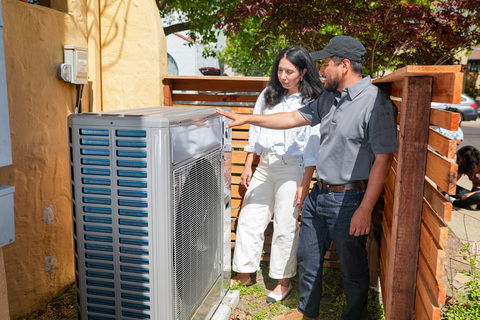
An HVAC contractor speaks to a customer about a heat pump. Credit: Building Decarbonization Coalition (BDC)
The report also found that state legislatures have passed 41 building decarbonization bills so far this year, as rising utility bills made energy affordability one of the defining issues of this year’s legislative sessions.
“Households and legislators appear to be reaching the same conclusion: clean heating and cooling can help rein in rising utility bills,” said Kevin Carbonnier, Associate Director of Analytics at BDC. “In the first half of 2026, heat pumps led the space-heating equipment market even after the federal tax credit expired. In state capitols, legislators concerned about energy costs are turning to heat pumps and thermal energy networks to bring their constituents affordable heating and cooling.”
The report’s Legislative Roundup describes how energy affordability drove many of the building-decarbonization bills introduced and passed in 2026. The approaches these bills used to tackle affordability varied: some states passed bills to streamline permitting, others updated energy efficiency programs to include heat pumps, and others addressed the underlying systems that drive high utility costs, including data centers.
Examples of some of the building decarbonization-related bills passed by legislatures in 2026 that addressed energy affordability include:
- California’s Heat Pump Access Act (SB 222), which makes California the first state in the nation to streamline heat pump permitting by updating its permitting process to make it faster, easier, and more affordable for homeowners and contractors to install heat pumps.
- Maryland's Utility RELIEF Act (HB1532), which will help lower Marylanders’ energy bills and create jobs through several building decarbonization provisions that encourage heat pump adoption. The bill also includes other energy affordability provisions, including provisions on utility ratemaking, data center tariffs, and the creation of a reverse auction to encourage new clean energy generation.
- Rhode Island’s Thermal Energy Network and Jobs Act (RI H7879A), which requires the state’s public utilities to identify between two and 12 potential locations for thermal energy network (TEN) feasibility studies, with at least two feasibility studies implemented within the next 18 months. After completing a feasibility study, the utility may develop a pilot TEN project and recover the associated costs through rates, subject to Public Utilities Commission approval.
"Families across the U.S. are finding themselves struggling to pay rising gas utility bills every month,” said Kristin George Bagdanov, Associate Director of Research at BDC. “These higher bills are increasingly leading state policymakers and utility regulators to reform line extension allowances, accelerated gas pipeline replacement programs, and other utility spending that increases gas rates while delivering little to no benefits to their customers.”
At the same time that legislators and utility regulators are raising more affordability concerns regarding our current energy system, utilities are seeking substantial increases in customer rates. As of the end of the third quarter of 2026, electric and gas utilities are requesting a combined $17.2 billion in rate increases, even as energy costs rose 16% over the last 12 months—nearly 5 times the rate of inflation.
Recent research from BDC highlights how the tens of billions of dollars utilities spend annually on pipeline expansion, replacement, and maintenance, even as average customer demand for gas declines, is a key reason why gas utilities are raising rates. For example:
- The Cost of Heat: Managing Pennsylvania’s Thermal Transition report found that Pennsylvania’s six largest gas utilities spent more than $11 billion on accelerated pipeline replacement programs from 2013 through 2025. This spending was a major driver of the 67% average increase Pennsylvanians have seen on their monthly residential gas bills over the past ten years, even as average gas use per residential customer in Pennsylvania has fallen 28% since 2000.
- The Momentum Q1 | 2026 report found that gas utility spending on distribution infrastructure has more than tripled since 2010, which has led to two-thirds of a typical household’s gas bill now going toward pipeline replacements and other distribution infrastructure investments, rather than the gas itself, and gas bills rising 60% faster than electric bills and four times faster than inflation in 2025.
- The End of Gas System Subsidies research brief includes findings showing that utility customers across the United States could save $2 to $7 billion annually if policymakers act now to reform gas line extension allowances (LEAs), which are subsidies that cover some or all of the costs associated with connecting a new building to the gas system.
This year marks BDC's fifth annual legislative roundup. Since 2022, BDC has tracked 580 building decarbonization bills across 44 states, up from 16 states in the first year, and 206 of those bills have passed.
The report’s authors are available for interviews.
The Momentum Q3 | 2026: Legislative Roundup Edition report is available at https://buildingdecarb.org/momentum-q3-2026.
ABOUT THE BUILDING DECARBONIZATION COALITION
The Building Decarbonization Coalition (BDC) aligns critical stakeholders on a path to transform the nation’s buildings through clean energy, using policy, research, market development, and public engagement. The BDC and its members are charting the course to eliminate fossil fuels in buildings to improve people’s health, cut climate and air pollution, prioritize high-road jobs, and ensure that our communities are more resilient to the impacts of climate change. Learn more at www.buildingdecarb.org.
View source version on businesswire.com: https://www.businesswire.com/news/home/20261006859950/en/
“Households and legislators appear to be reaching the same conclusion: clean heating and cooling can help rein in rising utility bills,” said Kevin Carbonnier, Associate Director of Analytics at BDC.
Contacts
Media Contact:
Jason Brown
Communications Manager
jbrown@buildingdecarb.org
(917) 548-5451