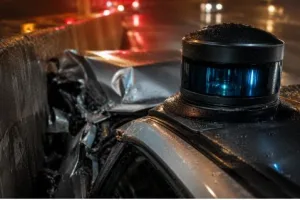
In August 2025, a federal jury found Tesla partially liable for a fatal crash involving its Autopilot system and awarded $43 million for pain and suffering plus $200 million in punitive damages. That verdict shows why self-driving car accident product liability can put human conduct and system design on trial at the same time. It applied only to that case. It didn’t create a nationwide rule.
So who pays when a self-driving car crashes? The deciding questions are what caused the collision, who controlled that risk, and how the applicable state’s negligence and product-liability rules allocate fault. Almost anyone in the chain can end up as a defendant, from the person behind the wheel to the company that wrote the code.
Self-driving car accident product liability disputes are growing because the label itself is imprecise. Vehicles operate with different levels of automation, and understanding self driving autonomous vehicle product liability requires distinguishing between systems that can operate without an onboard driver and driver-assistance products that demand constant human supervision. Some vehicles operate with no onboard driver, but only in limited conditions, while many consumer systems still require continuous human oversight.
Who Is Liable in a Self-Driving Car Accident Product Liability Claim?
There is no automatic rule. Liability follows the conduct or defect that caused the crash, and more than one party may be responsible for the same collision under state product-liability law and ordinary negligence principles.
What Legal Liabilities Can Self-Driving Cars Create?
Self-driving-car crashes can create negligence, product-liability, maintenance, fleet-operation, and insurance liabilities. Which ones apply depends on whether human conduct, a product defect, poor upkeep, unsafe deployment, or several causes contributed to the collision.
Human drivers and safety operators
A human operator can face a negligence allegation when the system required active supervision and the person was distracted, impaired, speeding, or slow to respond to a clear takeover request. The analysis differs sharply between a consumer driver-assistance feature and a vehicle operating without a human driver inside its approved autonomous domain. Marketing labels such as “Autopilot” or “Full Self-Driving” do not establish the system’s legal capabilities, and they do not erase the operator’s duties behind the wheel.
Vehicle manufacturers and component suppliers
When a claim targets the product rather than the person, state law generally recognizes three categories of alleged defect:
- Design defect: The system or component was allegedly unsafe as designed.
- Manufacturing defect: A particular vehicle or component allegedly departed from its intended design.
- Warning or instruction defect: Safety limits, foreseeable risks, or required supervision allegedly were not communicated adequately.
An accident by itself proves none of these. A claimant generally must connect the alleged problem to the collision and the resulting harm under the applicable state’s rules.
Software developers and automated-driving-system providers
Defective self-driving software liability arises when evidence indicates that faulty perception, object classification, path planning, braking logic, driver monitoring, or an over-the-air update contributed to the crash. But a separate software developer is not always liable on its own. Contractual relationships, corporate structure, the way the product was built into the vehicle, and state law all affect which company can be sued and under what theory.
When a crash traces back to the system itself rather than the person at the wheel, the claim moves into autonomous vehicle product liability: which company designed the failing component, what it knew about the risk, and what it told owners. That is a different kind of case from ordinary driver negligence, and the available claims depend on the evidence and applicable state law.
Owners, maintenance providers, fleets, and other road users
Owners may bear responsibility for ignored recalls, skipped sensor calibration, unauthorized modifications, or overdue maintenance. A fleet operator may face scrutiny if it controlled deployment, remote assistance, operator training, updates, or maintenance schedules. Another driver, cyclist, pedestrian, or road contractor can also be implicated when that person’s conduct or a road condition contributed to the outcome. Claims against public entities raise notice deadlines and immunity rules that vary so much by jurisdiction that they warrant separate, state-specific advice.
The table below connects each party with the conduct and records that often help decide the question.
| Potentially responsible party | Conduct or problem under investigation | Evidence that may matter
|
|---|---|---|
| Human driver or safety operator | Distraction, misuse, speeding, failed takeover | Driver-monitoring data, phone records, video, warnings |
| Automaker or component maker | Defective design, manufacture, or warning | Engineering records, recalls, sensor data, testing |
| Software-update issue | Failed update | System logs, update history |
| Auto shop | Repair complaint or collision-repair concern | Service and repair records or collision-repair inspection |
| Rideshare or fleet company | Unsafe deployment, maintenance, training, remote support | Fleet policies, dispatch records, maintenance logs |
| Another road user | Negligent driving or other unsafe conduct | Crash video, witness accounts, police documentation |
Regulators can flag software behavior that creates crash risk. In February 2023, Tesla recalled 362,758 vehicles equipped with its Full Self-Driving Beta system after the NHTSA determined that the software posed an unreasonable risk to motor vehicle safety. A recall can support an investigation. It does not automatically prove defect, causation, or liability in any individual case.
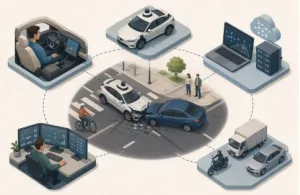
Liability investigations can reach the operator, hardware, software, fleet, and other road users at once.
Is the Driver or Manufacturer Responsible for an Autonomous-Vehicle Crash?
The driver may be responsible when careless operation or failure to supervise causes the crash, while a manufacturer may be responsible when a defective vehicle, automated-driving system, component, or warning causes it. If both failures contribute, state law may divide responsibility between them.
Driver vs manufacturer liability for autonomous vehicles depends on identifying who or what was performing the driving task when things went wrong, then matching that fact to a legal theory.
How control and automation level affect the analysis
The central question is who or what was doing the driving immediately before the collision. Investigators ask whether the system was engaged, whether it was operating within its intended conditions, whether it issued a takeover request, and whether the human had enough time to react. A supervised driver-assistance system, a highly automated vehicle limited to defined conditions, and a driverless fleet vehicle supported by remote staff present three very different fact patterns.
Automation levels describe technical capability. They are not liability rules. Legal responsibility still turns on state law and the evidence.
Why Is Control the Main Autonomous-Vehicle Liability Issue?
The biggest liability issue is determining whether human conduct, system performance, or both caused the crash. That answer often depends on technical records showing the vehicle’s operating mode, warnings, responses, and limits at the time.
Can the manufacturer be liable for autonomous-driving software?
Yes, potentially, if the claimant can show that defective software, an unsafe combination of components, inadequate monitoring, or insufficient warnings contributed to the crash and legally compensable harm. The August 2025 Autopilot verdict shows how this plays out: a jury allocating fault between a human operator and a manufacturer in one fatal collision.
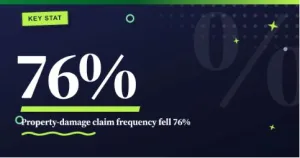
A 2023 study by Swiss Re and Waymo reported a 76% reduction in property-damage claim frequency and no bodily-injury claims across 3.8 million fully autonomous miles in the studied dataset.
Aggregate statistics can point in a different direction and deserve consideration. A 2023 study by Swiss Re and Waymo reported a 76% reduction in property-damage claim frequency and no bodily-injury claims across 3.8 million fully autonomous miles in the studied dataset. Those figures can inform policy and insurance discussions. They cannot decide fault in a single collision.
Fleet-wide safety performance and legal causation are different questions. A technology can perform well overall while one particular crash still warrants a full investigation, just as one crash does not establish that the technology was defective. The facts of the individual event control.
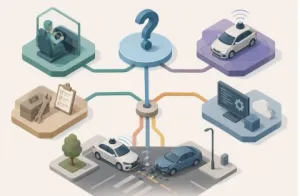
The analysis begins with a central question: who controlled the driving task?
Can Several Parties Share Fault for the Same Collision?
Yes. A driver, vehicle owner, manufacturer, software provider, maintenance contractor, fleet operator, and another road user may share fault when separate actions or failures combine to cause one collision. How that shared responsibility affects compensation depends on the state’s comparative-fault or contributory-fault rules.
Shared fault in autonomous vehicle accidents may arise because these crashes can involve overlapping failures rather than a single mistake. Comparative- and contributory-fault rules vary by state, and those differences can determine whether a claimant recovers fully, partially, or not at all.
A worked example of overlapping failures
Picture a semi-automated vehicle that fails to identify a stopped motorcycle because a sensor is misaligned. The owner skipped a required calibration, the system issued an ambiguous warning, and the human operator was looking at a phone when a takeover alert appeared.
No party’s responsibility is established by those facts alone.
The operator could face a negligence claim based on distraction and the missed takeover. The owner or service provider could face a negligent-maintenance claim tied to the skipped calibration. The system’s maker could face a design- or warning-defect claim based on the misaligned sensor and unclear alert. A jury applying the state’s fault rules might then allocate responsibility among several defendants according to the evidence presented at trial.
Who may be responsible when a Waymo crashes?
Responsibility could rest with another road user, the autonomous-vehicle operator or fleet company, a vehicle or component manufacturer, a maintenance provider, or a combination of parties. The absence of a conventional driver does not make the fleet company automatically liable, and it does not eliminate possible product claims.
The investigation should establish whether the vehicle was operating within its authorized area and conditions, how the automated system responded, and whether remote support or maintenance affected the event. Those answers, not the brand name on the door, drive the outcome.
How Can Police Pull Over a Waymo Robotaxi?
Police can stop a Waymo robotaxi even without a human driver inside. Officers may use emergency signals and follow the operator’s first-responder procedures, while remote support may help secure or move the vehicle. Any citation or enforcement action depends on what occurred and the law governing the operator, owner, or other road user.
How commercial insurance changes the claim
A robotaxi or rideshare collision may involve commercial vehicle coverage, corporate self-insurance, or several overlapping policies. Coverage and legal fault are related but separate issues: an insurer may provide a source of payment even if its policyholder isn’t solely responsible for the crash. Insurance requirements differ by state and operating model, so universal figures about limits or claim values would be misleading.
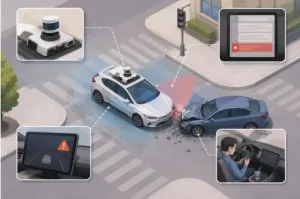
One crash may involve several failures and multiple potential defendants.
What Evidence Is Needed for a Self-Driving Car Liability Claim?
Evidence for a self-driving car liability claim may include system and sensor logs, event-recorder data, video, software and update records, maintenance history, warnings, driver-monitoring information, witness accounts, and physical crash evidence. Together, those records can show what the vehicle, automated system, human operator, and surrounding road users did before and during the crash.
The vehicle itself may hold answers no witness can provide, so these claims tend to be more technical than an ordinary collision.
Digital and vehicle evidence
Automated-driving-system logs and operational-status data can show whether the system was engaged and what it detected in the seconds before impact. Records from cameras, radar, and lidar can be synchronized with event data recorder output and driver-monitoring information to reconstruct the sequence of alerts and responses. Software version details and over-the-air update history matter too, since an update can change how a vehicle behaves from one week to the next.
Not every vehicle records the same information. A consumer may have no direct access to proprietary system data, and the absence of a data category is not proof of wrongdoing.
Physical, documentary, and human evidence
Scene evidence may include vehicle damage, sensor condition, roadway markings, weather observations, and surveillance footage. Documents carry equal weight: service records, recall notices, owner communications, and fleet protocols can confirm or contradict what the digital logs suggest. Witness statements and police documentation supply the human timeline that technical records may lack.
Whenever feasible, preserve the vehicle in its post-crash condition. Repairs, disposal, software updates, and routine data-retention practices can each destroy material evidence.
What happens after an autonomous vehicle gets in an accident?
The practical sequence matters because each step protects the ones that follow:
- Seek emergency assistance and medical evaluation.
- Report the collision and identify the automated or driver-assistance mode if known.
- Photograph the vehicles, road, visible sensors, damage, and relevant traffic controls.
- Preserve app messages, ride receipts, dashboard warnings, witness contacts, and insurer communications.
- Request legal advice promptly about evidence preservation and state filing deadlines.
Do not attempt to access, alter, or download vehicle systems yourself. You do not need to refuse all communication with an insurer, but avoid speculation and consider declining an unnecessary recorded statement until you understand what they are requesting.
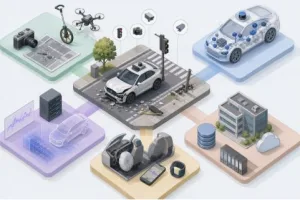
Important evidence may exist at the crash scene, inside the vehicle, and in corporate records.
Protecting the Evidence That Determines Responsibility
The vehicle’s label does not decide liability, and neither does the presence or absence of a driver. Evidence does: the operational mode at the time of the crash, the software state, the maintenance condition, the human conduct, and the actions of every other road user involved. Preserve those records early, before repairs and data-retention cycles erase them. When injuries, disputed fault, a fleet vehicle, or a possible technical failure are involved, prompt legal advice tailored to your state’s rules is a practical next step.