As the digital asset market continues to evolve, users’ expectations for trading platforms are changing as well.
In the past, when choosing a digital asset platform, users may have focused primarily on questions such as: “What trading pairs are available?” “What are the fees?” and “Can I trade the assets I want?”
As the market matures, however, users are paying attention to a much broader range of factors, including product diversity, trading experience, service quality, risk management, and the platform’s ability to continuously adapt to changing market demands.
Against this backdrop, competition among digital asset trading platforms is gradually shifting from competition around individual products toward competition based on comprehensive service capabilities.
For a platform, simply offering a trading function is only the starting point. The long-term challenge lies in continuously developing a comprehensive product matrix around different user needs while building a more complete ecosystem covering trading, services, user experience, and security.
ASTX is continuously moving in this direction.
From Single Trading Products to a Diversified Product Portfolio
The digital asset market is highly diverse.
Different users have different trading habits, risk preferences, and approaches to market analysis. Some users focus on long-term digital asset holdings, while others pay greater attention to short-term price movements. Some also prefer to participate in the market through different types of derivatives.
Therefore, a mature digital asset trading platform needs to provide a wider range of products and allow users to select trading methods that match their individual needs.
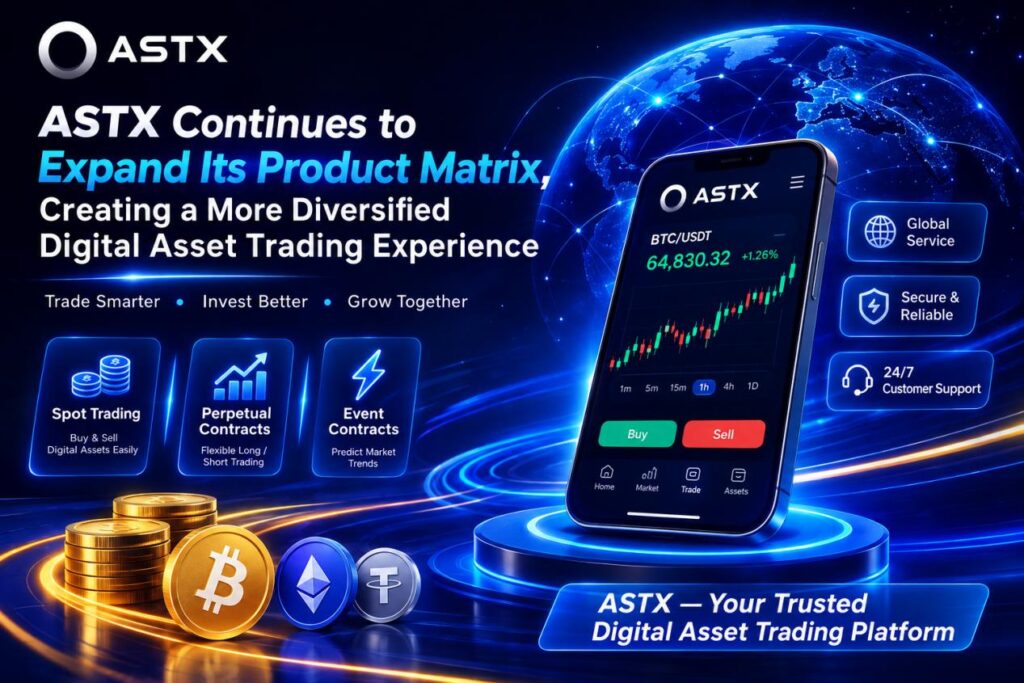
ASTX continues to expand its product matrix and improve its digital asset trading offerings, including spot trading, perpetual contracts, and event contracts, providing users with more diversified ways to participate in the market.
From basic digital asset trading to more flexible derivative products, different products serve different trading scenarios and give users greater choice.
The expansion of the product matrix is not simply about increasing the number of products. More importantly, it is about gradually building a more complete digital asset trading ecosystem through different products and use cases.
Spot Trading: Building the Foundation of Digital Asset Trading
Spot trading is one of the most fundamental forms of digital asset trading and is an important entry point for many users entering the digital asset market.
Through spot trading, users can directly buy and sell digital assets and make trading or asset allocation decisions based on their own market views.
For a trading platform, the spot market is not only a basic trading function but also an important foundation of the broader digital asset product ecosystem.
ASTX continues to improve its spot trading products and related trading experience, providing users with a more convenient environment for digital asset trading.
At the same time, as the digital asset market continues to expand, users are placing increasing importance on trading efficiency, interface design, market information, and account operations.
Therefore, ASTX focuses not only on whether users can trade, but also on the entire process—from entering the trading page and reviewing market information to submitting orders and completing transactions.
The focus is not simply on trading functionality, but on the complete trading journey.
Perpetual Contracts: Meeting Diverse Trading Needs
As the digital asset derivatives market continues to develop, perpetual contracts have become an important component of the digital asset trading ecosystem.
Unlike traditional futures contracts, perpetual contracts generally do not have a fixed expiration date, allowing users to trade based on long or short market views.
For experienced traders, perpetual contracts can provide a more flexible way to participate in market movements.
At the same time, derivatives trading also involves higher risks.
Leverage, margin, liquidation, funding rates, and other mechanisms all require users to fully understand the relevant rules before participating.
Therefore, a comprehensive perpetual contract product should not only provide trading functionality but also help users better understand how the product works and the associated risks.
ASTX continues to expand its perpetual contract offerings while improving the related trading experience and product information, helping users understand and participate in digital asset derivatives trading within a clearer product environment.
For new users, fully understanding the mechanisms and risks of perpetual contracts is particularly important. For experienced traders, a broader range of trading assets and product choices can provide greater flexibility in different market conditions.
Event Contracts: Exploring New Ways to Participate in the Market
In addition to traditional spot and perpetual contract products, the digital asset market is also seeing the emergence of innovative trading products.
Event contracts are one example.
The basic concept of an event contract is relatively straightforward: users predict the direction of an asset’s price over a specified period and select Up or Down. Once the contract expires, the system automatically settles the contract according to the applicable settlement price.
Unlike products that require users to manage leverage and margin, event contracts do not require leverage or additional margin.
Key characteristics include:
- Multiple expiration periods;
- Fixed-return mechanism;
- Automatic settlement at expiration;
- No additional margin required;
- Maximum loss limited to the actual amount invested;
- No early closing after the contract is executed.
For example, if a user invests 100 USDT in an event contract and makes a correct prediction, according to the product rules, the user can receive an 80 USDT profit plus the return of the 100 USDT principal, resulting in a total return of 180 USDT.
If the prediction is incorrect, the entire 100 USDT invested in the transaction is lost.
Therefore, although the basic structure of event contracts may be relatively straightforward, they remain high-risk trading products. Users should fully understand the applicable rules and carefully consider their own risk tolerance before participating.
By incorporating event contracts into its product matrix, ASTX is also exploring different trading models and market participation scenarios.
Beyond Product Variety, User Experience Matters
The number of products alone is not the only measure of a trading platform’s overall capabilities.
If a platform offers an increasing number of products but users find the experience complicated, information unclear, or processes cumbersome, the value of those products may be diminished.
Therefore, as ASTX continues to expand its product matrix, trading experience remains an important area of focus.
A complete trading experience involves multiple stages:
Account Registration → Identity Verification → Asset Deposit → Market Analysis → Product Selection → Order Placement → Order Management → Asset Management → Withdrawal → Customer Support
A significant issue at any stage can affect the user’s overall perception of the platform.
For this reason, ASTX is not only expanding its trading products but also continuously improving areas such as platform interfaces, operational processes, product information, and user services, with the goal of creating a more convenient experience for different types of users.
From “Products” to a “Product Matrix”
For a digital asset platform, launching an individual product is not necessarily difficult.
The greater long-term value lies in building connections among different products around actual user needs.
Spot trading addresses basic digital asset trading needs.
Perpetual contracts provide a more flexible form of derivatives trading.
Event contracts offer a market participation model that differs from traditional trading products.
These products are not simply substitutes for one another. Instead, they serve different scenarios and user needs.
This is the significance of a product matrix.
A product matrix does not mean that more products are always better. It means that users with different needs can find trading tools that suit their individual circumstances.
ASTX continues to expand its product offerings with the goal of gradually building a richer and more diversified digital asset trading ecosystem.
Security and Risk Management Are Equally Important
Digital asset trading is characterized by significant market volatility.
As product offerings become more diverse and users gain access to more trading options, the requirements for platform risk management also increase.
Therefore, while expanding its product matrix, ASTX also considers risk management an important part of platform development.
ASTX continues to focus on areas such as abnormal trading activity, market integrity, account security, and trading risks, while managing abnormal or prohibited activities in accordance with platform rules.
For users, understanding product rules, managing trading amounts appropriately, and recognizing market risks are important foundations for participating in digital asset trading.
Especially when using derivatives such as perpetual contracts and event contracts, users should understand mechanisms including leverage, margin, settlement, and potential losses before participating.
Product innovation and risk awareness need to move forward together.
Global Services for a Broader User Base
The digital asset market is inherently global.
Users from different countries and regions may have different languages, usage habits, and trading needs.
For a digital asset platform serving a global audience, localization and multilingual support have therefore become increasingly important components of the overall user experience.
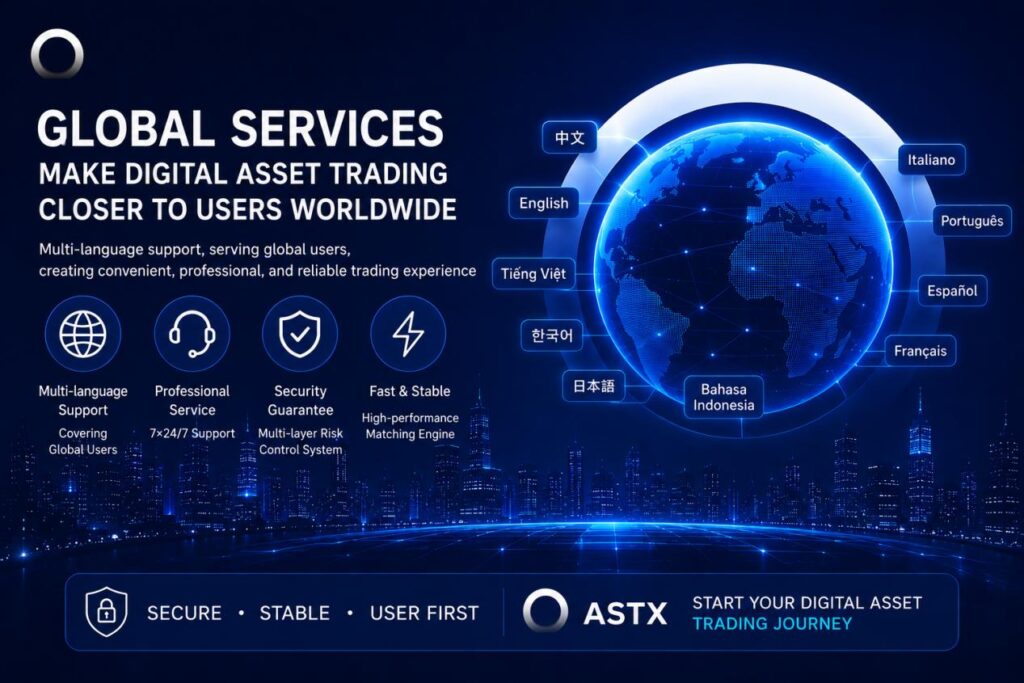
ASTX continues to develop multilingual content, providing users in different language markets with clearer access to product information and platform resources.
From Chinese and English to Vietnamese, Indonesian, Russian, French, Korean, Japanese, Spanish, Italian, and Portuguese, ASTX continues to develop multilingual content to make it easier for users in different regions to understand its products and services.
Globalization is not simply about reaching more regions. More importantly, it means providing users in different markets with a clear and convenient experience.
From Feature Expansion to Ecosystem Development
Today’s digital asset trading platforms are gradually evolving from single-purpose trading tools into comprehensive digital asset service platforms.
Users increasingly need more than a page where they can place orders. They want a platform that can cover multiple scenarios, including trading, products, asset management, market information, and customer support.
For this reason, ASTX continues to develop its product matrix. The objective is not simply to increase the number of products, but to continuously improve the platform ecosystem around users’ trading needs.
From spot trading to perpetual contracts and event contracts;
From trading products to user services;
From product development to risk management;
From localized content to global services.
Together, these areas form an evolving product and service framework for ASTX.
Continuous Innovation for a More Diversified Digital Asset Trading Experience
The digital asset market remains in a constant state of development and change.
New trading products, evolving market demands, and emerging user groups continue to appear, meaning trading platforms must also continuously improve their products and user experience.
For ASTX, expanding the product matrix is not a short-term initiative, but an ongoing long-term effort.
Moving forward, ASTX will continue to monitor developments in the digital asset market, explore new product directions based on user needs, and continuously improve its existing trading products, platform features, and user services.
From one trading product to multiple product scenarios; from individual features to a complete trading experience; from a platform tool to a broader digital asset ecosystem.
Through continuous product innovation and service improvements, ASTX is exploring a more diversified digital asset trading experience.
In a rapidly changing digital asset market, platforms with long-term value need to do more than offer more products. They must continue to understand users, optimize the experience, strengthen their overall ecosystem, and explore new possibilities.
ASTX will continue moving forward in this direction.