Nashville, March 30, 2026 (GLOBE NEWSWIRE) -- NASHVILLE, Tenn. (March 30, 2026)—The Frist Art Museum presents International Surrealism from Tate: Fifty Years of Dreams, an exhibition that investigates the global appeal of surrealism and how it has widely influenced culture and society over the last century through the work of artists including Eileen Agar, Louise Bourgeois, Salvador Dalí, René Magritte, Joan Miró, Yves Tanguy, and Dorothea Tanning. Organized in collaboration with Tate, the exhibition will be on view in the Frist’s Ingram Galleries from May 22 through August 30, 2026.
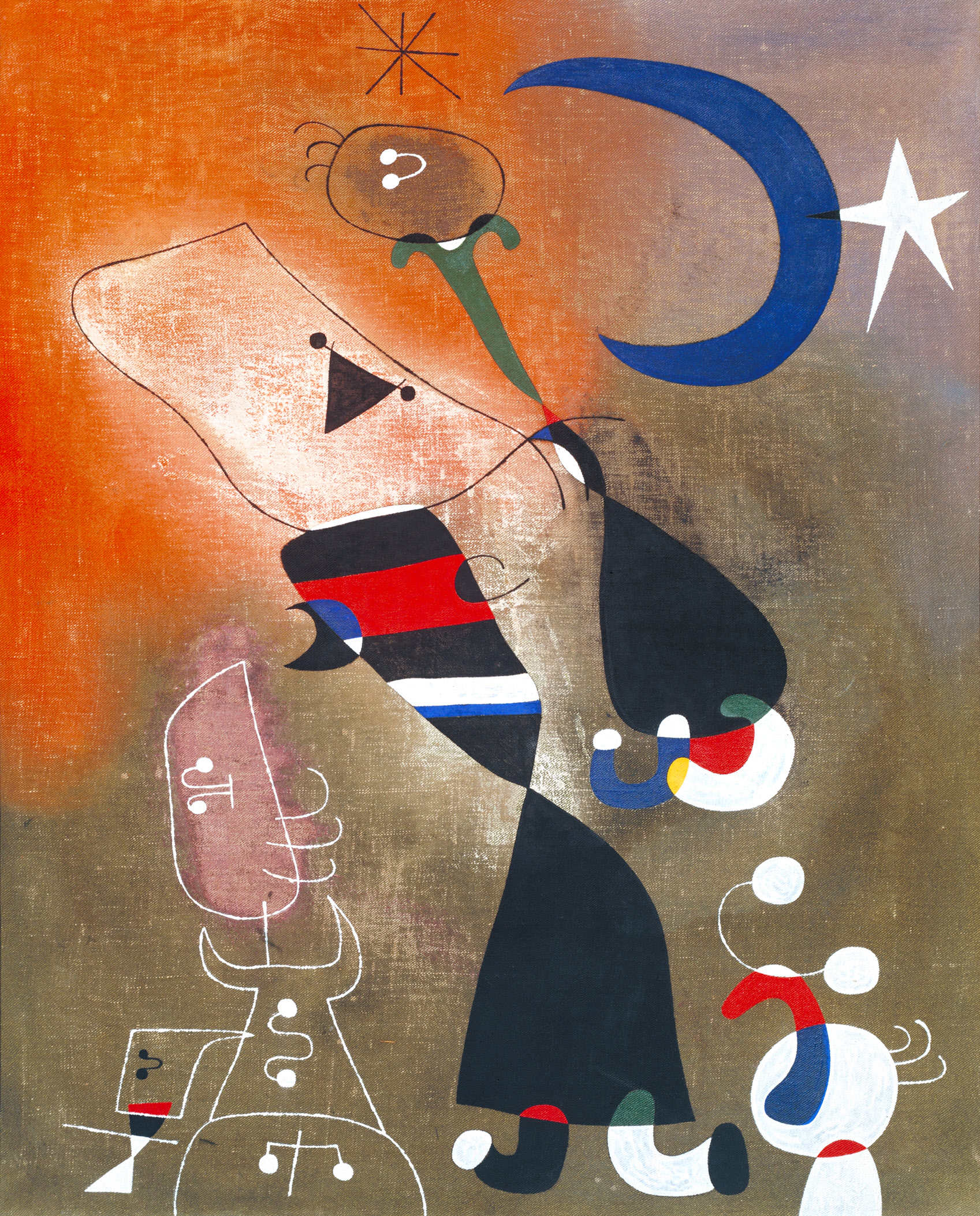
Joan Miró. Women and Bird in the Moonlight,
1949. Tate, Purchased 1951. © Successió
Miró / Artists Rights Society (ARS),
New York / ADAGP, Paris 2026.
Photo: Tate
Drawn from the Tate collection, UK, the exhibition of approximately 125 works focuses on the long trajectory and broad reach of surrealism as a state of mind through a captivating selection of film, paintings, photographs, sculpture, and other art objects, as well as publications and archival material. “One of the great attractions of surrealism was its internationalism,” writes Matthew Gale, exhibition curator and former Tate senior curator at large. “In an era of violent nationalism, the recognition of a global association of like-minded creators was a lifeline, at different times connecting artists and writers in New York and Santiago de Chile, Paris and Prague, Mexico City, and Tokyo.”
International Surrealism from Tate: Fifty Years of Dreams is presented just over a century after the first exhibition of surrealism, in Paris in November 1925, following the publication of André Breton’s Surrealist Manifesto and Louis Aragon’s A Wave of Dreams a year earlier. Featuring the aforementioned celebrated artists, the exhibition also includes many from around the world deserving of further consideration such as Kati Horna, Malangatana Ngwenya, Shiihara Osamu, and Lionel Wendt.
The surrealists were inspired by the theories of Viennese psychoanalyst Sigmund Freud, who proposed the existence of the unconscious, a part of the mind containing emotions and impulses that are censored by the conscious mind. Breton’s philosophy of surrealism, though initially attracting writers and poets, was soon adopted by visual artists. “Surrealists embraced the unknown and mysterious, depicted and interpreted dreams, found inspiration in nature and unexpected aspects of the everyday, and explored the ‘mad love’ of unleashed passions,” writes Gale.
Along with their pursuits of personal freedom and the liberation of the mind, the surrealists also allied themselves with leftist politics in opposition to growing totalitarianism in Europe between the world wars. “They rejected authoritarianism, colonialism with its repression and exploitation, and the inequalities embedded in capitalism,” Gale explains. “With its dual focus on individual freedom and social and political change, surrealism attracted many artists, writers, and intellectuals worldwide for decades after its initial appearance.” International Surrealism from Tate gathers artworks from a range of centers and periods, highlighting the multiplicity of surrealist practices represented in the Tate’s collection.
As surrealism was made up of individual responses rather than a specific style, key themes that united various surrealist practices anchor the exhibition’s six loose, transhistorical sections. Works in “Automatism: Angel Images” exemplify attempts to produce works “automatically”—free from conscious control and self-censorship. Artists associated with or interested in surrealism, like Max Ernst, Joan Miró, Jackson Pollock, and Judit Reigl, developed their own automatic processes, such as improvised drawing, gestural brushwork, dripping, spilling, or scraping paint across rough surfaces to stimulate new images or reveal hidden forms that emerged from chance marks.
Works in the section titled “Politics: Public Thirst” focus on social and political liberty as essential for personal and creative freedom. The surrealist movement generally opposed inequality, repression, and colonialism, and exhibited artists such as Wifredo Lam, Manuel Álvarez Bravo, and Merlyn Evans engaged with the struggle against fascism as well as the complex tension between intellectual freedom and political ideology.
Sigmund Freud’s theories about the influence of repressed desires permeated surrealist practices, and the section “Dreams: The Reckless Sleeper” explores how artists such as Leonora Carrington and Paul Nash were interested in the unrestrained creativity of the unconscious mind. “For surrealist painters, the unconscious generated images that were familiar but refracted: people who were at once identifiable but unrecognizable, spaces charged with emotion, actions loaded with meaning,” notes Gale. René Magritte, for example, placed familiar imagery in an irrational context to expose repressed fears and desires hidden in the unconscious mind.
“Desires: Sleeping Venus” explores the surrealists’ focus on love and sexual freedom. Often, surrealist works, such as that by Paul Delvaux, reflect heterosexual men’s desires and objectify women. “This led to unequal treatment of women among so many revolutionary men, and maintained an ingrained convention unrecognized as a blind spot at the time,” writes Gale. However, many women also challenged the dominance of the male gaze. This section features works by Ithell Colquhoun, Leonor Fini, and Dorothea Tanning, who became known for emphasizing women’s desires. Artists like Claude Cahun, whose work is also included in this exhibition, explored gender fluidity, enriching the surrealist conversation on liberation with a gender-nonconforming perspective.
For many surrealists, nature was stimulating in both its destruction and abundance.
Artists like Eileen Agar and Yves Tanguy explored the natural world’s forces of proliferation and decay, as can be seen in “Uncanny Nature: The Invisibles.” Agar’s photographs of rock formations in Brittany, France, suggest animal, human, and more mysterious forms depending upon her camera angle; Tanguy’s The Invisibles depicts partly mechanical, partly organic structures that appear like skyscrapers against a threatening sky.
“Objects: The Future of Statues” includes provocative “surrealist objects” by artists including Louise Bourgeois, Marcel Duchamp, and Marcel Mariën, who combined disparate, everyday elements to affirm the power of imagination. Some of these objects resemble three-dimensional sculptures but evade classification, serving no rational function except to unsettle and provoke. “In the 1930s, Salvador Dalí sparked a wave of object production by proposing the ‘symbolically functioning object,’” writes Gale. “As a result, a wide range of surrealists contributed to the . . . Surrealist Exhibition of Objects. . . . Many of the objects exhibited arose spontaneously but attracted elaborate interpretation. Temporary in nature, some survive only in photographic evidence.”
In Martin ArtQuest, the Frist’s award-winning art-making space, new interactive stations connect thematically to the exhibition. Guests are invited to participate in a game at the Wonder Wall inspired by the concept of automatism, as well as a collaborative drawing activity based on the surrealist Exquisite Corpse game. Elsewhere is a surrealist collage activity, a still life subject based on works in the exhibition, a puppet theater, and a magnet poetry activity with words drawn from the Surrealist Manifesto.
Program
Opening Conversation featuring Matthew Gale, Michael J. Ewing, and Caroline Yates Thursday, May 21, 6:30 p.m.
Auditorium
Free for members; gallery admission required for not-yet-members Registration required
Join us for an engaging discussion on International Surrealism from Tate: Fifty Years of Dreams. In this conversation, Matthew Gale, exhibition curator; Michael J. Ewing, Frist Art Museum associate curator; and Caroline Yates, Frist Art Museum Susan H. Edwards Curatorial Fellow, will offer insights into the exhibition’s themes, the works on view, and the lasting influence of the surrealist movement.
Exhibition Credit
Organized in collaboration with Tate
Supporter Acknowledgment
Platinum Sponsor: HCA Healthcare/TriStar Health
Education and Community Engagement Supporter: Windgate Foundation
The Frist Art Museum is supported in part by The Frist Foundation, Metro Arts, and the Tennessee Arts Commission, which receives funding in part from the National Endowment for the Arts.
Connect with us @FristArtMuseum
FOR ADDITIONAL INFORMATION
Buddy Kite: 615.744.3351, bkite@FristArtMuseum.org
About the Frist Art Museum Accredited by the American Alliance of Museums, the Frist Art Museum is a 501(c)(3) nonprofit art exhibition center dedicated to presenting and originating high-quality exhibitions with related educational programs and community outreach activities. Located at 919 Broadway in downtown Nashville, Tenn., the Frist Art Museum offers the finest visual art from local, regional, national, and international sources in exhibitions that inspire people through art to look at their world in new ways. Information on accessibility can be found at FristArtMuseum.org/accessibility. Gallery admission is free for guests ages 18 and younger and for members, and $20 for adults. For current hours and additional information, visit FristArtMuseum.org or call 615.244.3340.
Contact Info
Buddy Kite
bkite@fristartmuseum.org
+1 615-744-3351
Attachment