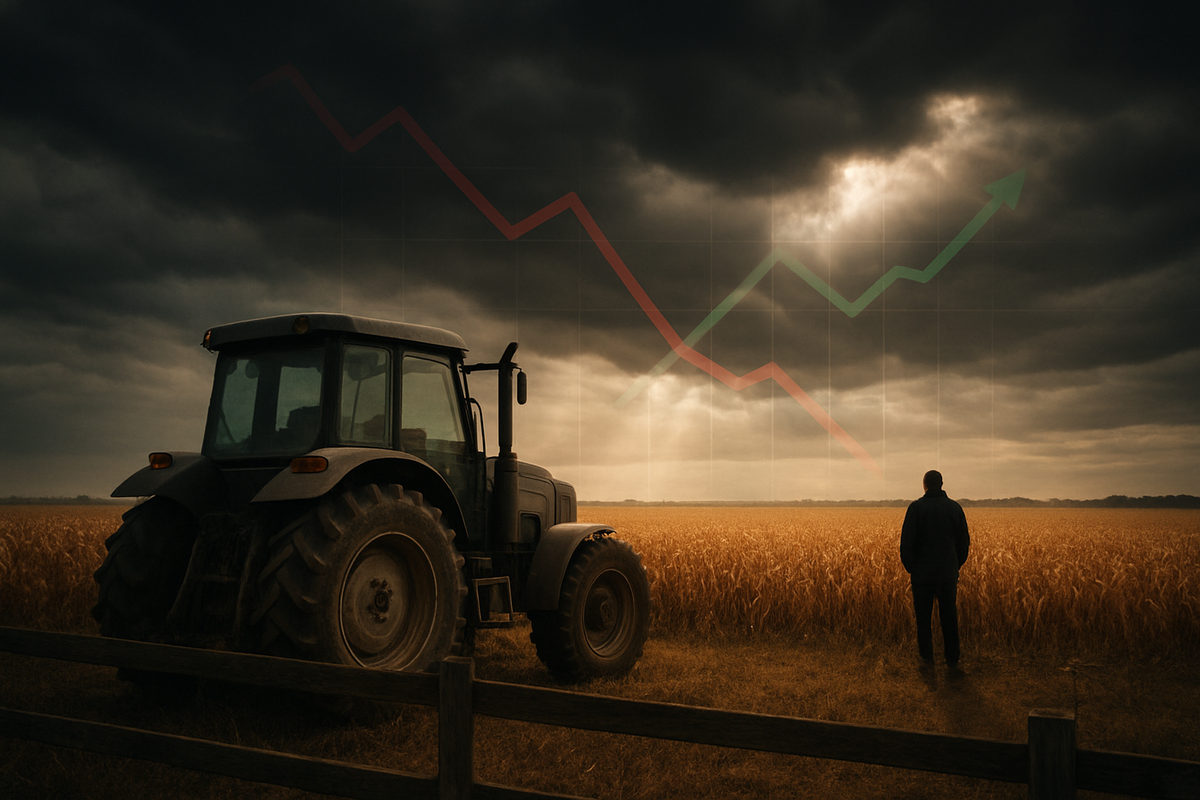
As 2025 draws to a close, the American agricultural heartland is grappling with a financial paradox. While aggregate net farm income figures appear bolstered by historic levels of federal intervention, the underlying market reality for the individual producer is the most challenging in a decade. A widening "scissors effect"—characterized by record-high production expenses and a multi-year slump in commodity prices—has pushed the median farm income from operations into negative territory, threatening the long-term stability of the U.S. food supply.
The economic strain is palpable across rural America. Total farm production expenses are forecast to reach a staggering $467.4 billion this year, driven by a 73% surge in interest payments since 2020 and a resurgence in fertilizer costs. Simultaneously, the prices for staples like corn and soybeans have retreated to levels not seen since the pre-pandemic era, leaving many producers unable to cover their break-even costs without the $30 billion lifeline provided by the recently enacted American Relief Act of 2025.
The Anatomy of a Margin Crisis
The current crisis is the culmination of several years of compounding economic pressures. Following the record-high commodity prices of 2022, which were driven by global supply disruptions, input costs for fuel, labor, and chemicals reset at a higher floor. As global production—particularly in Brazil and Argentina—rebounded, the surplus of grain has driven U.S. corn prices down to a projected range of $4.10 to $4.48 per bushel, a sharp decline from the $6.50 peaks of 2022. Soybeans have faced a similar fate, with prices hovering near $10.00 per bushel as export competition intensifies.
The timeline of this downturn began in late 2023, as the Federal Reserve’s interest rate hikes began to fully penetrate the agricultural credit market. By mid-2024, the "cost-price squeeze" was no longer a theoretical concern but a balance-sheet reality. Farmers who had invested in expensive machinery and land during the boom years found themselves servicing debt at rates significantly higher than their returns on investment. The situation became so dire by the fall of 2024 that the federal government was forced to intervene with the American Relief Act of 2025 (P.L. 118-158), which included $10 billion in direct economic relief to bridge the gap for 2024 and 2025 crops.
Key stakeholders, including the American Farm Bureau Federation and various commodity groups, have spent much of 2025 lobbying for a more permanent solution through a modernized Farm Bill. However, legislative gridlock has left many of the structural issues unaddressed. While the emergency aid has prevented a wave of immediate bankruptcies, it has not solved the fundamental problem: it currently costs more to grow a bushel of grain in many parts of the U.S. than the market is willing to pay for it.
Corporate Fallout: Winners, Losers, and Strategic Pivots
The agricultural downturn has sent shockwaves through the public markets, particularly affecting companies that rely on farmer capital expenditures. Deere & Company (NYSE: DE) has emerged as one of the primary "losers" in this cycle. The equipment giant reported a 15-20% decline in sales for large agricultural machinery in 2025, as farmers deferred purchases to preserve liquidity. Deere has signaled that 2026 may represent the "bottom of the cycle," but the company remains vulnerable to potential trade volatility and high interest rates that discourage equipment financing. Similarly, CNH Industrial (NYSE: CNHI) has faced downward pressure on margins as inventory levels for tractors and combines swell at dealerships.
On the processing side, Archer-Daniels-Midland (NYSE: ADM) has faced its own set of challenges. The company’s "crush margins"—the profit earned from processing soybeans into oil and meal—plunged nearly 93% at points during the year. ADM has also been hampered by regulatory uncertainty surrounding U.S. biofuel policy, specifically the 45Z tax credit, which has left multi-billion dollar investments in renewable diesel in a state of limbo. Bunge Global (NYSE: BG) has shown slightly more resilience due to its global footprint, but it remains susceptible to the same margin compression affecting the broader processing industry.
Conversely, some agricultural technology and seed companies are attempting to navigate the storm through restructuring. Corteva, Inc. (NYSE: CTVA) has remained relatively resilient, raising its 2025 EBITDA guidance to $3.8-$3.9 billion on the back of strong demand for high-yield, premium seeds. In a bold strategic move to unlock shareholder value, Corteva announced plans to split into two separate public entities—one focused on Seed and the other on Crop Protection—by late 2026. This move suggests that while the "hardware" side of farming (machinery) is suffering, the "software" side (genetics and chemistry) remains a critical, non-discretionary expense for farmers looking to maximize every acre.
Wider Significance and Historical Context
The current environment draws uncomfortable comparisons to the Farm Crisis of the 1980s, though there are key differences. Unlike the 80s, land values have remained relatively stable, providing farmers with a collateral base that has prevented a total systemic collapse. However, the reliance on government aid in 2025 is at its highest level in decades, raising questions about the long-term fiscal sustainability of the U.S. agricultural model. If emergency payments are stripped away, the "median" American farm would be operating at a loss of over $1,100 per year.
This event fits into a broader trend of agricultural consolidation. Small and mid-sized family farms are finding it increasingly difficult to compete with large-scale operations that can leverage economies of scale to survive thin margins. This consolidation has ripple effects on rural communities, leading to declining populations and reduced economic activity in "Main Street" businesses. Furthermore, the instability in the U.S. farm sector has national security implications. As the U.S. loses export market share to Brazil and Russia, its influence over global food prices and supply chains diminishes.
From a policy perspective, the 2025 squeeze has highlighted the inadequacy of current crop insurance and safety net programs. The "reference prices" established in previous Farm Bills have not kept pace with the inflationary surge in input costs. This has led to a growing consensus that the next iteration of agricultural policy must move beyond simple price supports and address the rising costs of "doing business" in the modern era, including labor shortages and the high cost of capital.
The Road Ahead: 2026 and Beyond
Looking toward 2026, the agricultural sector is searching for a "new normal." In the short term, the industry is bracing for continued volatility. Farmers are expected to further "tighten their belts," which will likely mean continued low demand for major equipment and a focus on "precision agriculture" tools that promise to reduce fertilizer and chemical waste. Companies that provide these efficiency-boosting technologies may find a silver lining in the crisis, as necessity drives adoption.
The long-term outlook depends heavily on two factors: interest rates and global trade relations. If the Federal Reserve continues a path of modest rate cuts, the burden of farm debt—currently at a record $386 billion—may begin to ease. On the trade front, the U.S. relationship with China remains the ultimate wild card. Any further escalation in tariffs or trade barriers could further depress commodity prices, making the 2025 relief measures look like a temporary bandage on a much deeper wound.
Strategic pivots will be required for both farmers and the companies that serve them. We may see an accelerated shift toward "carbon farming" and other alternative revenue streams, such as solar leasing or biological crop inputs, as farmers seek to diversify away from the volatile grain markets. The survival of the American farmer in the late 2020s will likely depend less on maximum production and more on extreme financial efficiency and the ability to navigate a complex regulatory and geopolitical landscape.
Summary and Investor Outlook
The 2025 agricultural landscape is defined by a historic "cost-price squeeze" that has left the sector more dependent on government intervention than at any point in the last decade. While headline income figures are high, the reality for most producers is a struggle for break-even survival against record expenses and falling crop prices. The American Relief Act of 2025 has provided a critical buffer, but it does not address the underlying structural imbalances in the market.
For investors, the coming months require a cautious approach to the agricultural sector. Watch for the 2026 "bottoming" signal from equipment manufacturers like Deere & Company (NYSE: DE) and monitor the restructuring progress of Corteva (NYSE: CTVA). The key metrics to track will be fertilizer price trends, the pace of interest rate declines, and any movement on a permanent Farm Bill. As the industry moves into 2026, the focus will shift from crisis management to structural adaptation, with the most resilient players being those who can help farmers do more with less in a low-margin environment.
This content is intended for informational purposes only and is not financial advice.