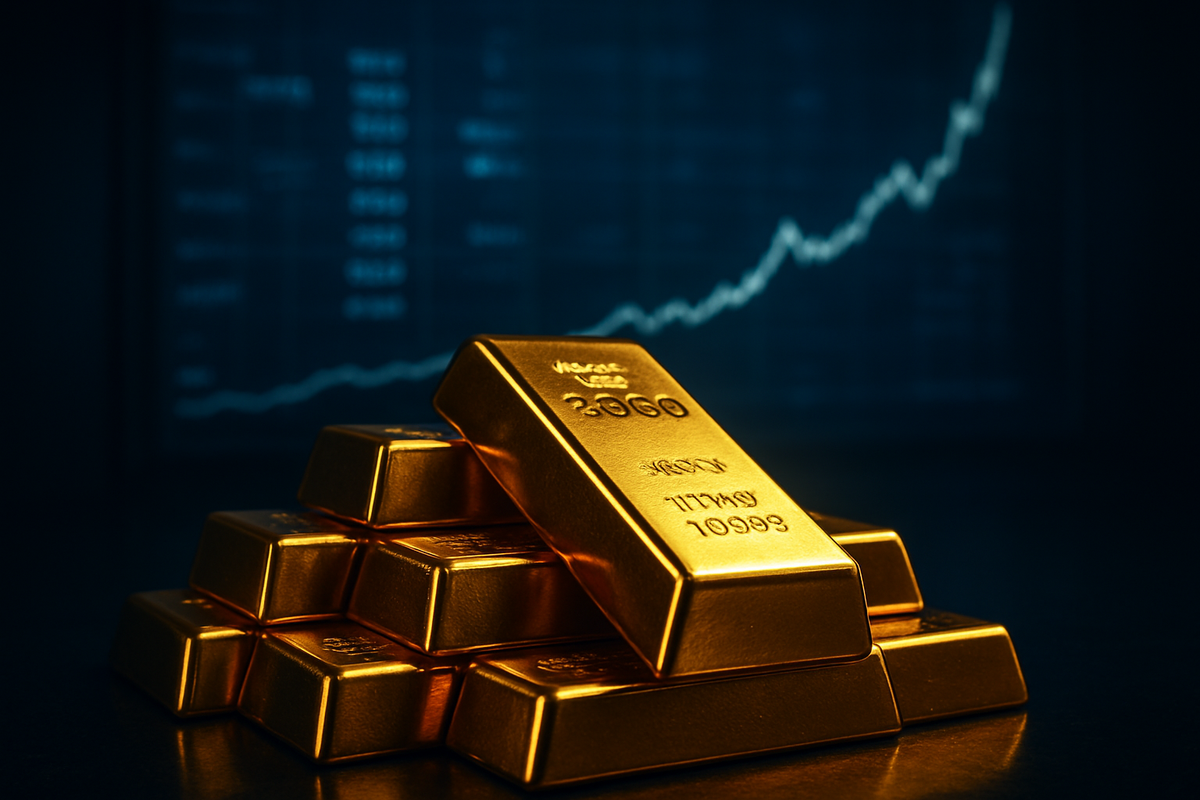
As of February 17, 2026, the global financial landscape is witnessing a historic realignment as gold prices solidified their position at a record $4,900 per ounce. This massive rally, which saw the precious metal briefly pierce the $5,000 psychological barrier earlier this month, represents a fundamental shift in how institutional investors and central banks view sovereign debt and fiat currency. The surge has been punctuated by a staggering $19 billion in monthly inflows into gold-backed exchange-traded funds (ETFs), the highest volume ever recorded in a single thirty-day period.
The immediate implications of this "Golden Dawn" are profound. While equity markets grapple with volatility and bond yields struggle to compensate for rising geopolitical risk, gold has emerged as the ultimate arbiter of value. For the average consumer, this surge signals a period of significant currency devaluation and heightened inflation expectations, while for the institutional sector, it marks the definitive end of the post-2008 era of dollar-centric stability.
A Perfect Storm: The Path to $4,900
The journey to $4,900 per ounce was paved by a multi-year structural rebasing of the gold market that began in earnest in early 2025. Following a period of consolidation around the $2,600 mark, gold prices accelerated throughout last year, gaining nearly 66% as macro-economic cracks began to widen. By the time January 2026 arrived, a "fear trade" had taken full command of the charts. The breach of $4,900 in early February was catalyzed by a confluence of events: a surprise downgrade of U.S. sovereign debt by Moody’s to Aa1 and an unprecedented criminal investigation into Federal Reserve leadership that sent shockwaves through the Treasury markets.
Key stakeholders, including the World Gold Council and major bullion banks like JPMorgan Chase & Co. (NYSE: JPM), have noted that this is not merely a speculative bubble but a "scarcity-driven revaluation." The $19 billion inflow into ETFs like the SPDR Gold Shares (NYSE Arca: GLD) during January 2026 alone has effectively "locked up" a significant portion of the world's available physical supply. This institutional stampede occurred as traditional safe havens, such as the U.S. 10-year Treasury, failed to provide the negative correlation investors typically rely on during periods of high geopolitical friction.
Market reactions have been swift and binary. While technology and consumer discretionary sectors have faced selling pressure due to the rising "cost of certainty," the commodities sector has seen a renaissance. Physical gold dealers are reporting lead times of up to six weeks for standard bullion bars, a phenomenon not seen since the peak of the 2020 pandemic.
Mining Giants and Market Winners
The primary beneficiaries of this historic price action are the major gold producers, whose profit margins have expanded to levels previously thought impossible. Newmont Corporation (NYSE: NEM), the world’s largest gold miner, has seen its revenue projections for 2026 revised upward by nearly 40%. With All-In Sustaining Costs (AISC) remaining relatively stable between $1,200 and $1,400, Newmont is essentially printing cash, achieving margins exceeding 70% at current spot prices.
Similarly, Agnico Eagle Mines Limited (NYSE: AEM) has emerged as a top performer due to its unhedged production profile and operations in low-risk jurisdictions like Canada and Australia. Investors have flocked to AEM as a "pure play" on gold's upside, driving its stock price to triple-digit gains over the last 12 months. Barrick Gold Corporation (NYSE: GOLD) has also leveraged the rally to announce aggressive dividend hikes and the reactivation of several "stranded" low-grade assets in Nevada and Africa that are now highly profitable at $4,900 gold.
On the losing side of this equation are manufacturers and luxury goods companies that rely on gold as a raw material. Jewelry conglomerates and high-end electronics firms are facing a massive squeeze on input costs. Furthermore, financial institutions heavily weighted toward long-duration bonds are seeing their portfolios devalued as the "flight to gold" drains liquidity from the fixed-income markets.
De-Dollarization and the New Monetary Order
The wider significance of gold’s ascent to $4,900 lies in the accelerating trend of "de-dollarization." Central banks, led by the People’s Bank of China and the Reserve Bank of India, have been net buyers of gold for 15 consecutive years, but the pace has reached a fever pitch in 2025-2026. After the freezing of various sovereign reserves in recent years, nations are increasingly viewing gold as the only truly "sanction-proof" asset. This shift in central bank behavior has created a permanent floor for the market, making any significant price pullbacks brief and shallow.
Historically, this era bears a striking resemblance to the stagflationary period of the late 1970s, yet the scale of global debt today—now exceeding $340 trillion—makes the current situation far more volatile. Geopolitical "wildcards," including trade disputes over the acquisition of strategic territories and military tensions in the Middle East and South America, have destroyed the "peace dividend" that kept inflation low for decades. As trust in the debt-anchored financial system erodes, gold is reclaiming its historical role as the primary global reserve asset.
Regulatory implications are also emerging. Governments are now looking at gold more closely, with some proposing "windfall taxes" on mining profits to fill budget deficits created by higher debt-servicing costs. There is also a renewed debate in Washington and Brussels about the potential for a "digital gold" standard to stabilize fluctuating fiat currencies.
The Road to $6,000: What Comes Next?
In the short term, technical analysts expect gold to consolidate between $4,700 and $5,000 as the market absorbs the massive January ETF inflows. However, the long-term trajectory remains aggressively bullish. Several major investment banks have already raised their 2027 targets to $6,300, citing the continued inability of global mining supply to keep pace with institutional demand. Discovering and developing new gold mines now takes an average of 15 years, meaning the supply crunch is likely to persist for the remainder of the decade.
Strategic pivots are already underway. Many institutional funds that previously held 0% to 2% in gold are now mandating a "base-load" allocation of 5% to 10%. This structural shift ensures that a steady stream of capital will continue to flow into the sector, regardless of short-term price fluctuations. However, the market also faces challenges; if gold continues to climb at this pace, it could trigger a "liquidity trap" where investors refuse to sell, leading to extreme price volatility and a breakdown in traditional market-making.
Potential scenarios include a "blow-off top" if a major geopolitical conflict erupts, followed by a period of extreme government intervention. Conversely, if the Federal Reserve can successfully restore its credibility and stabilize the dollar, we could see gold enter a high-plateau phase, where $4,500 becomes the "new normal" for the foreseeable future.
Conclusion: A Turning Point for Investors
The milestone of $4,900 gold in February 2026 is more than just a number on a screen; it is a signal that the global financial system is in the midst of a historic transition. The record-breaking $19 billion ETF inflows and the relentless accumulation by central banks suggest that the world’s elite investors are preparing for a protracted period of instability and currency realignment.
Moving forward, the market will likely be defined by the tension between physical scarcity and growing institutional demand. Investors should watch for the quarterly production reports from majors like Newmont and Barrick Gold to see if they can ramp up supply, and keep a close eye on U.S. Treasury auctions for signs of further debt fatigue. While the "Golden Fever" has brought immense profits to some, it also serves as a sobering reminder of the fragility of the modern economic order.
This content is intended for informational purposes only and is not financial advice.