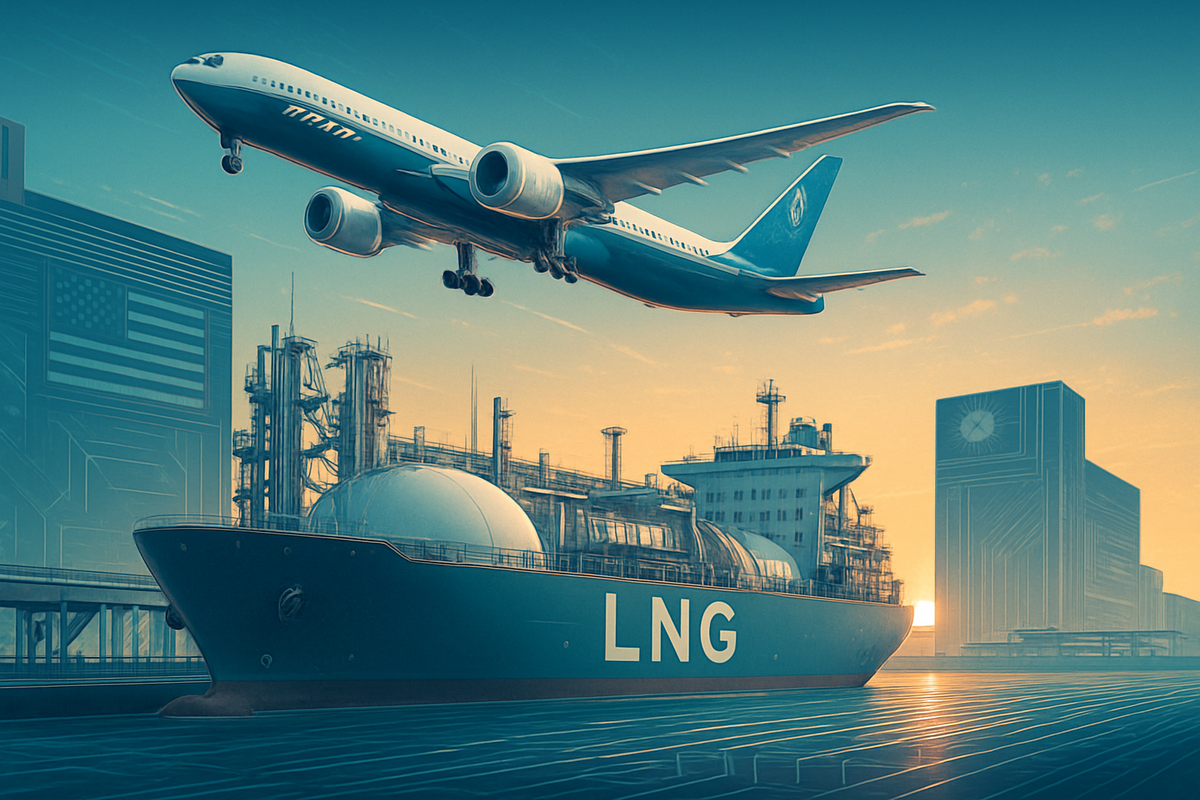
In a move that significantly recalibrates the geopolitical and economic landscape of the Pacific, the United States and Taiwan finalized a sweeping trade agreement on February 13, 2026. This "U.S.–Taiwan Agreement on Reciprocal Trade" (ART) marks a transformative shift in bilateral relations, centering on a massive exchange: the U.S. will slash and cap tariffs on Taiwanese high-tech goods in return for a multi-billion dollar commitment from Taipei to purchase American energy and aircraft.
The immediate implications are profound for both the energy and aviation sectors. By securing long-term contracts for liquefied natural gas (LNG) and high-efficiency aircraft, Taiwan is effectively tethering its energy security and transportation infrastructure to American industry. Conversely, the U.S. has secured a commitment from Taiwan to invest over $250 billion into the domestic high-tech and energy sectors, promising a ripple effect of job creation and industrial modernization across the American heartland.
The Art of the Deal: A Strategic Recalibration
The agreement, finalized in Washington D.C. after months of high-level deliberations, sets a 15% cap on reciprocal tariffs for Taiwanese goods, a sharp decrease from the volatile rates of previous years that often climbed above 20%. In exchange, Taiwan has pledged to eliminate or drastically reduce 99% of its tariff barriers on U.S. industrial and agricultural exports. This "secret" deal, as it was referred to during the final stages of negotiation due to the sensitivity of the geopolitical implications, represents the most significant trade milestone between the two entities in decades.
The timeline for this achievement traces back to early 2025, following a series of bilateral "21st-Century Trade" initiatives. Under the leadership of U.S. Trade Representative Jamieson Greer and Taiwanese President Lai Ching-te, the negotiations accelerated in late 2025 as global energy markets faced renewed volatility. The deal was signed under the auspices of the American Institute in Taiwan (AIT) and the Taipei Economic and Cultural Representative Office (TECRO), providing a formal framework for what officials are calling a "high-tech security supply chain."
Key stakeholders include Taiwan’s state-owned CPC Corporation and the Taiwan Power Company (TPC), both of which will be instrumental in executing the $44.4 billion energy purchasing mandate. On the American side, the deal was lauded by the Department of Commerce as a victory for domestic manufacturing. Initial market reactions were overwhelmingly positive, with energy stocks and aerospace manufacturers seeing a notable uptick in early trading following the February 13 announcement, as investors priced in years of guaranteed order backlogs.
Winners and Losers: Corporate Giants at the Forefront
The primary beneficiary of the aviation component is The Boeing Company (NYSE: BA). Under the new agreement, Taiwan’s major carriers have already begun placing massive orders to satisfy the $15.2 billion commitment for American aircraft. China Airlines (TPE: 2610) finalized a deal for 14 Boeing 777X aircraft, including ten 777-9 passenger jets, while EVA Airways (TPE: 2618) announced a $1.94 billion plan to acquire additional 787-9 Dreamliners. This provides Boeing with a critical long-term backlog as it competes with European rivals in the Asian market.
In the energy sector, Cheniere Energy, Inc. (NYSE: LNG) and Sempra (NYSE: SRE) are positioned as the dominant suppliers for Taiwan’s burgeoning demand for natural gas. With Taiwan aiming to increase the U.S. share of its energy imports from roughly 15% to over 35% by 2030, these exporters are looking at a decade of steady revenue. Furthermore, GE Vernova (NYSE: GEV) has already secured contracts with Taiwan Power Company to repower wind turbines, highlighting the deal's reach into renewable infrastructure.
However, the shift is not without its challenges. Middle Eastern energy exporters may find their market share in Taiwan eroded as Taipei prioritizes American supply for strategic reasons. Additionally, while Taiwan Semiconductor Manufacturing Company (NYSE: TSM) stands to benefit from the 15% tariff cap on its exports to the U.S., the requirement for $250 billion in direct investment into U.S. soil represents a massive capital expenditure that could strain short-term margins, even with government credit guarantees.
A New Blueprint for Global Energy Security
This agreement fits into a broader global trend of "friend-shoring," where nations align their trade policies with their security interests. By integrating Taiwan into the U.S. energy and tech ecosystem, Washington is creating a blueprint for how to stabilize critical supply chains without relying on adversarial nations. This moves the needle beyond simple commerce, transforming trade policy into a primary tool of national security and regional stability.
The historical precedent for such an agreement is rare; it echoes the major trade pacts of the late 20th century but adds a modern layer of technological integration. Unlike past deals that focused solely on commodity prices, the ART agreement includes provisions for AI and semiconductor research. This holistic approach ensures that the U.S. and Taiwan are not just trading partners, but are co-dependent nodes in the global high-tech economy.
Furthermore, the policy implications for China are significant. Beijing’s Taiwan Affairs Office has already criticized the deal, claiming it "hollows out" Taiwan's domestic industry. However, for the U.S., the deal serves as a counterbalance to Chinese economic influence in the region, offering an alternative to the Regional Comprehensive Economic Partnership (RCEP) and other China-led initiatives. It signals to other regional players that the U.S. remains a committed and stable economic partner in the Pacific.
The Road Ahead: Implementation and Strategic Pivots
In the short term, the market can expect a flurry of contract signings as the $84 billion in purchase commitments begins to take concrete form. The launch of a new nonstop route between Taipei and Washington D.C. by EVA Air in July 2026 will serve as a symbolic "bridge" for this new era. Investors should watch for the formalization of long-term LNG supply agreements, which will likely serve as the bedrock for the deal’s success over the next five years.
Long-term, the challenge will be the execution of the $250 billion investment pledge. As TSMC (NYSE: TSM) and other tech giants build out their U.S. footprints, they will need to navigate the complexities of the American labor market and regulatory environment. Success in these ventures will determine if the deal truly "reshills" American industry or if it remains a high-level strategic alignment on paper. Potential scenarios range from a flourishing "Silicon Desert" in the U.S. Southwest to a slower-than-expected rollout plagued by construction delays and cost overruns.
Navigating the Multi-Billion Dollar Shift
The "U.S.–Taiwan Agreement on Reciprocal Trade" is more than a trade deal; it is a foundational document for the next era of Pacific economics. By trading tariff stability for energy and aviation security, both nations have hedged against the uncertainties of the 2020s. The immediate winners are clear: American aerospace and energy giants like Boeing and Cheniere, alongside Taiwanese tech firms that now face a more predictable American regulatory landscape.
Moving forward, the market will be looking for consistency in the implementation of these multi-year purchase cycles. Investors should keep a close eye on the quarterly earnings of the involved energy and aerospace companies for updates on "ART-related" contracts. As the first shipments of U.S. LNG under these new terms begin to arrive in Taiwan, the world will see a tangible shift in how energy and technology are utilized as the ultimate currency of international diplomacy.
This content is intended for informational purposes only and is not financial advice