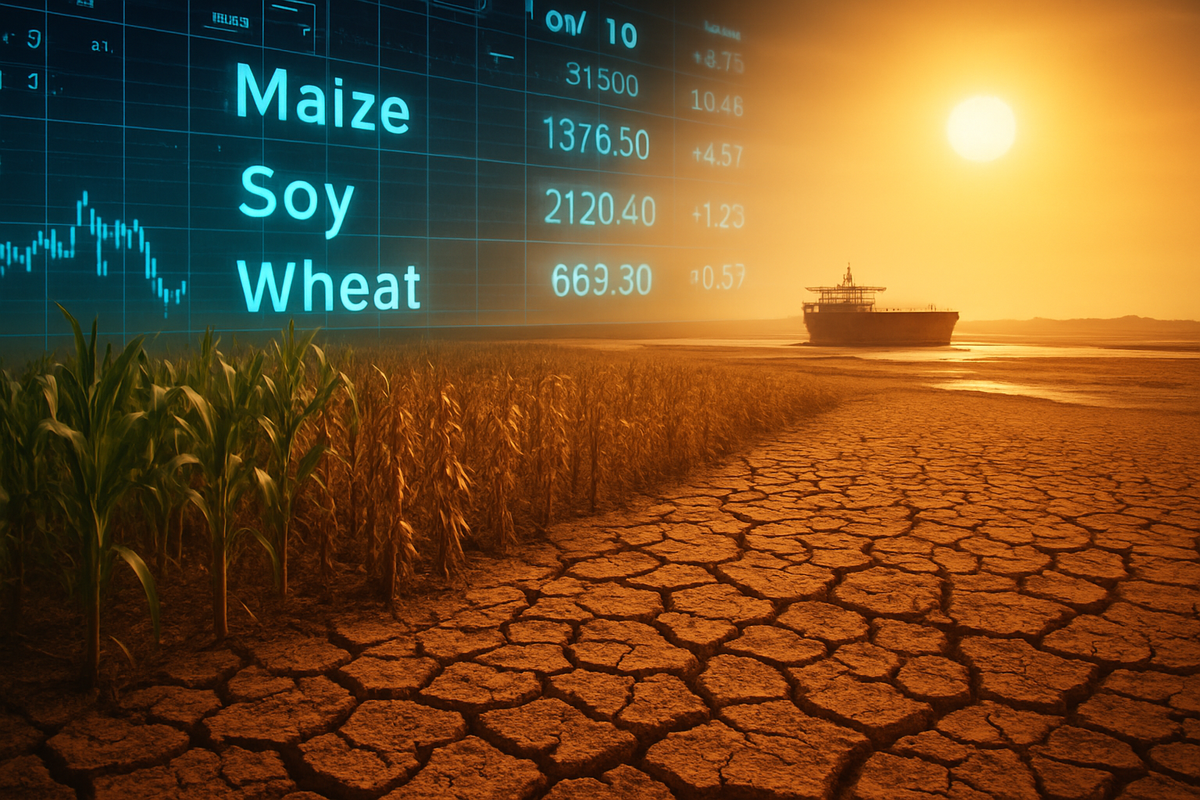
The World Bank’s latest 2026 Commodity Markets Outlook reveals a fragile stability in global food systems, projecting a 2% slip in the agricultural price index for the year. This forecast, released as markets navigate a "low-price, high-volume" environment, suggests that the sharp inflationary shocks of the previous years are finally receding, primarily due to record-breaking harvests in 2025 and a cooling of fertilizer input costs. However, this projected decline is far from guaranteed, as meteorologists and economists alike warn of a major "upside risk" that could send prices spiraling once more.
The primary shadow looming over this optimistic forecast is the persistence of La Niña. While the baseline expectation is for lower prices, the World Bank identifies this climate phenomenon as a potential catalyst for severe production disruptions across the Americas. If La Niña remains entrenched through the first half of 2026, the resulting drought and heat could decimate yields in critical "breadbasket" regions, effectively erasing the predicted price relief for consumers and creating a high-stakes environment for global agribusinesses.
Climate Volatility vs. Market Stability: The 2026 Outlook
The World Bank’s report highlights a significant divergence between market fundamentals and environmental risks. On paper, the 2026 agricultural landscape looks robust; grain prices for maize and wheat are expected to stabilize following a nearly 11% drop in 2025, while the beverage sub-index, including coffee and cocoa, is slated for a 7% correction as supply chains finally recover. This stabilization is bolstered by a 5% projected decrease in fertilizer costs, driven by a relaxation of export limits from major producers like China. These factors combined led the Bank to its headline 2% reduction in the overall price index.
However, the timeline of events since late 2025 has been dominated by the official confirmation of La Niña conditions. As of February 18, 2026, the phenomenon is expected to persist through at least the first quarter, bringing historically hot and dry conditions to the Southern Cone of South America and the U.S. Gulf Coast. In Argentina and Southern Brazil, the timing is particularly perilous; irregular rainfall in late 2025 has already delayed planting windows, putting maize and soybean crops at extreme risk during their critical pollination phases this month.
In the United States, the impact is two-fold. Beyond the direct threat of drought in the Southern Plains affecting winter wheat, La Niña is once again causing critically low water levels on the Mississippi River. This logistical bottleneck restricts barge capacity and inflates freight rates for commodities departing from the U.S. Gulf Coast. This "logistical tax" effectively raises the price of American exports on the global stage, even if the farm-gate prices remain low, complicating the World Bank’s vision of a smoother 2026.
Winners and Losers in the Agribusiness Sector
The shifting landscape of 2026 has created a stark divide among the "ABCD" giants and equipment manufacturers. Bunge Global SA (NYSE: BG) has emerged as an early winner this year, with its stock hitting 52-week highs near $121 in February. The company’s successful integration of Viterra has provided it with a diversified global footprint that allows it to capitalize on record South American volumes while hedging against localized U.S. droughts. Bunge’s ability to navigate trade flows during climate disruptions has made it a favorite among analysts, who have recently raised price targets in anticipation of strong synergy gains.
Conversely, Archer-Daniels-Midland (NYSE: ADM) has faced a more turbulent start to 2026. Despite trading near $69, the company recently issued a cautious guidance that fell below analyst expectations, citing uncertainty in U.S. biofuel policy and tightening margins in its carbohydrate solutions segment. For ADM, a persistent La Niña is a double-edged sword; while it may drive up commodity prices, the resulting logistical hurdles on the Mississippi River and reduced U.S. export volumes could further squeeze processing margins.
Equipment and input providers are also feeling the heat. Deere & Company (NYSE: DE) is currently trading at a premium, buoyed by strong momentum, but investors are wary of an impending earnings release that could show a nearly 40% year-over-year decline in earnings per share. High input costs and a softening North American equipment cycle are making farmers more cautious with capital expenditures. Meanwhile, Corteva Inc. (NYSE: CTVA) is navigating its own internal transformation, focusing on its planned business split in late 2026. While its seed business could benefit from demand for drought-resistant varieties necessitated by La Niña, the overall market volatility remains a significant headwind.
Trade Truces and Global Ripple Effects
A critical stabilizing force identified by the World Bank is the easing of trade tensions between the U.S. and China. After years of "trade diversion," where China redirected its soybean purchases toward Brazil to avoid U.S. tariffs, a fragile diplomatic truce in early 2026 has provided a floor for demand. Reports of a potential high-level meeting between U.S. and Chinese leadership later this year have fueled hopes for a formal agreement that could see China commit to purchasing upwards of 25 million metric tons of U.S. soybeans. This geopolitical thaw is essential for balancing the market, as it ensures that even if South American production is hit by La Niña, U.S. farmers have a reliable destination for their yields.
Historically, this situation echoes the 2011-2012 La Niña cycle, which saw similar patterns of South American drought followed by sharp spikes in global grain prices. However, the 2026 context is unique due to the increased integration of biofuels into the global energy mix. Today, a supply shock in maize or soybeans doesn’t just affect the dinner table; it ripples through the energy sector, influencing ethanol and biodiesel prices. Regulatory bodies in both the EU and the U.S. are closely monitoring these developments, as a sudden spike in "ag-flation" could complicate central bank efforts to keep interest rates steady.
Furthermore, the World Bank’s focus on fertilizer costs highlights a shift in global policy. The 5% projected decline in fertilizer prices is contingent on China continuing to relax its export restrictions on nitrogen and phosphate. If China were to reverse this policy—perhaps in response to renewed trade friction or domestic food security concerns—the "stabilizing effect" mentioned in the 2026 outlook would vanish, leaving farmers to face high input costs alongside climate-driven crop failures.
The Path Forward: Strategic Pivots in a Changing Climate
In the short term, the market will be laser-focused on Pacific sea surface temperatures and the March planting intentions reports. Agribusinesses are already pivoting their strategies; companies like The Mosaic Company (NYSE: MOS) are banking on a recovery in North American fertilizer demand as farmers attempt to maximize yields in a volatile environment. For investors, the next three months are critical. If La Niña begins to fade by April as some models suggest, the World Bank’s 2% price slip remains a viable baseline. If it persists, we may be entering a period of "scarcity pricing" for maize and soybeans.
Longer-term, the industry is accelerating its move toward climate-resilient agriculture. This includes a surge in R&D spending for drought-tolerant seed traits and precision irrigation technologies. Public companies that can offer these "adaptation tools" will likely see a valuation premium as climate volatility becomes the rule rather than the exception. The 2026 outlook serves as a reminder that in the modern global economy, a trade agreement in Washington or Beijing can be just as impactful as a rainstorm in the Mato Grosso or a dry spell in the Mississippi Delta.
Conclusion and Investor Takeaways
The World Bank’s 2026 outlook paints a picture of a market at a crossroads. While the projected 2% decline in the agricultural price index offers a glimmer of hope for global food price stability, the "upside risks" are formidable. The combination of La Niña’s dry grip on the Americas and the delicate nature of U.S.-China trade relations means that volatility is likely to remain high. For the market to realize the Bank’s forecast, the easing of trade tensions must hold firm, and the climate must transition toward a neutral state by mid-year.
Moving forward, investors should keep a close watch on three key metrics: Mississippi River water levels, South American harvest progress reports, and the progress of U.S.-China agricultural trade negotiations. While Bunge Global SA and Corteva Inc. represent different ways to play this volatility—one through global logistics and the other through seed technology—the overarching theme for 2026 is one of cautious adaptation. The "calm" predicted by the World Bank is welcome, but in the world of commodities, the storm is rarely far behind.
This content is intended for informational purposes only and is not financial advice.