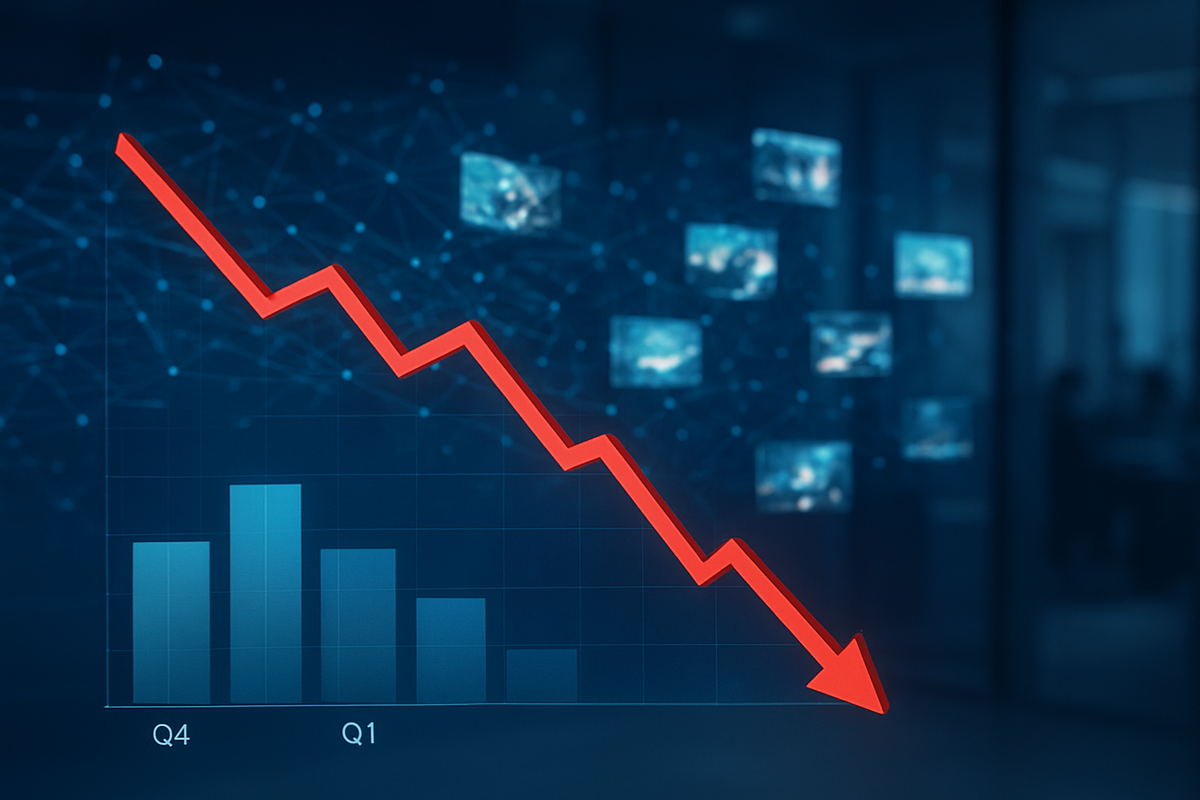
The digital advertising landscape was jolted on February 26, 2026, as The Trade Desk (Nasdaq: TTD) saw its stock price crater by more than 16% in pre-market trading. The sharp decline followed the company’s fourth-quarter 2025 earnings report, which presented a jarring contrast: a solid revenue beat for the holiday quarter dampened by a first-quarter 2026 outlook that fell significantly short of Wall Street's expectations.
While the company reported Q4 revenue of $847 million—surpassing the consensus estimate of $841 million—the focus shifted instantly to the future. Management’s guidance for Q1 2026 of "at least $678 million" suggests a dramatic deceleration in growth to approximately 10% year-over-year. For a company historically valued as a high-growth "disruptor" in the programmatic ad space, this conservative forecast triggered an immediate re-evaluation of its premium valuation, sending shares to a 52-week low as investors grappled with the implications of a cooling ad market.
A Tale of Two Quarters: The Beat and the Guidance Chasm
The Trade Desk’s fourth-quarter performance was, on the surface, a testament to its market-leading position in the "Open Internet." The $847 million in revenue represented a 14.3% increase over the previous year. When adjusted for the lack of political ad spend compared to the 2024 election cycle, the organic growth rate sat at a more robust 19%. Profitability remained a bright spot, with adjusted EBITDA hitting $400 million, reflecting a disciplined 47% margin. CEO Jeff Green used the earnings call to highlight the company’s technological strides, noting that nearly 100% of clients have migrated to the Kokai AI platform and introducing Audience Unlimited, a product designed to simplify premium data access for advertisers.
However, the narrative shifted during the question-and-answer session with analysts. The Q1 2026 guidance of $678 million was a far cry from the $689 million to $696 million analysts had modeled. This projected 10% growth rate represents a steep drop-off from the 25% growth recorded just one year prior. Management attributed the cautious outlook to a "volatile macro environment" and a strategic shift toward quality over quantity. Green emphasized that advertisers are increasingly moving away from "cheap reach" and toward "measurable outcomes," a transition that The Trade Desk is leading but one that may cause short-term friction in billing volume.
The market reaction was swift and unforgiving. By early morning on February 26, the stock was down 16.2%, erasing billions in market capitalization. Major brokerages moved quickly to adjust their stances; Loop Capital and New Street Research both issued downgrades, citing concerns over leadership stability following recent executive turnover and the intensifying competitive pressure from retail media giants.
Winners and Losers: The Shifting Balance of Power
The Trade Desk's stumble has cast a spotlight on the relative strength of its competitors. The primary "winners" in this environment appear to be the massive "walled gardens" that possess first-party data. Meta Platforms (Nasdaq: META) recently reported 24% revenue growth and projected a 30% surge for the upcoming quarter, suggesting that social media advertising is capturing a larger share of the migrating budgets. Similarly, Amazon (Nasdaq: AMZN) has emerged as a formidable threat; its advertising arm grew 22% in the final quarter of 2025. Analysts noted that Amazon’s aggressive "head-to-head" testing for its Demand-Side Platform (DSP) is successfully poaching brands that previously relied solely on The Trade Desk for their programmatic needs.
On the losing side, The Trade Desk's "soft" guidance suggests that the broader "Open Internet"—the collection of independent publishers and websites—may be struggling to compete for ad dollars against the data-rich ecosystems of Big Tech. Smaller, independent DSPs may find themselves in an even more precarious position if the industry leader is seeing a slowdown. However, Roku (Nasdaq: ROKU) offered a more resilient outlook, reporting 16% growth and guiding for 18% in Q1, indicating that while programmatic web advertising is slowing, the Connected TV (CTV) segment where Roku and TTD both play remains a relative pocket of strength.
The CTV Pivot and the "Walled Garden" War
The broader significance of this earnings report lies in the maturation of the Connected TV (CTV) market. CTV now accounts for approximately 50% of The Trade Desk’s total business. Jeff Green’s comments regarding "measurable outcomes" highlight a fundamental shift in how television is bought. Advertisers are no longer content with broad demographic targeting; they demand the same precision in streaming that they get in search or social. This shift is a double-edged sword: while it favors TTD’s data-driven platform, it also invites intense competition from streaming giants who are increasingly building their own internal ad-tech stacks to keep margins for themselves.
Furthermore, the launch of the Ventura CTV ecosystem represents TTD's attempt to build a new standard for the streaming industry that circumvents the limitations of traditional hardware and OS providers. This move is a direct challenge to the status quo and suggests that the company is willing to sacrifice short-term growth to secure its place as the underlying infrastructure of the future TV landscape. The struggle TTD faces is a microcosm of the larger battle between the "Open Internet" and "Walled Gardens," where the value of independent, objective measurement is being weighed against the sheer scale and ease of use provided by Google and Meta.
The Path Forward: AI Integration and Strategic Pivots
Looking ahead, the next several months will be a "prove-it" period for The Trade Desk. The company’s focus will likely remain on the full-scale rollout of its Kokai AI platform. Management believes that Kokai will eventually allow advertisers to optimize their spends with a level of granularity that was previously impossible, potentially re-accelerating growth in the second half of 2026. Investors will also be watching the adoption of Audience Unlimited, which aims to lower the barrier for entry for brands to use high-quality third-party data, potentially making the platform stickier for mid-sized agencies.
A potential strategic pivot may involve deeper integrations with retail media networks. As cookies continue to face obsolescence and privacy regulations tighten, the "shopper data" held by retailers is becoming the new gold standard. TTD's ability to forge deep, exclusive partnerships with retailers beyond Amazon will be a critical factor in whether it can regain its 20%+ growth trajectory. If these initiatives fail to gain traction by the Q3 2026 reporting cycle, the company may face pressure to explore more radical changes, including potential mergers or acquisitions to shore up its data advantages.
Closing Thoughts for Investors
The Trade Desk’s Q4 2025 earnings serve as a sobering reminder that even the most innovative companies are not immune to macroeconomic headwinds and the gravity of high expectations. The "revenue beat" was a hollow victory in the face of a guidance miss that suggests the company is entering a new, slower phase of its lifecycle. The key takeaway for the market is that the easy growth of the early streaming era has ended, replaced by a "knife fight" for every advertising dollar.
Moving forward, investors should keep a close eye on the company's ability to maintain its margins while fending off Amazon's DSP. The 16% stock slide reflects a "reset" of the company’s valuation multiples, and the stock may remain range-bound until there is clear evidence that the Q1 slowdown is a temporary blip rather than a permanent trend. In the coming months, the focus will shift from total revenue to the "quality" of that revenue—specifically, how much of it is being driven by the high-margin CTV and retail media segments. For now, The Trade Desk remains a leader in a challenging environment, but one that must now prove it can still outpace the giants it seeks to disrupt.
This content is intended for informational purposes only and is not financial advice.