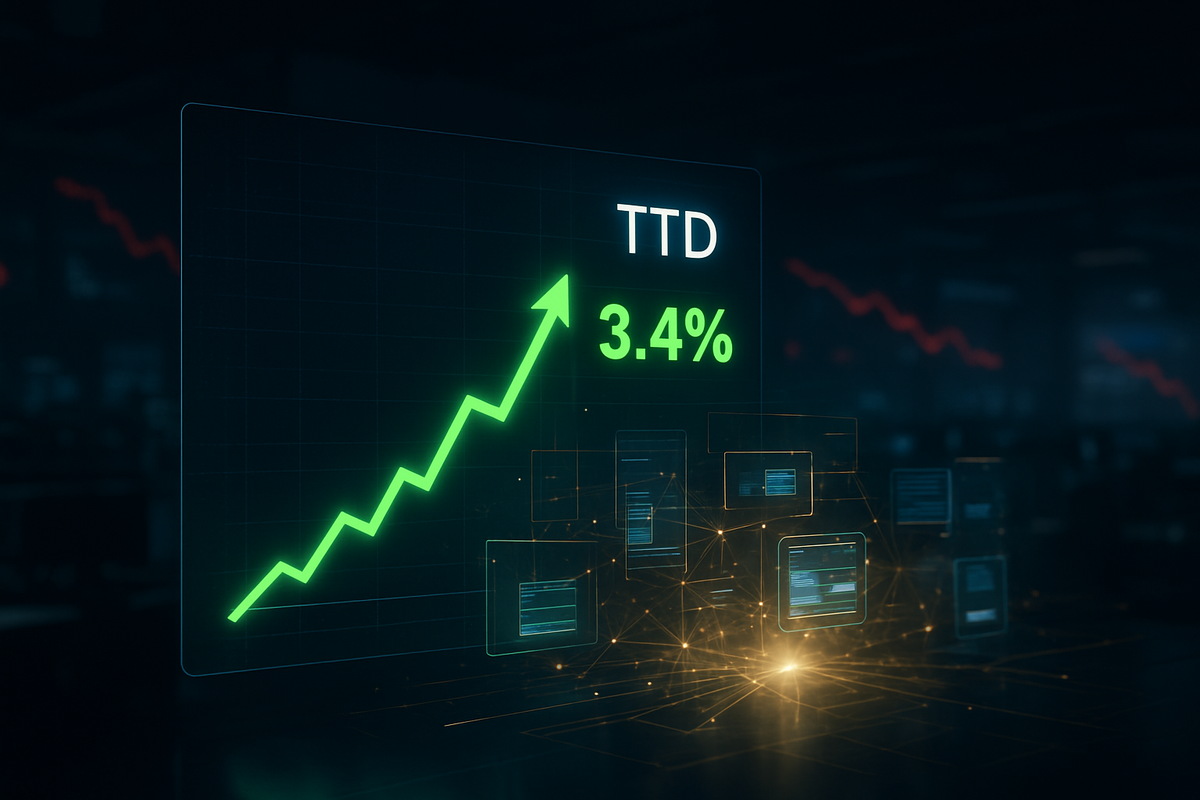
In a trading session defined by red ink across major indices, The Trade Desk (NASDAQ: TTD) emerged as a resilient outlier on March 20, 2026. The ad-tech powerhouse saw its shares climb 3.4% to close at approximately $24.11, providing a stark contrast to a broader market weighed down by geopolitical volatility and rising Treasury yields. While the S&P 500 and the Nasdaq Composite fell by 1.51% and 1.98% respectively, the programmatic advertising leader signaled that the demand for transparent, AI-driven media buying remains a structural pillar of the digital economy.
The day’s gain is being characterized by analysts as a "relief rally," marking a decisive turnaround after a turbulent week for the company. The surge was fueled by a potent combination of massive insider buying from leadership, circulating rumors of a landmark partnership with OpenAI, and a growing consensus that recent industry disputes may have been overblown. As the market grapples with macro-economic headwinds, The Trade Desk’s performance underscores a "flight to quality" within the advertising sector, where efficiency and data-driven results are becoming the ultimate currency.
The Recovery Path: CEO Confidence and the OpenAI Factor
The immediate catalyst for the 3.4% jump was a significant show of confidence from the top. Earlier this month, CEO Jeff Green executed a series of massive share purchases, acquiring over 6 million shares worth an estimated $150 million. This insider activity served as a powerful signal to institutional investors that the stock had reached an oversold territory following a mid-March dip. The buy-back sentiment was further bolstered on March 20 when Needham reaffirmed its "Buy" rating on the stock, setting a price target of $32 and dismissing recent friction with agency partners as "transient economic struggles" rather than fundamental cracks in the business model.
Adding fuel to the fire are persistent reports that The Trade Desk is in advanced negotiations with OpenAI to manage advertising sales for its suite of generative AI platforms, including ChatGPT. If confirmed, such a partnership would position The Trade Desk as the primary infrastructure for the next generation of conversational AI advertising. This comes on the heels of the company’s own AI advancements; in the first quarter of 2026, the company introduced "Performance Mode" to its Kokai platform, an "agentic AI" feature that automates bidding and ROI optimization with minimal human intervention.
The week leading up to this rally was not without drama. The Trade Desk recently found itself in a public dispute with Publicis Groupe (OTC: PUBGY), one of the world's largest advertising holding companies. Publicis had briefly advised clients to reconsider their spend on the platform following a disagreement over transparency audits and fee structures. However, by March 20, market sentiment shifted as reports surfaced that many major brands were choosing to ignore the agency's guidance, opting instead to stay on The Trade Desk’s platform due to its unparalleled reach into the "Open Internet" and Connected TV (CTV).
Winners and Losers in the Programmatic Shift
The Trade Desk's resilience has significant implications for the wider ad-tech ecosystem. Among the winners is Magnite (NASDAQ: MGNI), the leading independent sell-side platform, which saw a sympathetic rise in its share price as investors regained confidence in the independent web's health. Furthermore, retail giants like Walmart (NYSE: WMT) and Target (NYSE: TGT) continue to benefit from their deep integration with The Trade Desk’s retail data marketplace. By providing closed-loop measurement that proves an ad led to a specific purchase, these retailers have turned their first-party data into a high-margin revenue stream.
Conversely, the traditional "walled gardens"—namely Alphabet’s Google (NASDAQ: GOOGL) and Meta—face a more complex landscape. While they remain dominant, the rising adoption of Unified ID 2.0 (UID2) as the "identity fabric" of the internet is eroding the competitive advantage once held by proprietary logins. The Trade Desk’s success in scaling UID2 with partners like Microsoft (NASDAQ: MSFT) and iHeartMedia has created a credible alternative for advertisers who want to reach audiences outside of the social media giants' ecosystems without relying on third-party cookies, which have now been largely phased out by the 2026 deadline.
Advertising agencies like Publicis find themselves in a delicate position. While they attempt to exert leverage over tech platforms to secure better margins for their clients, the essential nature of The Trade Desk’s technology makes a total pivot difficult. The current market reaction suggests that in the battle between "Big Agency" and "Big Tech," the platform providing the most measurable ROI is currently holding the upper hand.
AI and the Evolution of the Open Internet
The broader significance of today’s market movement lies in the maturation of the programmatic market. By early 2026, U.S. programmatic display spending is projected to exceed $203 billion, representing a 12.5% year-over-year growth despite a sluggish macro economy. This growth is being driven by the shift from experimental AI to structural AI. The Trade Desk’s Kokai platform has successfully integrated "Audience Unlimited" features, allowing advertisers to apply AI-driven insights to massive datasets with zero friction, a trend that is now becoming the industry standard.
The regulatory environment also plays a role in this trend. As antitrust pressure continues to mount against integrated players like Google, independent platforms that do not own the content they sell ads against are viewed as more compliant and less conflicted. This "neutrality" has become a selling point for The Trade Desk, allowing it to aggregate data from diverse sources like Kroger (NYSE: KR), Instacart (NASDAQ: CART), and Costco (NASDAQ: COST) into a single, cohesive buying platform.
Historically, this moment mirrors the "flight to safety" seen in previous market downturns, but with a digital twist. In 2008, investors fled to gold; in 2026, advertisers are fleeing to data-backed, programmatic efficiency. The Trade Desk’s ability to maintain a 3.4% gain while the Nasdaq fell nearly 2% suggests that the market now views programmatic advertising not as a luxury, but as a defensive utility in a brand’s marketing budget.
The Road Ahead: OpenAI and International Expansion
Looking forward, the short-term focus for investors will be the potential confirmation of the OpenAI partnership. Such a deal would likely trigger a significant re-rating of the stock, potentially pushing it toward the $30 mark. Strategically, The Trade Desk is also expected to pivot more aggressively into international markets. With the successful rollout of EUID (the European counterpart to UID2) across major European supply-side platforms, the company is well-positioned to capture the growing digital ad spend in the EMEA and APAC regions.
The long-term challenge will be maintaining the delicate balance between platform fees and agency relationships. The dispute with Publicis may be the first of several "transparency wars" as agencies struggle to justify their own margins in an increasingly automated world. The Trade Desk will need to continue innovating its "Performance Mode" to ensure that the value it provides to the end advertiser far outweighs the friction caused by agency negotiations.
Conclusion: A Benchmark for the New Advertising Era
The Trade Desk’s performance on March 20, 2026, serves as a definitive signal that the programmatic revolution has entered a new, more resilient phase. By outperforming the broader market during a period of high volatility, the company has demonstrated that its platform is more than just a tool for media buying—it is an essential piece of global economic infrastructure. The key takeaways for the market are clear: AI integration is no longer optional, retail data is the new oil, and the "Open Internet" is a formidable competitor to the walled gardens.
As we move into the second quarter of 2026, investors should keep a close eye on the company's Q1 earnings report and any official announcements regarding AI partnerships. While macro-economic risks such as oil price volatility and interest rate fluctuations persist, The Trade Desk has shown that it can navigate the storm by sticking to its core mission of providing a transparent, data-driven alternative to the traditional advertising world. For now, the "Green" signal from the CEO's massive share purchase appears to be the most accurate indicator of the company's trajectory.
This content is intended for informational purposes only and is not financial advice.