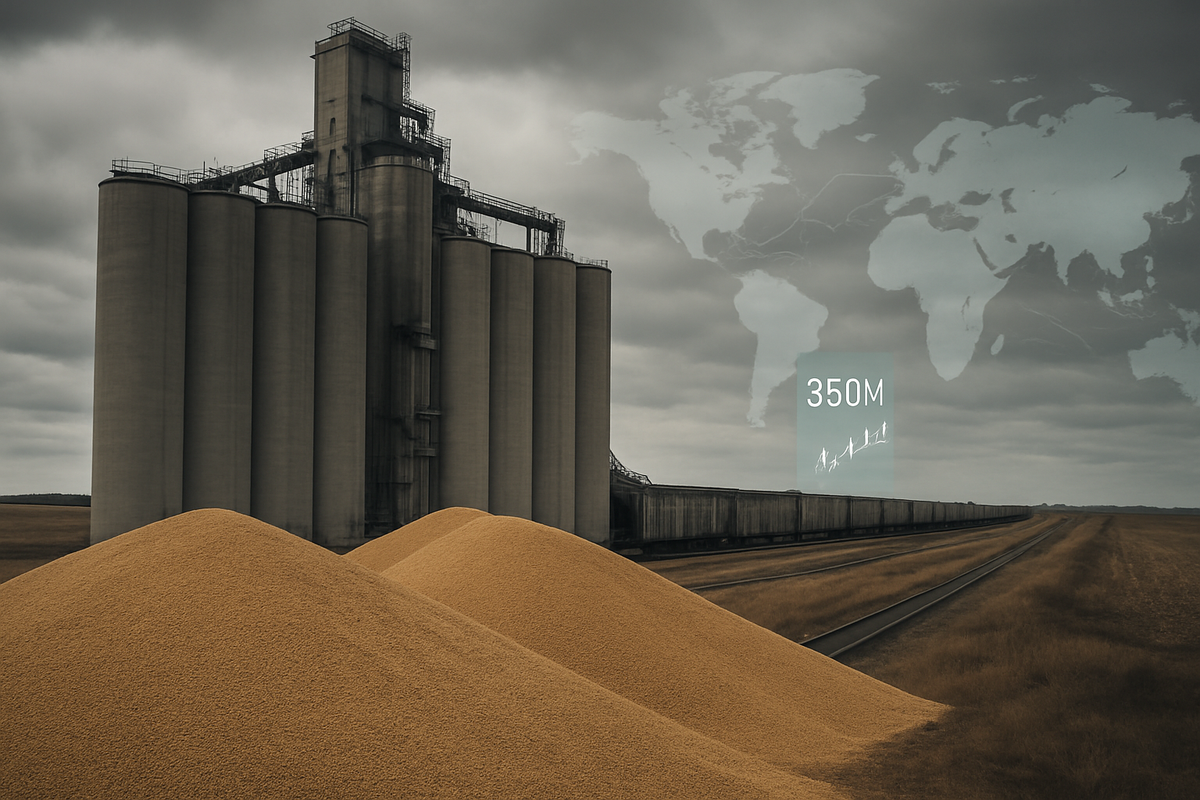
The American soybean market is currently grappling with a mounting supply crisis as domestic ending stocks have surged to a six-year high, reaching 350 million bushels. According to the March 10, 2026, World Agricultural Supply and Demand Estimates (WASDE) report, the United States is facing a "neutral-to-bearish" fundamental outlook characterized by stagnant export demand and a massive production overhang. This domestic glut is being exacerbated by a historic harvest in South America, which has effectively priced U.S. producers out of the global stage during what is traditionally their peak shipping window.
The immediate implications for the market are stark: with the season-average farm price hovering at a modest $10.20 per bushel, U.S. farmers are entering the 2026/27 planting season with significant financial headwinds. While domestic demand for soybean crush remains a rare bright spot—driven by a burgeoning renewable diesel sector—the lack of international buyers is creating a storage bottleneck. For the broader financial markets, this shift signals a period of intense margin pressure for traditional grain handlers, while highlighting a growing divergence between companies with North American versus global operational footprints.
A Perfect Storm: Record Stocks and the $1 Premium
The road to the current 350-million-bushel carryout has been paved by a series of logistical and geopolitical shifts over the past eighteen months. The March 2026 WASDE report confirmed that despite a slight increase in domestic crush demand to 2.435 billion bushels, the overall supply balance remains heavily weighted toward a surplus. Compounding the issue, the USDA recently increased soybean import projections to 25 million bushels—a move that analysts at ADM Investor Services described as a tactical necessity for East Coast crushers who find it cheaper to import South American beans than to transport them from the U.S. Midwest.
Key to this crisis is the "price gap" that has emerged at the U.S. Gulf. Throughout early 2026, U.S. soybeans have traded at a premium of $1.00 or more per bushel over Brazilian Free on Board (FOB) offers. This pricing disparity is largely due to Brazil’s record-breaking 2026 harvest, estimated at a staggering 180 million metric tons. With South American supplies flooding the market, U.S. exporters have found themselves sidelined. The timeline of this decline was punctuated in early March when Chinese private crushers almost entirely bypassed U.S. origins in favor of cheaper Brazilian cargoes, which benefit from a significantly lower import duty (3% compared to the 13% faced by U.S. beans).
The lack of Chinese buying has been the most damaging factor for U.S. stakeholders. While state-owned enterprises like Sinograin have made symbolic "trade truce" purchases totaling approximately 12 million metric tons since late 2025, private commercial demand has cratered. In the first two months of 2026 alone, U.S. soybean exports to China plunged by 83.7% year-over-year. This retreat is not merely a pricing issue; it is a structural shift, reinforced by a new regulatory agreement between China and Brazil that eased "zero-tolerance" weed policies, further streamlining the trade corridor between the two nations at the expense of American producers.
Corporate Winners and Losers in a Two-Speed Market
The current market environment has created a clear divide among the "Big Three" agricultural titans. Archer-Daniels-Midland (NYSE: ADM) has emerged as one of the most visible victims of the U.S.-centric supply glut. The company recently reported its weakest fourth-quarter profit since 2019, citing "intense crush margin pressure" as a primary headwind. Because a significant portion of ADM’s processing infrastructure is concentrated in North America, the company is uniquely vulnerable to the loss of U.S. export competitiveness and the ongoing regulatory delays surrounding the 45Z Clean Fuel Production Credit, which many had hoped would bolster domestic demand even further.
Conversely, Bunge Global SA (NYSE: BG) is positioned as a primary winner in the 2026 landscape. Following its successful merger with Viterra in mid-2025, Bunge has optimized its global logistical footprint to capitalize on regional imbalances. With roughly 36% of its processing capacity now located in South America, Bunge is perfectly positioned to profit from the record Brazilian and Argentine crops. While U.S. markets stagnate, Bunge’s ability to originate and ship from low-cost South American hubs has allowed the company to maintain high margins, leading to the announcement of a $3 billion share repurchase program in March 2026.
In the technology and inputs sector, Corteva, Inc. (NYSE: CTVA) has demonstrated remarkable resilience. Despite the bearish outlook for grain prices, Corteva’s stock is up 13% year-to-date in 2026. The company has successfully insulated itself from the volatility of physical grain trading by focusing on high-margin seed licensing and advanced agricultural biologicals. While farmers may be cutting back on capital expenditures like new machinery, they are continuing to invest in Corteva’s premium seed genetics to maximize yields—an essential strategy for maintaining farm-level profitability in a low-price environment.
Shifting Tides: The Global Soybean Hegemony
The significance of the 350-million-bushel carryout extends far beyond a single season; it represents a fundamental shift in the global agricultural hierarchy. Historically, the U.S. and Brazil shared dominance of the soybean market, with the U.S. controlling the northern hemisphere’s harvest window. However, the $1+ premium currently seen in the U.S. suggests that Brazil has achieved a level of scale and logistical efficiency that makes it a year-round preferred supplier for the world's largest importer, China. This "crowding out" effect is a ripple effect of massive infrastructure investments in the Brazilian Cerrado over the last decade.
The situation also highlights a growing policy divergence. While the U.S. has leaned heavily into "demand-side" solutions like renewable diesel to soak up excess supply, these policies have yet to fully offset the loss of the export market. Furthermore, the 13% import duty disadvantage for U.S. beans in China serves as a persistent reminder of the unresolved trade tensions that continue to reshape global commodity flows. This event mirrors the 2018-2019 trade war era, but with a critical difference: Brazil now has the physical capacity to meet Chinese demand almost entirely on its own, leaving the U.S. as a "residual supplier" rather than a primary one.
The broader industry trend is one of regionalization. As China deepens its ties with South American producers through regulatory easing and currency-swap agreements, the U.S. market is being forced to become more inward-looking. This shift necessitates a massive pivot in infrastructure investment toward domestic processing and away from export elevators at the Gulf, a transition that will likely take years and billions of dollars in capital to complete.
The Road Ahead: 2026/27 and Strategic Pivots
As the 2026/27 season approaches, U.S. producers face a difficult choice. With ending stocks at a six-year high, the market is signaling that less acreage is needed. However, with corn prices also facing pressure, many farmers may find themselves "stuck" with soybeans due to lower input costs compared to corn. This could lead to a persistent surplus that keeps prices near or below the $10.00 mark for the foreseeable future. A strategic pivot toward specialized soy varieties—such as high-protein or non-GMO beans—may offer a niche escape for some, but for the majority of the "I-state" farmers, the focus will remain on cost containment.
Short-term, the market will be hyper-focused on the USDA's Prospective Plantings report due at the end of March. Any indication that farmers are not cutting back on soybean acreage could send prices into a tailspin. Long-term, the U.S. industry is pinning its hopes on the "Green Transition." If the 45Z tax credits are implemented in a way that aggressively incentivizes domestic soy oil for sustainable aviation fuel (SAF), the current surplus could eventually be absorbed. However, until that infrastructure is fully online, the U.S. market remains in a vulnerable state of limbo.
Summary and Investor Outlook
The current state of the U.S. soybean market is a sobering reminder of the volatility inherent in global commodity trading. With ending stocks at 350 million bushels and a significant price disadvantage against South American origins, the U.S. is facing its most challenging export environment in over half a decade. The divergence between diversified global players like Bunge (NYSE: BG) and U.S.-heavy processors like ADM (NYSE: ADM) underscores the importance of geographic diversity in an era of shifting trade alliances.
Moving forward, the market will likely remain in a "wait-and-see" mode. Investors should closely watch for any shifts in China’s buying patterns during the late summer—the traditional window for U.S. new-crop sales—and monitor the progress of renewable diesel facility completions across the Midwest. While the current outlook is bearish, the agricultural sector is notoriously cyclical. However, for the 2026 season, the "Soybean King" appears to have been dethroned by a combination of Brazilian bounty and a shifting geopolitical landscape.
This content is intended for informational purposes only and is not financial advice.