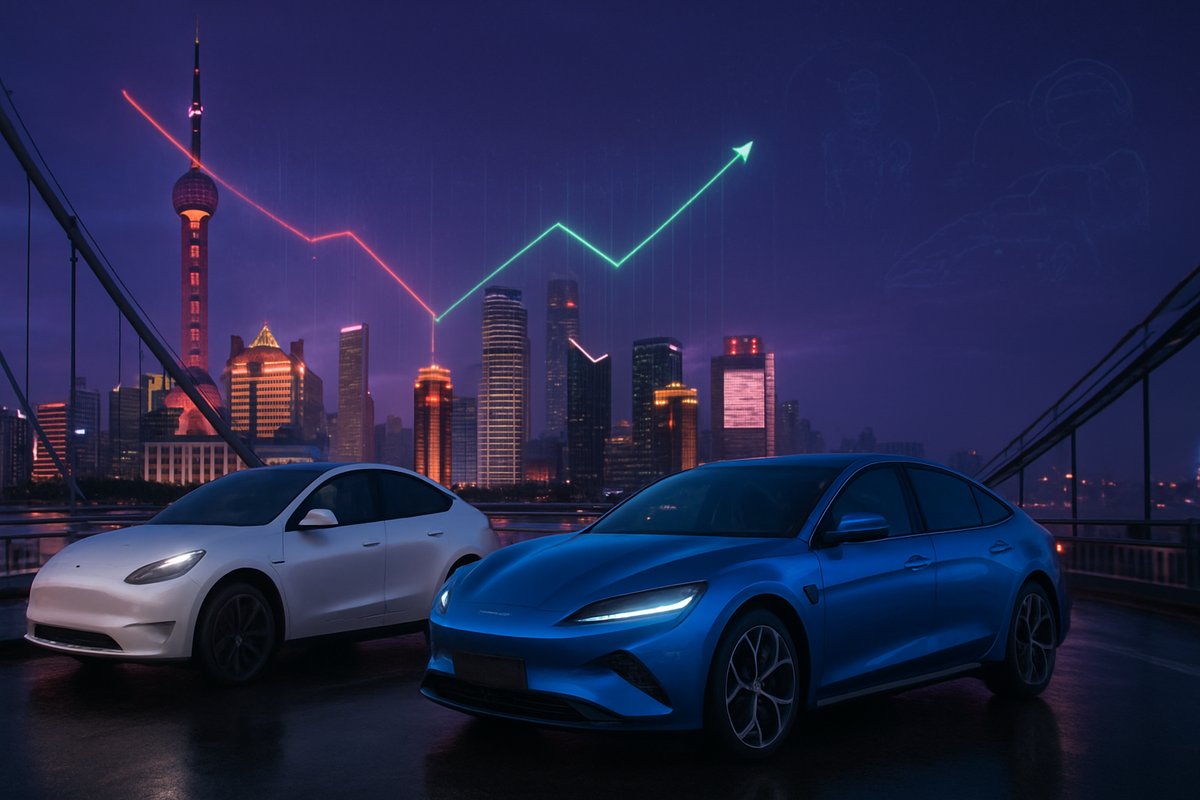
The global electric vehicle (EV) landscape reached a historic inflection point this week as Q1 2026 delivery reports signaled a definitive shift in market leadership. Tesla (NASDAQ: TSLA) reported first-quarter deliveries of 358,023 vehicles, falling short of the Wall Street consensus of approximately 367,000 units. While the figures represent a slight rebound from the depths of 2025, they were not enough to reclaim the title of the world’s largest battery-electric vehicle (BEV) manufacturer from BYD (HKG: 1211).
This latest delivery miss underscores a persistent struggle for the Austin-based automaker to maintain its dominance in an increasingly crowded and price-sensitive global market. As BYD continues to leverage its vertically integrated supply chain and aggressive international expansion, the narrative of "Tesla vs. The World" has shifted into a reality where Tesla is now fighting to remain a top-three player in the world's largest automotive market: China.
The Numbers Behind the Decline
Tesla’s Q1 2026 results arrived on April 2nd, revealing a production volume of 408,386 vehicles against deliveries of just 358,023. This substantial gap has led to the largest inventory buildup in the company’s history, fueling concerns that demand for its aging lineup—specifically the Model 3 and Model Y—has hit a ceiling. This follows a volatile 24-month period that began with the shock Q1 2024 delivery miss of 386,810 units, which at the time was the first year-over-year decline for the company since the pandemic.
The timeline of this transition traces back to late 2023 when BYD first surpassed Tesla in quarterly BEV sales. Although Tesla briefly regained the lead in early 2024, the momentum shifted permanently throughout 2025. By the end of last year, BYD officially closed 2025 with 2.26 million BEV sales compared to Tesla’s 1.64 million. The first quarter of 2026 has only widened this gap, as BYD continues to pump out a diverse array of models across all price points, while Tesla has prioritized shifting its manufacturing lines toward robotics and the "Cybercab" autonomous platform.
Market reactions have been swift. Tesla’s stock faced immediate downward pressure following the announcement, as analysts questioned the "AI and Robotics" valuation premium that CEO Elon Musk has championed. Meanwhile, BYD shares remained resilient, buoyed by the company's ability to maintain high margins through internal battery production and its expanding footprint in Europe and Southeast Asia.
Winners and Losers in the New EV Order
The primary winner in this reshuffled deck is undoubtedly BYD. By controlling nearly every aspect of its production—from lithium mining to microchips—BYD has been able to lower prices more aggressively than any competitor without sacrificing profitability. However, the real disruptor of late has been Xiaomi (HKG: 1810). Since entering the market in 2024, Xiaomi has seen meteoric growth; its YU7 SUV, launched in mid-2025, has consistently outsold the Tesla Model Y in China for three consecutive quarters, capturing the "tech-first" consumer segment that once belonged exclusively to Tesla.
On the losing end of this cycle are legacy international players who have struggled to keep pace with the software innovation of Chinese firms. Volkswagen (OTC: VWAGY) and other European stalwarts have seen their market share in China erode to record lows, forcing them into defensive partnerships. Conversely, "pure-play" Chinese innovators like Li Auto (NASDAQ: LI) and Nio (NYSE: NIO) have found a second wind by targeting the premium niche and battery-swapping sectors, respectively, which Tesla has largely ignored in favor of global mass production.
Xpeng (NYSE: XPEV) has also emerged as a strategic winner through its deep integration of AI-driven ADAS (Advanced Driver Assistance Systems). By partnering with global brands for manufacturing while providing the "brains" of the vehicle, Xpeng is carving out a role as a software provider, a path that Tesla originally pioneered but has found difficult to monetize in a competitive regulatory environment like China’s.
Broader Industry Trends and Policy Shifts
The current market dynamic is heavily influenced by a "survival of the fittest" environment in China. As of 2026, New Energy Vehicle (NEV) penetration has surpassed 60% of all new car sales in the country. This maturity has led to the expiration of the decade-long full purchase tax exemption. Starting January 1, 2026, a 5% purchase tax was implemented for NEVs under RMB 300,000, creating a significant headwind for mid-market brands. This policy shift has favored companies with the scale to absorb costs, such as BYD and Geely (HKG: 0175).
Historically, the EV market was driven by early adopters and government subsidies. Today, it is driven by "Intelligent Cockpits" and AI integration. The Chinese market has entered a phase where hardware is commoditized, and the "value-add" is entirely in the software. This transition mirrors the smartphone wars of the 2010s, where a few dominant players consolidated the market while others were relegated to niche status.
Regulatory standards have also tightened. China’s new mandatory energy consumption standards have effectively forced older EV models off the tax-exempt list, requiring manufacturers to invest heavily in efficiency. This has created a barrier to entry for smaller startups and a persistent R&D burden for established players like Tesla, whose current fleet architecture is several years old.
The Road Ahead: Strategic Pivots and Market Outlook
Looking forward, the remainder of 2026 will likely see Tesla double down on its pivot toward artificial intelligence. With traditional auto margins thinning, the company is betting its future on the Optimus humanoid robot and its upcoming dedicated Robotaxi. For investors, the short-term challenge will be navigating the "valley of death" between the decline of Tesla's hardware sales and the eventual monetization of its AI software.
In contrast, BYD is expected to focus on global dominance. With several new factories opening in Hungary, Brazil, and Thailand throughout 2026, BYD is positioning itself to bypass potential trade barriers and tariffs. The strategic challenge for BYD will be maintaining its brand prestige as it scales into the ultra-high-volume mass market, where it must compete not just on price, but on the "cool factor" currently being captured by newcomers like Xiaomi.
Potential scenarios for the next 18 months include further consolidation in the Chinese market, where dozens of smaller EV brands may be forced into mergers or bankruptcies. The "price war" that began in 2023 has evolved into a "tech war," and companies without massive R&D budgets or deep-pocketed tech partners (like the Huawei-backed Aito) will struggle to survive.
Investment Summary and Market Assessment
The key takeaway from the Q1 2026 delivery numbers is that the "Tesla-centric" era of the EV market has concluded. We have entered a multipolar reality where BYD is the volume king, Xiaomi is the tech disruptor, and Tesla is a transitioning AI firm. The massive inventory build at Tesla suggests that price cuts alone are no longer enough to stimulate demand in a market that now demands rapid iteration and cutting-edge software.
Moving forward, the market will be defined by how well these companies navigate the end of subsidies and the rise of autonomous driving. Investors should closely watch Tesla’s "AI Day" scheduled for later this year, as well as BYD’s quarterly margin performance to see if their international expansion is as profitable as their domestic operations.
The lasting impact of this shift is clear: the automotive industry has been permanently decoupled from its traditional cycles. Success now depends on the speed of silicon, not just the strength of steel.
This content is intended for informational purposes only and is not financial advice.