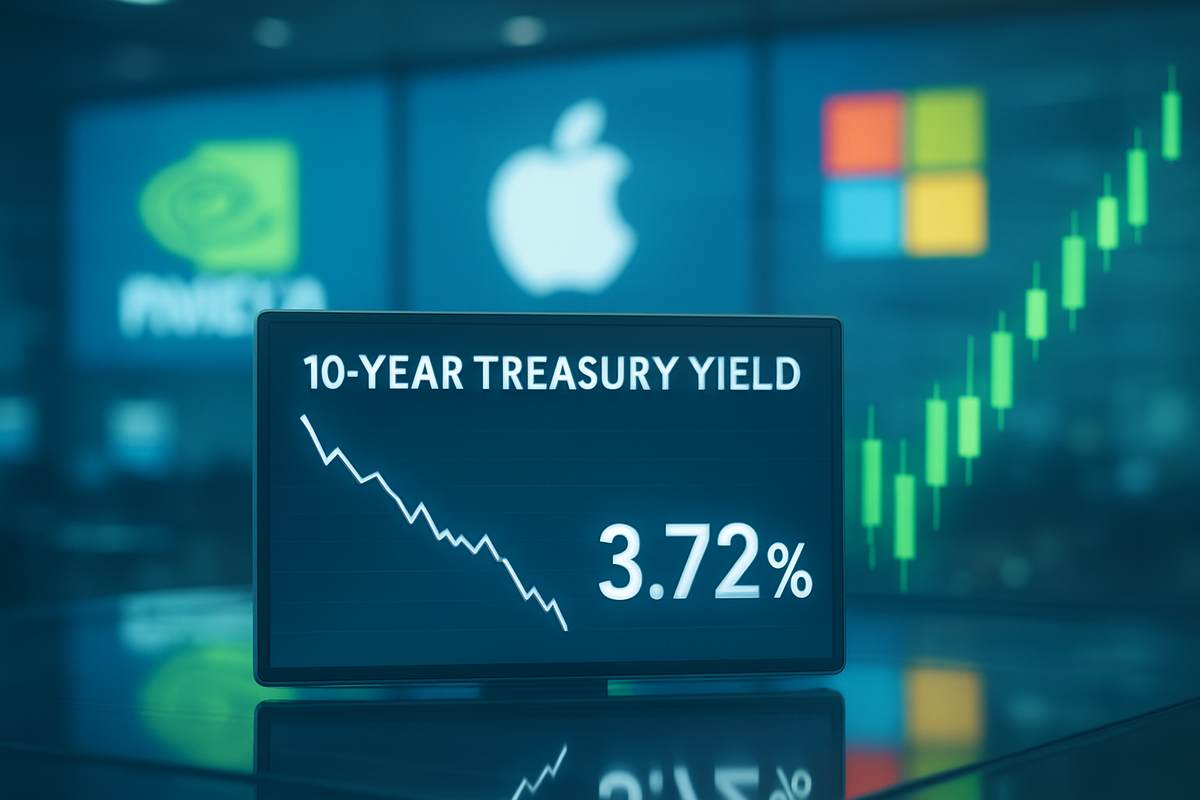
NEW YORK — The long-awaited "soft landing" for the U.S. economy appears to have finally touched down. Following the release of the March Consumer Price Index (CPI) report on April 8, 2026, financial markets witnessed a seismic shift in sentiment as inflation cooled to 2.1% year-over-year. The data, which represents a near-perfect alignment with the Federal Reserve's long-term targets, triggered a massive technical breakout in growth stocks and sent the 10-year Treasury yield plummeting below the critical 3.8% psychological threshold.
The immediate reaction across trading desks was one of unbridled optimism. With the "inflation bogeyman" seemingly defeated, investors have aggressively pivoted into high-duration assets. This movement has effectively cemented expectations for a pivot in monetary policy, with the market now pricing in a near-certainty of interest rate cuts beginning this summer.
The March Mandate: Disinflation Goes Broad-Base
The Bureau of Labor Statistics reported this morning that the CPI rose a mere 0.1% on a month-over-month basis for March 2026. This pushed the annual rate down to 2.1%, the lowest level seen in five years. Crucially, the "sticky" components of inflation—most notably shelter and core services—which had plagued the Federal Reserve throughout 2024 and 2025, finally showed significant deceleration. Core CPI, which excludes the volatile food and energy sectors, moderated to a healthy 2.3% year-over-year.
The path to this moment has been a grueling three-year journey of restrictive policy. Since the peak of the rate-hiking cycle in 2023, the Federal Open Market Committee (FOMC), led by Chair Jerome Powell, has maintained a "higher for longer" stance that many feared would eventually break the labor market. However, the 2026 data suggests a rare historical feat: bringing inflation to heel without a surge in unemployment. Following the announcement, the 10-year Treasury yield—the benchmark for global borrowing costs—slipped to 3.72%, marking its lowest point in over 24 months and signaling a definitive end to the era of emergency-level rates.
Growth Giants Lead the Technical Breakout
The collapse in yields provided the ultimate fuel for the technology sector, particularly for companies whose valuations rely on discounting future cash flows. As the 10-year yield broke its support level of 3.8%, the "Magnificent Seven" and other growth leaders saw a coordinated technical breakout.
Nvidia (NASDAQ: NVDA) led the charge, with shares surging 4.2% to new all-time highs. Investors are betting that a lower-rate environment will further accelerate capital expenditures into AI infrastructure, as the cost of financing massive data center projects begins to fall. Similarly, Microsoft (NASDAQ: MSFT) saw a 2.8% gain, as the cooling inflation data reassured enterprise customers that IT budgets could expand in the 2026 fiscal year without the threat of a recessionary pullback.
Apple (NASDAQ: AAPL) also benefited significantly, rising 3.1%. Analysts pointed to the "wealth effect" of lower mortgage rates and improved consumer credit conditions as a primary driver for hardware demand. On the flip side, traditional banking institutions like JPMorgan Chase & Co. (NYSE: JPM) saw more muted action, as narrowing net interest margins (NIMs) became a growing concern for investors, contrasting sharply with the exuberant growth seen in the tech and consumer discretionary sectors.
A Historical Pivot: The End of Restrictive Policy
This cooling of inflation is more than just a monthly data point; it represents the final piece of the puzzle for the Federal Reserve's post-pandemic recovery strategy. Historically, periods where inflation drops toward 2% while the labor market remains resilient are exceedingly rare. The current environment mirrors the "Goldilocks" economy of the mid-1990s, where productivity gains—this time driven by artificial intelligence—allowed for non-inflationary growth.
The ripple effects are already being felt across the globe. As U.S. yields fall, the dollar has begun to soften against a basket of currencies, providing much-needed relief to emerging markets and multinational corporations with heavy international exposure. This shift also places pressure on other central banks, such as the European Central Bank (ECB), to accelerate their own easing cycles to prevent their currencies from becoming overvalued against a weakening greenback.
The Road to June: What’s Next for the Fed?
All eyes are now firmly planted on the FOMC meeting in June. According to the CME FedWatch Tool, the probability of a 25-basis point rate cut in June 2026 has skyrocketed to 85% following this CPI print. Market participants are no longer asking if the Fed will cut, but rather how fast the normalization cycle will proceed.
In the short term, the market may experience a "buy the rumor, sell the news" dynamic as we approach the actual meeting. However, the fundamental shift in the 10-year yield suggests that the "neutral rate" for the economy—the rate at which growth is neither stimulated nor restricted—is likely lower than previously estimated. Investors should prepare for a strategic pivot away from cash and short-term "money market" instruments and into longer-duration equities and bonds to capture the benefits of the falling rate environment.
Market Outlook and Investor Strategy
The March 2026 CPI release will likely be remembered as the definitive turning point for this decade's economic narrative. By successfully guiding inflation back to 2.1% without a systemic collapse, the Federal Reserve has regained the credibility that was questioned during the 2021-2022 inflation spike. For the market, this provides a "clear runway" for growth stocks to continue their ascent, supported by lower discount rates and improving corporate margins.
Moving forward, investors should keep a close watch on "real-time" economic indicators like retail sales and manufacturing PMIs. While the inflation battle appears won, the risk of "undershooting" the target or seeing a cooling labor market now becomes the secondary concern. For now, the bulls are in control, and the technical breakout below 3.8% on the 10-year Treasury yield serves as a green light for a sustained rally in the months ahead.
This content is intended for informational purposes only and is not financial advice.