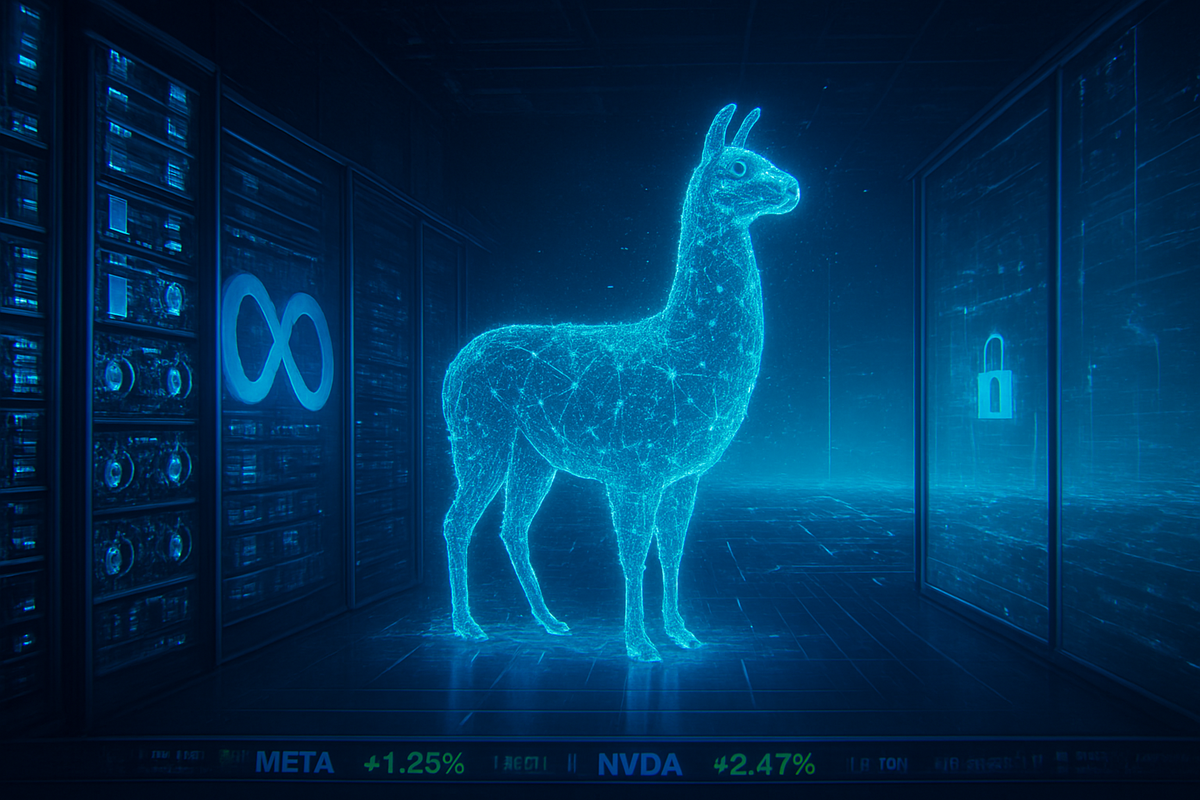
In a move that has sent shockwaves through Silicon Valley and the global financial markets, Meta (NASDAQ: META) CEO Mark Zuckerberg officially announced the release of Llama 5 today, April 8, 2026. This latest iteration of the company’s open-source large language model (LLM) represents a watershed moment in the artificial intelligence arms race. Zuckerberg, speaking from the Meta AI Connect summit, claimed that Llama 5 not only matches but exceeds the performance of leading proprietary models, including OpenAI’s GPT-5 and Google’s Gemini 2.0, across critical benchmarks in reasoning, coding, and autonomous agentic behavior.
The immediate implications for the market are profound. By providing a "frontier-class" model with open weights, Meta is effectively attempting to commoditize the very technology that its competitors are trying to sell behind expensive API paywalls. Shares of Meta rose 4.2% in early trading as investors weighed the long-term strategic advantages of Meta's "Linux of AI" strategy against the massive $45 billion capital expenditure the company has committed to its AI infrastructure over the past year.
The Dawn of Llama 5: A New Benchmark for Intelligence
The release of Llama 5 follows a meticulously planned timeline that began with the disruptive success of Llama 3 in 2024 and the multimodal breakthroughs of Llama 4 in early 2025. Unlike its predecessors, Llama 5 was trained on a state-of-the-art compute cluster powered by over 500,000 NVIDIA (NASDAQ: NVDA) Blackwell B200 GPUs. The technical specifications are staggering: the flagship model boasts over 600 billion parameters and introduces "Recursive Self-Improvement" capabilities, allowing the model to refine its own internal logic and generate high-quality synthetic data to fill gaps in its knowledge base.
Key stakeholders in this launch extend beyond Meta itself. The announcement included a collaborative "Llama 5 Launch Day" partnership with cloud giants and hardware manufacturers. Zuckerberg emphasized that Llama 5 was designed with "System 2 thinking"—a cognitive science term referring to slow, deliberate reasoning—enabling the model to solve complex multi-step problems that previously required human oversight. Initial market reactions from the developer community have been overwhelmingly positive, with early testers reporting that Llama 5’s ability to handle long-context windows (up to 5 million tokens) makes it a superior choice for enterprise-level applications compared to more restrictive proprietary alternatives.
The timeline leading to today’s announcement has been marked by Meta’s aggressive pursuit of compute power. Since late 2024, Meta has consistently increased its capital expenditure guidance, reaching an estimated $48 billion for the 2025-2026 fiscal year. This "all-in" bet on AI infrastructure has been the primary driver of Meta's strategy, moving the company from a social media giant to the world’s leading provider of foundational AI technology.
Winners and Losers in the Open AI Ecosystem
The release of Llama 5 creates a clear set of winners and losers across the technology landscape. NVIDIA (NASDAQ: NVDA) stands as a primary beneficiary, as the "Llama-fication" of the enterprise world drives insatiable demand for high-end GPUs. Similarly, hardware providers like Dell Technologies (NYSE: DELL) and Hewlett Packard Enterprise (NYSE: HPE) are poised to win, as they have spent the last two years building "AI Factories" designed specifically to run Llama models on-premise for corporations concerned about data privacy. These companies have effectively become the "arms dealers" for the open-source revolution.
Conversely, proprietary model providers like OpenAI—and its primary backer Microsoft (NASDAQ: MSFT)—face a strategic dilemma. While Microsoft benefits from hosting Llama 5 on its Azure platform, the existence of a free, high-performing alternative to GPT-5 threatens the high-margin subscription revenue OpenAI relies on. Alphabet (NASDAQ: GOOGL) also faces pressure; while its Gemini 2.0 model remains deeply integrated into the Google Workspace ecosystem, the "open" nature of Llama 5 makes it a more attractive foundation for third-party developers, potentially eroding Google's influence in the AI developer community.
Cloud providers like Amazon (NASDAQ: AMZN) and its AWS division may see mixed results. While they will profit from the massive compute hours required to host and fine-tune Llama 5, the model's efficiency on Meta’s custom MTIA silicon and other non-NVIDIA hardware could eventually lower the barriers to entry for smaller cloud competitors, increasing price competition for AI hosting services.
The Macro Significance: Commoditizing the Complement
The broader significance of Llama 5 lies in Meta’s strategy of "commoditizing the complement." By making the underlying AI model (the complement to Meta’s core advertising business) free and open-source, Meta ensures that AI development remains decentralized and that no single competitor can build a "walled garden" around the technology. This mirrors the historical precedent of the Linux operating system, which eventually became the standard for enterprise servers, or the Android operating system’s role in the mobile market.
From a regulatory perspective, Meta’s move is a double-edged sword. While it promotes competition and prevents a monopoly on "frontier" intelligence, it also raises concerns among policymakers about the safety of open-weight models. Without the ability to "turn off" the model or restrict its usage, regulators in the EU and the US are already debating whether Llama 5 should be subject to stricter oversight. However, Meta’s proactive approach in releasing "Llama Guard 4" alongside the main model—a safety layer designed to filter harmful outputs—suggests the company is attempting to lead the conversation on AI safety through transparency rather than restriction.
Furthermore, this event marks a shift in how the market values AI companies. The "moat" is no longer the model itself, but rather the data used to train it and the ecosystem built around it. Meta’s vast repositories of user interaction data across Instagram, WhatsApp, and Threads provide a feedback loop that proprietary companies find difficult to replicate at scale, particularly as Llama 5 becomes the engine behind Meta’s own "Meta AI" assistant, which now boasts over 1 billion monthly active users.
What Comes Next: The Road to AGI and Agentic Autonomy
In the short term, expect a massive wave of fine-tuned "Llama 5 variants" to flood the market, specialized for everything from medical diagnostics to legal research. The real strategic pivot will be the emergence of "Agentic AI"—systems that don't just answer questions but take actions on behalf of the user. Meta has signaled that Llama 5 is the first model specifically optimized for these agents, which could soon handle tasks like booking travel, managing supply chains, or even conducting autonomous scientific research.
The long-term challenge for Meta will be proving to investors that the $48 billion annual spend is generating a sufficient Return on Invested Capital (ROIC). While Meta’s stock has performed well, the pressure to monetize AI through increased ad efficiency or new AI-driven hardware, like the next generation of Ray-Ban Meta smart glasses, will be intense. If Llama 5 succeeds in becoming the global standard, Meta will control the infrastructure of the next generation of computing, but the path to direct profitability from the model itself remains non-linear.
Market observers should also watch for a potential response from OpenAI and Google. Rumors are already swirling that OpenAI may be forced to accelerate the release of its "Orion" project or shift toward a more open licensing model to remain competitive. The "Intelligence War" is entering a phase of rapid attrition where only those with the deepest pockets and the most robust ecosystems can survive.
Market Outlook and Final Thoughts
The release of Llama 5 is more than just a technical update; it is a declaration of war against the closed-source model of AI development. For investors, the key takeaway is that Meta has successfully transitioned from a social media company to a foundational AI infrastructure provider. The "Llama ecosystem" is now a permanent fixture of the global economy, supported by heavyweights like Dell, NVIDIA, and the major cloud providers.
Moving forward, the market will be closely watching Meta’s quarterly earnings to see how AI integration is impacting its core advertising revenue and whether its capital expenditure has reached a plateau. The next six months will be critical as we see how quickly enterprises migrate from proprietary models to Llama 5. Investors should pay close attention to the adoption rates within the Fortune 500 and any new regulatory hurdles that may arise as "frontier" AI becomes widely accessible.
Ultimately, Mark Zuckerberg’s vision of an open AI future is being realized. Whether this leads to a democratic explosion of innovation or a race to the bottom in AI safety remains to be seen, but for now, Meta has firmly seized the lead in the battle for AI dominance.
This content is intended for informational purposes only and is not financial advice.