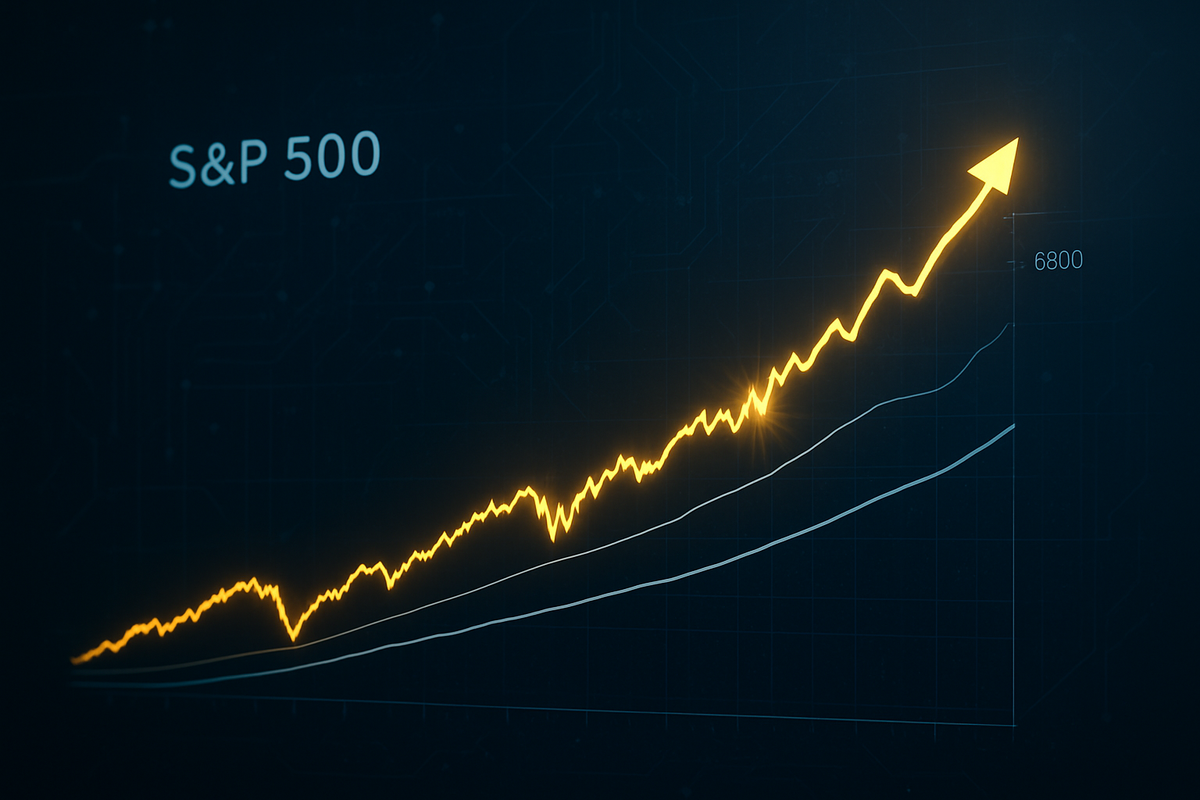
The financial world is buzzing this week as the S&P 500 (SPX) has officially triggered one of the most significant technical indicators in modern market history. For the first time since the post-pandemic recovery, the index has formed a "Golden Cross" on the weekly chart—a rare occurrence where the 50-week moving average crosses above the 200-week moving average. This structural shift in momentum is being hailed by technical analysts as the definitive "green light" for the next leg of the secular bull market, with many now raising their year-end price targets to a staggering 6,500.
This breakout signifies more than just a short-term rally; it represents the market’s final absorption of the inflationary shocks and interest rate volatility that defined the 2022–2024 era. As of April 8, 2026, the S&P 500 is trading firmly above previous psychological resistance levels, buoyed by a "Goldilocks" economic environment where inflation has settled near 2% and the Federal Reserve has successfully navigated a soft landing. For investors, the signal suggests that the current expansion phase may have years of runway left, driven by a rare combination of stable monetary policy and transformative technological growth.
The Path to the Cross: A Three-Year Journey
The journey to this weekly Golden Cross has been a grueling three-year climb. Following the bear market of 2022 and the choppy "recovery" of 2023, the market entered 2024 and 2025 with significant skepticism. However, as corporate earnings continued to outperform expectations—specifically in the technology and artificial intelligence sectors—the moving averages began their slow convergence. The 50-week moving average, which tracks the intermediate trend, spent much of 2025 accelerating upward, finally overtaking the long-term 200-week moving average this week.
Historically, the weekly Golden Cross is a far more reliable indicator than its daily counterpart. Previous occurrences in 2003, 2009, 2012, and 2020 all preceded multi-year bull runs that saw double-digit annualized returns. Market veterans like Ed Yardeni and technical strategists at Evercore ISI have been vocal about the "Roaring 2020s" thesis, arguing that productivity gains from AI are now showing up in the bottom lines of the world's largest companies. The timeline of this breakout aligns perfectly with the Federal Reserve's shift to a "neutral" interest rate policy, currently estimated between 3.00% and 3.50%.
The Titans of 6,500: Winners in the New Paradigm
The primary beneficiaries of this technical breakout are the same "megacap" titans that have spearheaded the AI revolution. Nvidia Corp. (NASDAQ: NVDA) remains the quintessential winner, as it transitions from its Blackwell chip architecture to the next-generation "Rubin" platform. With "AI Sovereignty" becoming a geopolitical necessity, Nvidia’s data center dominance continues to provide the foundational growth for the S&P 500. Analysts suggest that as the index marches toward 6,500, Nvidia’s high-margin hardware will be the primary engine of aggregate earnings growth.
Microsoft Corp. (NASDAQ: MSFT) and Apple Inc. (NASDAQ: AAPL) also stand to win significantly from this momentum shift. Microsoft has successfully moved from the "hype" phase of AI to the "monetization" phase, with Copilot and Azure services becoming staple utilities for global enterprises. Meanwhile, Apple is reaping the rewards of its "Apple Intelligence" super-cycle. As the iPhone 17 and 18 cycles take hold in 2026, the company’s hardware revenue is complementing its high-margin services, providing a stable "valuation floor" for the broader index. Other high-performers likely to see continued inflows include Broadcom Inc. (NASDAQ: AVGO) and Amazon.com Inc. (NASDAQ: AMZN), both of which are deeply integrated into the infrastructure of the digital economy.
A New Era of Secular Expansion
The significance of the 6,500 target and the weekly Golden Cross extends beyond simple price action. It fits into a broader industry trend of "technological deflation," where AI-driven efficiencies allow companies to maintain high margins despite stable labor costs. This event effectively ends the "rate hike anxiety" that plagued the previous five years. By comparing this to the 2009 breakout, economists note that we are moving away from a market supported by "emergency" liquidity toward one supported by genuine fundamental growth.
Ripple effects are already being felt across the financial landscape. As the S&P 500 breaks out, smaller-cap stocks and mid-market firms are also beginning to see a "catch-up" trade, as the cost of capital stabilizes and risk appetite returns to the broader market. Regulatory shifts are also in focus, as the government seeks to balance the explosive growth of AI leaders with the need for competitive markets. However, the prevailing sentiment is that the current administration's focus on domestic semiconductor manufacturing and energy independence is providing a tailwind that previous bull markets lacked.
Looking Ahead: The Road to 7,000?
While 6,500 is the immediate target, the weekly Golden Cross suggests that the momentum could carry the S&P 500 even higher in the long term. The short-term challenge will be the potential for "overbought" conditions, which could lead to healthy consolidations or "backtests" of the 6,000 level. Strategic pivots for investors are already underway, shifting from defensive cash positions and high-yield savings back into growth equities and tech-heavy ETFs as the fear of a "bubble" is replaced by the fear of missing out (FOMO).
Scenarios for the remainder of 2026 include a "melt-up" toward the 6,700 level if upcoming earnings seasons continue to show double-digit EPS growth. However, market participants must remain vigilant for any resurgence in geopolitical tensions or unexpected energy price spikes that could disrupt the 2% inflation target. The key for the next six months will be the "breadth" of the rally—whether sectors like industrials and financials can join the tech giants in pushing the index toward its next major milestone.
The Market Minute: Final Takeaways
The triggering of the weekly Golden Cross on the S&P 500 marks a historic turning point in the post-pandemic financial era. It confirms that the structural foundation of the market is stronger than many anticipated, supported by a neutral Fed and a technological revolution that is only just beginning to mature. The 6,500 target is no longer a "bull-case" outlier but is fast becoming the consensus baseline for a market that has rediscovered its upward trajectory.
Investors should watch for the "confirmation" of this breakout in the coming weeks, looking for sustained volume and a broadening of participation across the 11 sectors of the S&P 500. While the "Big Three" of NVDA, MSFT, and AAPL will continue to lead, a truly healthy march to 6,500 will require a wider range of winners. As we move further into 2026, the focus will remain on whether the "Roaring 2020s" can maintain its pace or if the market will eventually need to take a breather from its golden ascent.
This content is intended for informational purposes only and is not financial advice