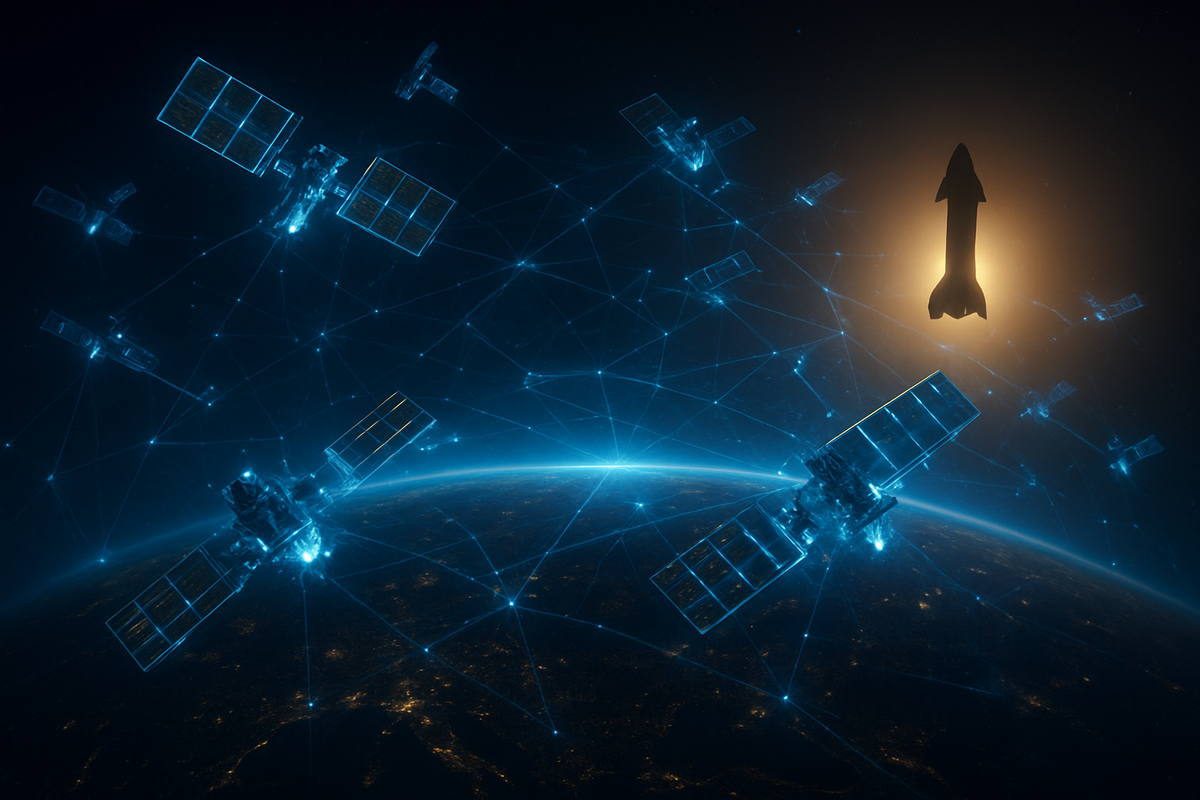
The dawn of a new industrial era has arrived with the finalized merger of SpaceX and xAI, creating a corporate behemoth valued at a staggering $1.25 trillion. This unprecedented consolidation, announced in February 2026, has birthed "Orbital Intelligence," a strategic initiative aimed at moving the world’s most demanding artificial intelligence computations off-planet. By integrating SpaceX’s Starship-enabled launch dominance with xAI’s advanced "Grok" large language models, the new entity seeks to bypass the terrestrial energy and cooling constraints that have begun to stifle the AI revolution on Earth.
The immediate implications for the market are seismic. With an Initial Public Offering (IPO) rumored for June 2026, the merged entity—currently operating under the SpaceX banner—is poised to become the most valuable aerospace and intelligence company in history. Investors are bracing for a shift in the global data infrastructure landscape as the promise of space-based data centers offers a solution to the "AI Energy Wall," a phenomenon where the power demands of massive server farms have begun to outstrip the capacity of traditional national grids.
The Birth of Orbital Intelligence: A Strategic Timeline
The merger was officially codified on February 2, 2026, after months of speculation following the successful maiden flight of SpaceX’s Starship Version 3. This third-generation heavy-lift vehicle was the missing piece of the puzzle, providing the necessary payload capacity to launch thousands of "Grok-Sats"—heavy, GPU-laden satellites designed for high-density computation in orbit. Elon Musk, serving as the CEO of the combined venture, described the move as a vertical integration of the "innovation engine," moving from mere connectivity to active, autonomous intelligence in the stars.
The timeline leading to this moment was marked by several critical milestones. Throughout 2025, xAI began integrating its neural networks directly into the Starlink constellation to optimize satellite routing, a move that hinted at deeper architectural synergies. By late 2025, SpaceX had secured massive contracts for radiation-hardened hardware, signaling a pivot from simple communication relays to complex processing nodes. When the $1.25 trillion merger was finalized, it valued SpaceX at approximately $1 trillion and xAI at $250 billion, creating a powerhouse that owns the entire "intelligence stack," from the rocket engine to the inference engine.
Industry reaction was initially one of shock, followed by a frantic reshuffling of capital. Analysts at major firms have noted that the "Orbital Intelligence" model solves the two greatest hurdles for AI scaling: energy and heat. In space, solar power is roughly eight times more efficient due to the lack of atmospheric interference, and the vacuum of space provides a natural, albeit technically complex, environment for radiative cooling. This allows the merged entity to scale its computing power without competing for the same electricity that powers homes and factories on Earth.
Market Winners and Industry Upheaval
The merger has created clear winners and prompted a defensive scramble among tech giants. NVIDIA (NASDAQ: NVDA) remains the primary beneficiary in the short term. Musk confirmed in March 2026 that the company has placed record-breaking orders for NVIDIA’s specialized, radiation-hardened Blackwell chips. As the exclusive supplier for the "Grok-Sat" architecture, NVIDIA’s position as the backbone of the AI era is further solidified, pushing their own valuation to new heights as they pivot toward space-qualified silicon.
Alphabet Inc. (NASDAQ: GOOGL) is also standing on the brink of a massive financial windfall. As an early investor in SpaceX, Alphabet’s estimated 7% stake could be worth upwards of $120 billion following a successful IPO. This provides Google with a significant "war chest" to fund its own competing AI initiatives, even as it faces a formidable new rival in the cloud space. Conversely, Microsoft (NASDAQ: MSFT) finds itself in a complex position. While it has long been a partner for SpaceX's ground-based Azure Space services, the rise of an independent "Orbital AI" utility creates a direct conflict with Microsoft's traditional cloud dominance, forcing a potential strategic pivot for the Redmond giant.
Meanwhile, Amazon (NASDAQ: AMZN) is reportedly in "crisis mode." Its Project Kuiper, intended to compete with Starlink, is now years behind in the race for orbital computing. Reports suggest Amazon is exploring an acquisition of Globalstar (NYSE: GSAT) to bolster its spectrum and ground infrastructure, while Jeff Bezos’s Blue Origin has fast-tracked "Project Sunrise," a direct competitor to the Orbital Intelligence data center model. The race for the "high ground" in data processing has effectively turned the space race into a cloud computing war.
Breaking the Terrestrial Energy Wall
The significance of this merger extends far beyond a simple corporate consolidation; it represents a fundamental shift in how humanity manages its digital footprint. For years, the tech industry has warned of the "AI Energy Wall." In 2025, data center power consumption was estimated to account for nearly 4% of global electricity use. By moving the "compute" to orbit, SpaceX and xAI are effectively decoupling the growth of intelligence from the physical limits of Earth’s environment. This bypasses the multi-year permitting delays and "Not In My Backyard" (NIMBY) opposition that have plagued massive terrestrial server farms in Virginia and Ireland.
This event mirrors the historical shift from local server rooms to the cloud in the early 2010s, but on a cosmic scale. Regulatory bodies are now playing catch-up, as the current Outer Space Treaty and FAA regulations were not designed for a "Sovereign Intelligence" orbiting the planet. Questions regarding data sovereignty, orbital debris from dense compute-nodes, and international law are being debated in the UN. However, the economic gravity of the $1.25 trillion entity is likely to force a new set of international standards tailored to the "Space-AI" era.
The Road to 'Project Apex' and Beyond
The next phase for the SpaceX-xAI powerhouse is "Project Apex"—the widely publicized plan for a June 2026 IPO. Unlike traditional public offerings, insiders suggest Musk intends to allocate up to 30% of the offering to retail investors, aiming to leverage the immense brand loyalty of his follower base. Bankers are targeting a public valuation of $1.5 trillion to $1.75 trillion, which would make it the largest IPO in history, surpassing even the 2019 Saudi Aramco debut.
In the short term, the market should watch for the deployment of the first 1,000 Grok-Sats. The success of these initial nodes will determine if the "Orbital Intelligence" model is technically viable or if thermal management in the vacuum of space proves too costly. Strategic pivots are also likely; Intel (NASDAQ: INTC) has already joined the "Terafab" initiative at Giga Texas to manufacture custom silicon for the merged entity, signaling a long-term goal of reducing dependence on third-party chipmakers.
Summary for the Forward-Looking Investor
The SpaceX and xAI merger is the defining financial event of the mid-2020s. By combining the means of launch with the means of intelligence, Elon Musk has created a company that exists outside the traditional constraints of the terrestrial economy. The creation of "Orbital Intelligence" marks the end of the era of earth-bound data centers and the beginning of a decentralized, space-based utility.
Investors should closely monitor the SEC filings for "Project Apex" in the coming weeks. The primary metrics for success will not just be launch frequency, but the "Floating Point Operations Per Second" (FLOPS) available in orbit and the cost-per-inference compared to terrestrial providers like AWS or Google Cloud. As we move toward the June IPO, the focus will remain on whether this $1.25 trillion bet can truly turn the stars into the world’s most powerful supercomputer.
This content is intended for informational purposes only and is not financial advice.