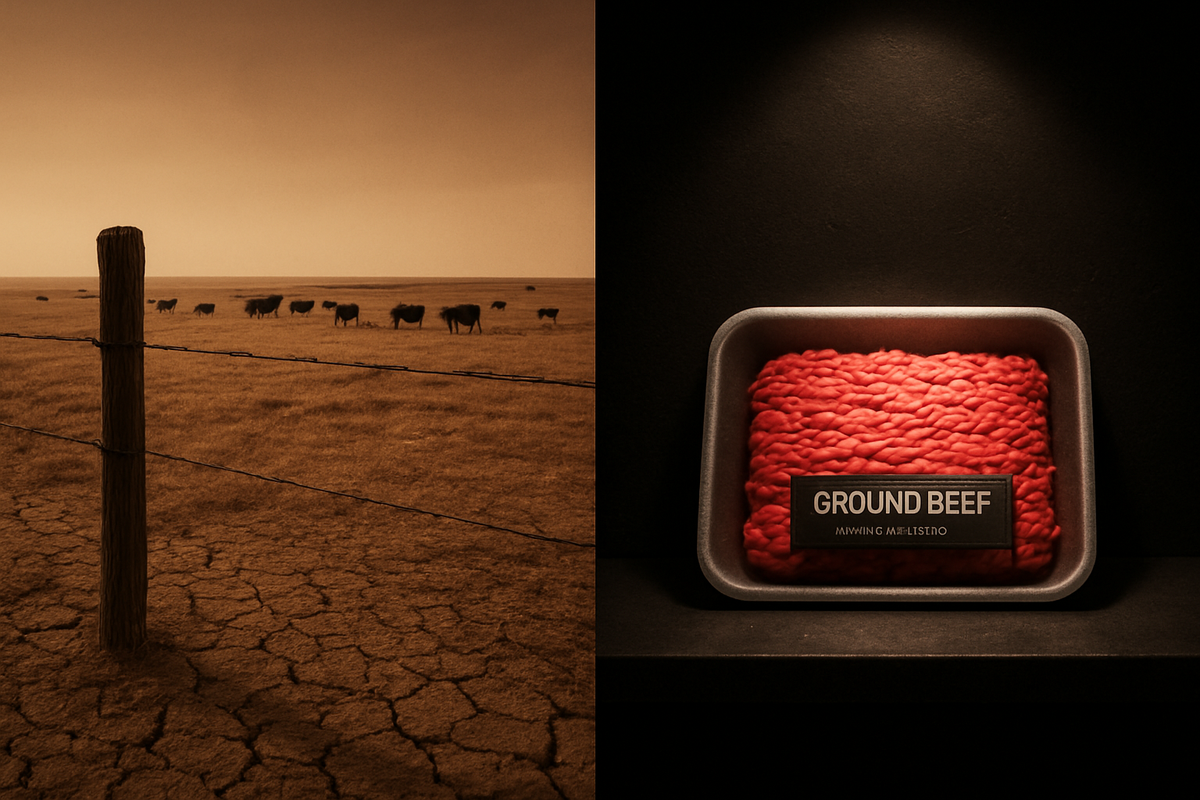
The American dinner table is undergoing a radical transformation as a “perfect storm” of economic and environmental factors has pushed the U.S. livestock market into its most severe crisis in generations. As of April 9, 2026, the national cattle herd has plummeted to its lowest level since the Truman administration, forcing consumers to rethink their reliance on beef. With ground beef prices soaring past $6.70 per pound, what was once the most accessible protein for the middle class is rapidly becoming a luxury item, reserved for special occasions rather than Tuesday night tacos.
This crisis is the result of a compounding set of pressures: a decade-long cycle of drought, high interest rates, and a historic liquidation of the female breeding herd. Despite a stabilization in feed costs—with corn currently trading at a more manageable $4.67 per bushel—the biological reality of cattle ranching means that supply cannot be "turned back on" overnight. The immediate implication for the market is a period of "protein protectionism," where meatpackers face crushing margins and retailers are forced to innovate with blended products to keep costs within reach of the average consumer.
The Shrinking Herd: A Decade of Contraction
The current state of the market is nothing short of historic. According to the USDA’s most recent inventory reports, the total U.S. cattle herd now stands at 86.2 million head, the smallest since 1951. More alarmingly, the beef cow herd—the engine of future production—has hit its lowest point since 1961, at just 27.6 million head. This massive contraction didn't happen in a vacuum; it is the culmination of eight consecutive years of herd reduction driven by a persistent "mega-drought" across the Great Plains and the Southwest that destroyed grazing lands and forced ranchers to sell off their breeding stock early.
The timeline leading to this crisis reached a boiling point in late 2024 and 2025, when high interest rates made it prohibitively expensive for ranchers to hold onto cattle or expand their operations. Even as corn prices dropped from their 2022 peaks to the current $4.67 per bushel, the relief came too late for many. Ranchers are now entering a "retention phase," keeping heifers (young females) for breeding rather than sending them to slaughter. While this is necessary for long-term recovery, it creates a "supply vacuum" in the short term, driving prices to the record highs seen today.
The industry's reaction has been one of consolidation and survival. Major meatpackers, who enjoyed record profits during the pandemic supply chain disruptions, are now finding the tables turned. With fewer cattle available, the competition for "shackle space" has reversed; packers are now paying premiums to secure limited livestock while their massive processing plants sit underutilized, leading to a wave of operational cuts across the Midwest.
Winners and Losers in the Protein Pivot
The financial fallout of this crisis is being felt most acutely by the giant meat processing firms. Tyson Foods (NYSE: TSN) has been forced to navigate some of its tightest margins in decades, projecting significant operating losses in its beef segment for the fiscal year. The company recently took the drastic step of closing its major slaughter facility in Lexington, Nebraska, a move signaling that the industry expects the supply shortage to last for years rather than months. Similarly, JBS S.A. (OTCMKTS: JBSAY) has reported hundreds of millions in losses from its North American beef operations, prompting the Brazilian-based conglomerate to pivot its capital investments toward Middle Eastern and Asian markets to offset the domestic U.S. slump.
However, where the traditional meatpackers are struggling, some defensive players are finding opportunities. Hormel Foods (NYSE: HRL) has managed to maintain a more stable position by focusing on branded, value-added products that are less susceptible to the volatility of raw commodity prices. By divesting from lower-margin segments like turkey and doubling down on "ready-to-eat" brands, Hormel is proving more resilient to the raw beef price spike.
On the retail side, the "Big Box" stores are taking matters into their own hands. Walmart Inc. (NYSE: WMT) and Costco Wholesale Corp. (NASDAQ: COST) have accelerated their vertical integration efforts. Walmart’s new processing facility in Olathe, Kansas, represents a strategic move to bypass traditional middlemen and secure a direct line of supply for its "Great Value" beef products. For these retail giants, the goal is no longer just price—it’s guaranteed availability for a dwindling resource.
A Structural Shift in the American Diet
The wider significance of this crisis lies in the potential permanent shift in consumer behavior. Analysts are calling this the "Protein Pivot," as middle-income families increasingly trade down from beef to poultry and pork. This fits into a broader industry trend where beef is no longer a commodity but a specialty product. The ripple effects are being felt by competitors like the Kroger Co. (NYSE: KR), which has had to revamp its meat departments to feature "blended" proteins—products that mix ground beef with plant-based fillers or mushrooms to keep the price point below the psychological $5.00 barrier.
Regulatory pressures are also mounting. In Washington, the Biden administration’s ongoing antitrust probe into the "Big Four" meatpackers has gained new momentum as lawmakers look for scapegoats for high grocery bills. To provide immediate relief, the federal government recently moved to quadruple beef import quotas from South America. While this helps provide lean beef for the processing of burgers, it has angered domestic cattlemen who argue that importing foreign beef further disincentivizes U.S. ranchers from rebuilding their own herds.
Historical precedents for this are few and far between. Not since the post-WWII era has the American beef industry seen such a drastic reduction in scale relative to the population. The 1970s saw a similar price spike, but it was driven by grain shortages; today’s crisis is structural, rooted in the biological limitations of a shrinking biological "factory"—the American cow.
The Road to Recovery: 2028 and Beyond
Looking ahead, the road to "normal" beef prices is likely measured in years, not quarters. In the short term, we can expect continued volatility as ranchers struggle with high capital costs for herd rebuilding. A strategic pivot is already underway among producers who are shifting toward "regenerative grazing" and higher-efficiency genetics to produce more meat from fewer animals. However, the market opportunity now lies in alternative proteins and premium "niche" beef that can justify the higher price point to the affluent consumer.
Potential scenarios for late 2026 and 2027 include a "double-bottom" in supply if a secondary drought hit or if interest rates remain "higher for longer." Conversely, if the current retention of heifers proceeds without interruption, we may see the first signs of supply relief by early 2028. Investors should watch for a "shakeout" among smaller, independent processors who lack the capital to survive these lean years, potentially leading to even further consolidation by the giants like Tyson and JBS once the cycle turns.
Summary: A Market in Transition
The 2026 livestock crisis is more than just a temporary spike in food prices; it is a fundamental reordering of the U.S. agricultural economy. The "perfect storm" of record-low inventory and structural economic shifts has effectively ended the era of cheap American beef. Key takeaways for investors include the precarious position of traditional meatpackers and the growing importance of vertical integration among major retailers like Walmart.
Moving forward, the market will be defined by scarcity. Investors should keep a close eye on quarterly "Cattle on Feed" reports and any shifts in USDA import policies. As beef becomes a luxury, the companies that can successfully manage supply chains or offer affordable alternatives will be the ones to lead the next era of the food industry. For the consumer, the "golden age" of the affordable steak may be a relic of the past, replaced by a more expensive, resource-conscious future.
This content is intended for informational purposes only and is not financial advice.