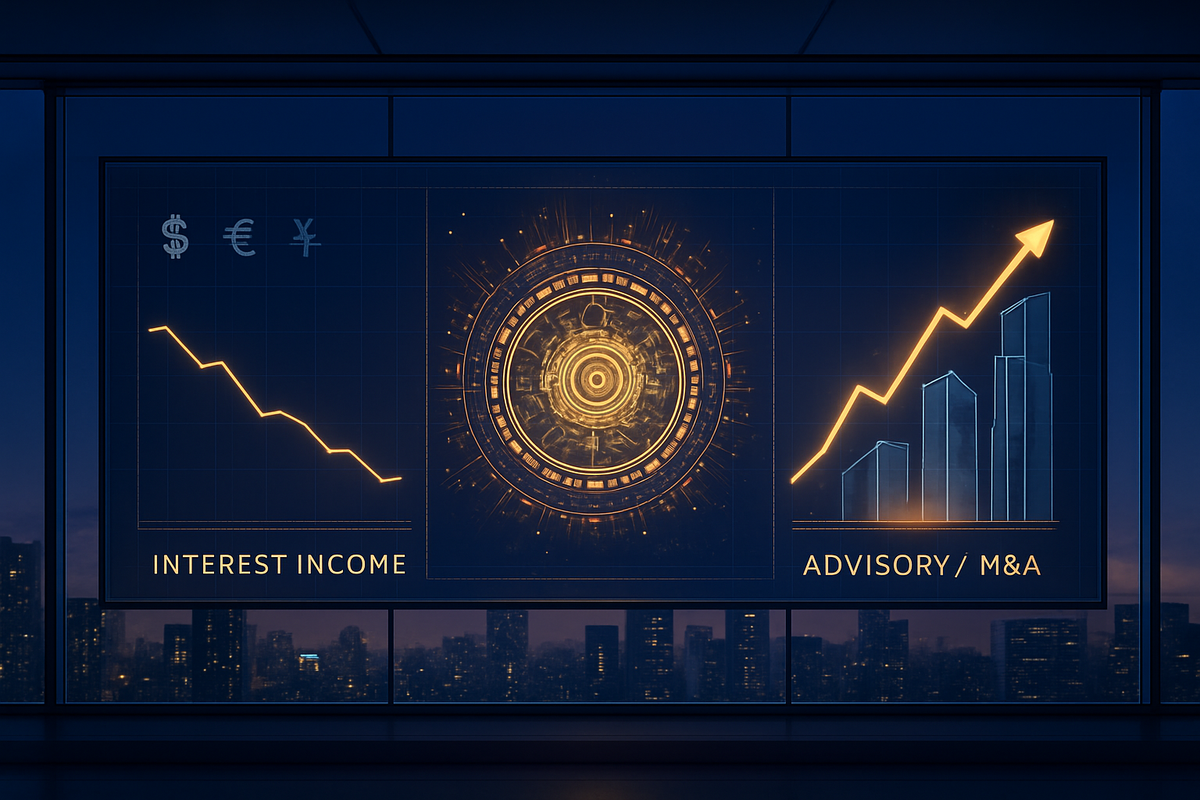
As the first quarter of 2026 draws to a close, the narrative dominating the financial district has undergone a profound transformation. For the better part of the last three years, the banking sector’s profitability was tethered to the whims of the Federal Reserve and the lucrative spreads of Net Interest Income (NII). However, as we approach the mid-April earnings kick-off, a new engine of growth—dubbed the "Fee Machine"—has taken center stage, signaling a renaissance in investment banking and M&A advisory that is rapidly replacing interest revenue as the primary driver of Wall Street’s bottom line.
This structural pivot is most visible in the anticipated performance of the industry’s titans, JPMorgan Chase (NYSE: JPM) and Goldman Sachs (NYSE: GS). With interest rates finally settling into a "neutral zone" between 3.50% and 3.75%, the "easy money" generated from lending spreads has plateaued. In its place, an "Innovation Supercycle" characterized by massive consolidation in AI infrastructure and biotechnology is fueling a deal-making revival not seen in years, fundamentally altering the profit architecture of global banking.
The 2026 Earnings Shift: A Tale of Two Tickers
The upcoming earnings releases—scheduled for April 13 for Goldman Sachs and April 14 for JPMorgan—are expected to validate this shift. Analysts are projecting a robust quarter for both, but for vastly different reasons than in 2024. For Goldman Sachs (NYSE: GS), the Q1 2026 results represent a "Strategic Renaissance." Having spent much of 2025 offloading its underperforming consumer banking ventures, the firm enters this earnings season as a pure-play investment banking powerhouse. Zacks estimates suggest Goldman’s investment banking fees could surge by more than 26% year-over-year, reaching approximately $2.42 billion for the quarter. This is bolstered by an advisory backlog that hit a four-year high in January, as corporate boardrooms regained the confidence to execute large-scale strategic shifts.
Meanwhile, JPMorgan Chase (NYSE: JPM) continues to demonstrate the defensive power of its "Fortress" balance sheet, even as its NII engine cools. The bank has guided for a full-year NII of roughly $104.5 billion, a significant figure but one that indicates a plateauing of growth compared to the record-breaking jumps of the high-rate era. To maintain its dominance, JPMorgan is leaning heavily into its Commercial & Investment Bank (CIB) division. By leveraging its massive scale, JPM is clearing a substantial backlog of deals from late 2025, with earnings per share (EPS) estimates sitting between $5.37 and $5.50. The transition from interest-rate sensitivity to transaction-based fees is a deliberate move to insulated the bank from the normalization of credit and the tightening of net interest margins.
Winners and Losers in the New Transaction Era
In this "Fee Machine" environment, the clear winners are the bulge-bracket firms with deep roots in advisory and capital markets. Goldman Sachs is positioned as the "high-beta" winner, meaning its stock is poised to react most aggressively to the uptick in deal volume. Because Goldman has shed its retail baggage, its profitability is now more directly tied to the success of its M&A and underwriting desks. JPMorgan, while less sensitive to individual deal fluctuations, wins through sheer volume, using its global footprint to capture the lion's share of the "Innovation Supercycle" fees.
Conversely, the potential losers in this landscape are the mid-sized and regional banks that lack significant investment banking arms. These institutions remain heavily dependent on traditional lending and are currently squeezed by higher deposit costs and stabilizing loan yields. Furthermore, firms that failed to invest in specialized sectors like AI infrastructure or biopharma advisory may find themselves left behind. Private equity firms, however, are emerging as secondary winners; with an estimated $3 trillion to $4.3 trillion in "dry powder" and more predictable financing costs, they are finally deploying capital, providing a steady stream of transaction fees to the big banks that facilitate these acquisitions.
The Wider Significance: An Innovation-Driven Supercycle
The 2026 M&A revival differs fundamentally from the speculative frenzy of 2021. Today’s activity is driven by what analysts call "capability-driven M&A." Corporations are no longer just buying growth; they are buying the "plumbing" of the future economy. This includes massive consolidations in the semiconductor and data center sectors to support AI compute demands, as well as a surge in biopharma deals as major pharmaceutical companies face a $200 billion "patent cliff." These are not speculative bets but strategic necessities for survival in an AI-integrated world.
This trend is further accelerated by a shifting regulatory landscape. In early 2026, a more lenient antitrust environment has allowed several "mega-mergers" (deals exceeding $10 billion) to proceed with less regulatory friction than in previous years. This policy shift has acted as a "tailbeat" for the industry, encouraging CEOs who were previously hesitant to engage in large-scale consolidation for fear of lengthy legal battles. Historically, such periods of regulatory relaxation combined with stable interest rates have preceded prolonged bull markets for investment banking fees.
Looking Ahead: The Path to 2027
In the short term, the primary challenge for these banks will be managing "credit normalization." As the "free money" era of the early 2020s fades further into the past, JPMorgan and Goldman must navigate rising net charge-offs (NCOs). JPM’s credit card charge-off rate is projected to rise to 3.4% in 2026, a sign that consumer stress is a lingering headwind. However, the long-term outlook remains bullish for the fee-based model. As long as the AI infrastructure build-out continues and private equity remains flush with cash, the transaction pipeline is expected to remain robust through the end of 2026.
Strategic pivots will be required for banks to maintain this momentum. Expect to see further investment in "sector-specialist" advisory teams, particularly in renewable energy and advanced manufacturing. The banks that can best advise on the complex cross-border regulations of the 2026 economy will likely command the highest premiums. The market opportunity is vast, but it requires a shift from the passive collection of interest to the active engineering of corporate strategy.
Summary and Final Thoughts
The Q1 2026 earnings season marks a historic pivot for Wall Street. The "Fee Machine" is back, and it is firing on all cylinders as M&A and investment banking fees take the baton from Net Interest Income. While the era of record-breaking NII growth has ended, the resurgence of deal-making—fueled by AI, biopharma, and a more favorable regulatory climate—is providing a high-margin replacement that could sustain profitability for years to come.
For investors, the key takeaways are clear: watch the deal backlogs and the advisory fee guidance. While credit normalization remains a risk to monitor, the transition to transaction-based profitability suggests a more dynamic and potentially more lucrative phase for the banking sector. As Goldman Sachs and JPMorgan report their findings in the coming days, the market will be looking for confirmation that the "Innovation Supercycle" has truly arrived to stay.
This content is intended for informational purposes only and is not financial advice.