Guideline Highlights:
- The first-ever clinical practice guideline on cardiovascular-kidney-metabolic (CKM) syndrome from the American Heart Association and the American College of Cardiology details staging to assess how a person’s kidneys, metabolism and heart are functioning. Higher stages of CKM syndrome are associated with a greater burden of serious health conditions, such as Type 2 diabetes, chronic kidney disease, and a higher risk of cardiovascular disease and mortality.
- The guideline reviews CKM syndrome risk factors including overweight/obesity, pre-diabetes/Type 2 diabetes, high blood pressure and abnormal lipids, as well as chronic kidney disease.
- Comprehensive recommendations include screening, prevention and treatment for people with or at risk of developing CKM syndrome. Healthy lifestyle behaviors; medications, including GLP-1-based therapies and SGLT2 inhibitors; and/or metabolic and bariatric surgery, when appropriate, are recommended with the goal of preventing, managing and potentially reversing CKM syndrome progression.
Embargoed until 1:00 p.m. CT/2:00 p.m. ET Tuesday, June 9, 2026
DALLAS and WASHINGTON - June 9, 2026 (NEWMEDIAWIRE) - The American Heart Association and the American College of Cardiology, along with two other leading medical organizations have developed the first-ever guideline aimed at preventing and managing cardiovascular-kidney-metabolic (CKM) syndrome, an interconnected set of health conditions that significantly increase the risk of multiorgan complications and negative cardiovascular outcomes. Nearly 90% of U.S. adults have at least one CKM syndrome risk factor, including excess weight, high blood pressure, abnormal lipids, high blood glucose (sugar) or reduced kidney function.
Recommendations to help clinicians and individuals identify CKM syndrome risk earlier and take action to protect long-term heart, metabolic and kidney health are detailed in this new clinical practice guideline, published today in the American Heart Association’s flagship peer-reviewed journal Circulation and in JACC, the flagship journal of the American College of Cardiology.
According to recent statistics from both the American Heart Association and the American College of Cardiology, 40% of U.S. adults and 21% of children and adolescents in the U.S. have obesity, defined as excess body fat that presents a risk to health. Obesity is a risk factor for high blood pressure, Type 2 diabetes, metabolic dysfunction, cardiovascular disease and kidney disease.
“Heart, kidney, and metabolic conditions don’t occur in isolation—they are deeply connected,” said Chiadi E. Ndumele, M.D., Ph.D., M.H.S., FAHA, chair of the guideline writing committee and the director of obesity and cardiometabolic research at Johns Hopkins School of Medicine in Baltimore. “This guideline calls for earlier screening and care, focusing on prevention and coordinated action to reduce the risk of cardiovascular disease before serious complications develop or a major cardiac event occurs.”
What are the stages of cardiovascular-kidney-metabolic (CKM) syndrome?
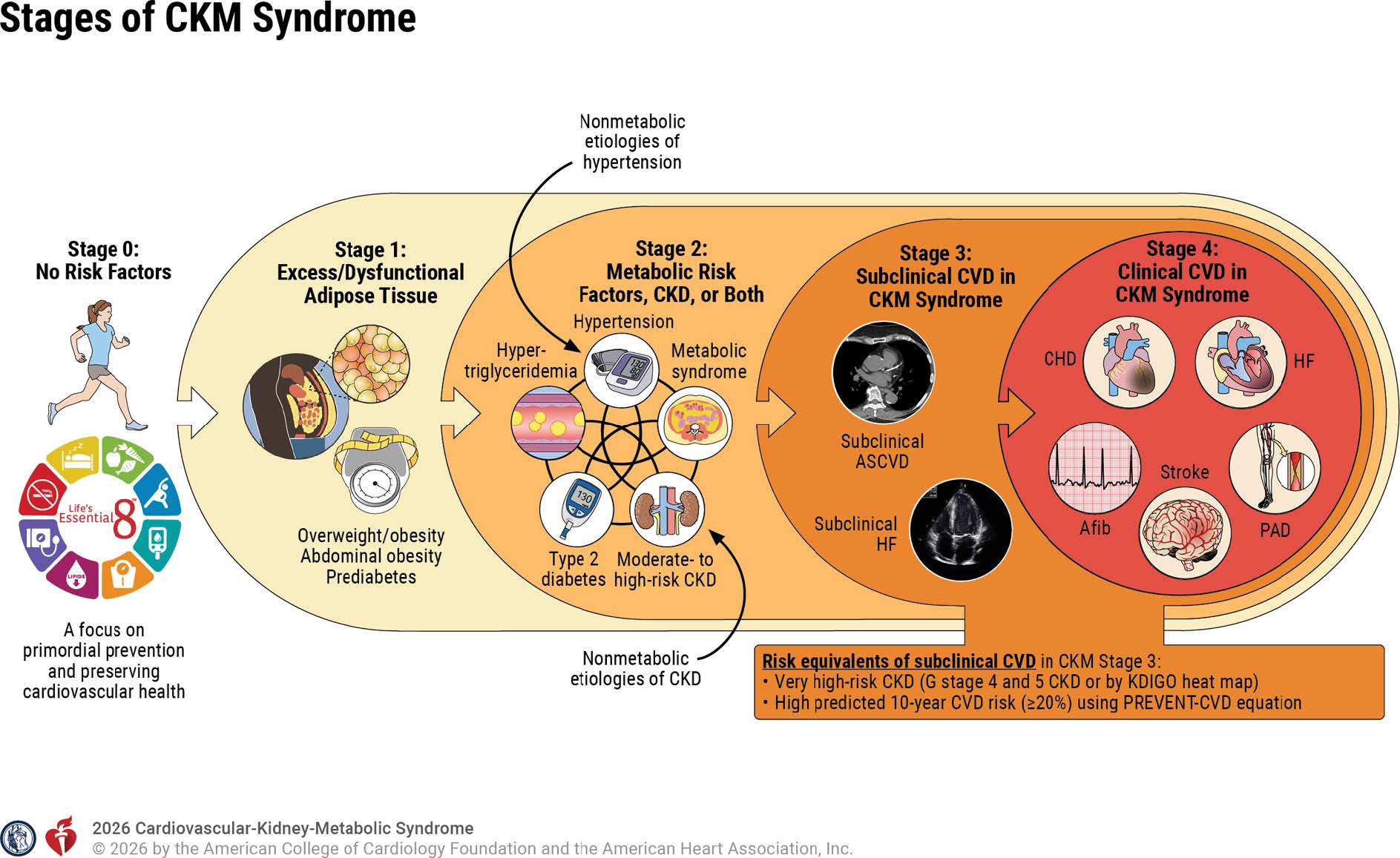
There are four stages of CKM syndrome. These stages identify risk and tailor prevention strategies to slow—or even reverse—progression of CKM syndrome:
- Stage 1: individuals with overweight/obesity or prediabetes, but without other metabolic risk factors, kidney disease or cardiovascular disease
- Stage 2: includes people with one or more metabolic risk factors (such as high blood pressure, abnormal lipid levels, Type 2 diabetes or metabolic syndrome) and/or kidney disease, but without cardiovascular disease
- Stage 3: people with subclinical (asymptomatic) cardiovascular disease and CKM risk factors; or those with the risk equivalents of very-high-risk chronic kidney disease or high predicted 10-year risk of cardiovascular disease (based on the PREVENT-CVD equations)
- Stage 4: individuals with diagnosed cardiovascular disease (coronary heart disease, heart failure, stroke, peripheral artery disease and/or atrial fibrillation) with overweight or obesity, other metabolic risk factors or kidney disease
Key highlights from the guideline include:
- Improved risk assessment using the Predicting Risk of cardiovascular disease EVENTs (PREVENT) equations to estimate 10- and 30-year risk for cardiovascular disease, which can help guide individualized lifestyle and treatment plans. PREVENT includes kidney and metabolic health factors in the equations for a more comprehensive and precise estimation of risk compared with previous tools.
- Screening for social factors that affect health, including food insecurity, housing instability and financial strain, is also recommended to identify individuals at higher risk of developing CKM syndrome.
- Coordinated interdisciplinary care and healthy lifestyle behaviors, including attention to physical activity, nutrition, weight, blood pressure, blood sugar and cholesterol, are emphasized to prevent and manage CKM syndrome.
- In conjunction with lifestyle management, additional treatment options for CKM syndrome include medications and surgical therapies, such as medications to manage blood pressure, cholesterol, blood sugar and weight, to protect the heart and kidneys. For the first time, GLP-1-based therapies are recommended for select individuals with obesity and/or Type 2 diabetes, and other risk factors for cardiovascular disease to reduce the risk of cardiac events. Metabolic and bariatric surgery may also be used to treat CKM syndrome.
What should people do to prevent CKM syndrome?
The guideline underscores that lifestyle modification can make a meaningful difference in overall health. Taking action early can help prevent a heart attack, heart failure, stroke or kidney failure. Individuals are encouraged to follow the American Heart Association’s Life’s Essential 8, measures recommended to improve and maintain cardiovascular health.
“Life’s Essential 8 focuses on regular physical activity, heart-healthy eating, maintaining a healthy weight, managing blood pressure, blood sugar and cholesterol, as well as avoiding tobacco and getting enough quality sleep. These are all powerful tools to improve cardiovascular-kidney-metabolic health,” said Fátima Rodriguez, M.D., M.P.H., FAHA, FACC, vice chair of the writing committee and an associate professor of cardiovascular medicine at Stanford Medicine in Stanford, California. “These actions reduce the risk of heart disease and also support kidney and metabolic health across the lifespan.”
The guideline, led by the American Heart Association and the American College of Cardiology Joint Committee on Clinical Practice Guidelines, was developed in collaboration with and endorsed by the American Diabetes Association; the American Diabetes Association Obesity Association; and the American Society of Nephrology. Members of the guideline writing committee and authors’ disclosures are listed in the manuscript.
The Association receives more than 85% of its revenue from sources other than corporations. These sources include contributions from individuals, foundations and estates, as well as investment earnings and revenue from the sale of our educational materials. Corporations (including pharmaceutical, device manufacturers and other companies) also make donations to the Association. The Association has strict policies to prevent any donations from influencing its science content and policy positions. Overall financial information is available here.
Additional Resources:
- Available multimedia is on right column of release link, including video interview clips with Chiadi E. Ndumele, M.D., Ph.D., M.H.S., FAHA, Fátima Rodriguez, M.D., M.P.H., FAHA, FACC and Claudia Mercado, heart attack survivor. Scroll through thumbnails for each clip topic and download option.
- General CVD Risk Factors/CKM photos | CVD Risk Factors/CKM B-roll | Heart Association animation | Medical Illustrations/Graphics
- Spanish news release
- Embargoed until 2 p.m. ET, June 9, 2026 - American Heart Association news release on obesity and CKM: New guideline reframes weight as health risk tied to diabetes, kidney and heart conditions and Nueva directriz que replantea el peso como riesgo para la salud vinculado a la diabetes, a nefropatías y a afecciones cardíacas
- After June 9, 2026, view the manuscript online in Circulation and JACC.
- American Heart Association Science News for Professionals (at embargo lift – 2 p.m. ET, June 9, 2026)
- JACC.org Guideline Hub (at embargo lift – 2 p.m. ET, June 9, 2026)
- 2026 ACC Cardiovascular-Kidney Metabolic Syndrome Guideline-at-a-Glance (at embargo lift – 2 p.m. ET, June 9, 2026)
- American Heart Association/American College of Cardiology Scientific Statement: Use of Risk and Benefit to Guide Decision-Making for CKM Therapies in the Primary Prevention of CVD in Circulation and JACC (at embargo lift – 2 p.m. ET, June 9, 2026)
- American Heart Association Presidential Advisory: Cardiovascular-Kidney-Metabolic Health (Nov. 2023)
- American Heart Association health information: Your Health is Connected
- American Heart Association health information: Myth vs Fact: Understanding CKM syndrome
- American College of Cardiology’s CardioSmart.org information on the Heart-Kidney connection (at embargo lift – 2 p.m. ET, June 9, 2026)
- Heart.org article on CKM GL – Link will be live at 2pm ET on June 9
- Follow American Heart Association/American Stroke Association news on X @HeartNews
- Follow the ACC at @ACCinTouch
- Follow news from the American Heart Association’s flagship journal Circulation @CircAHA
- Follow news from the ACC’s flagship journal JACC @JACCJournals
About the American Heart Association
The American Heart Association is a relentless force for a world of longer, healthier lives. Dedicated to ensuring equitable health in all communities, the organization has been a leading source of health information for more than one hundred years. Supported by more than 35 million volunteers globally, we fund groundbreaking research, advocate for the public’s health, and provide critical resources to save and improve lives affected by cardiovascular disease and stroke. By driving breakthroughs and implementing proven solutions in science, policy, and care, we work tirelessly to advance health and transform lives every day. Connect with us on heart.org, Facebook, X or by calling 1-800-AHA-USA1.
About the American College of Cardiology
The American College of Cardiology (ACC) is the global leader in transforming cardiovascular care and improving heart health for all. As the preeminent source of professional medical education for the entire cardiovascular care team since 1949, ACC credentials cardiovascular professionals in over 140 countries who meet stringent qualifications and leads in the formation of health policy, standards and guidelines. Through its world-renowned family of JACC Journals, NCDR registries, ACC Accreditation Services, global network of Member Sections, CardioSmart patient resources and more, the College is committed to ensuring a world where science, knowledge and innovation optimize patient care and outcomes. Learn more at www.ACC.org or follow @ACCinTouch.
For Media Inquiries: 214-706-1173
American Heart Association: Amanda Ebert, Amanda.Ebert@heart.org
American College of Cardiology: Olivia Walther, owalther@acc.org
For Public Inquiries: 1-800-AHA-USA1 (242-8721)
heart.org and stroke.org
View the original release on www.newmediawire.com