Initial prospecting nears completion at Spark's 15,691-hectare Solonópole Project in Ceará
Vancouver, British Columbia--(Newsfile Corp. - September 30, 2026) - Spark Energy Minerals Inc. (CSE: SPRK) (OTC Pink: SPARF) (FSE: 8PC) ("Spark" or the "Company") is nearing completion of an initial prospecting phase at its Solonópole Project in Ceará, north-eastern Brazil, and is awaiting sample results from SGS. For Spark, the opportunity is to look beyond the district's historic workings and test what its 15,691-hectare position could hold. The pending results will help guide that search for metals used in electronics, aerospace and batteries.
A 91,900-Hectare Flagship, a Separate Opportunity in Ceará
Solonópole comprises eight exploration permits and one application covering 15,691.24 hectares, with most of the ground west of the documented pegmatite corridor (Figure 2; Table A1). It is a separate property in Spark's Brazilian portfolio, alongside the approximately 91,900-hectare flagship Arapaima Project in Minas Gerais' Lithium Valley.
Paved highways connect the Project towns to Fortaleza, 275 km by road to the north-east, with its international airport. The Port of Pecém is about 320 km by road.
"What draws us to Solonópole is the combination of mining history and a geological question we can test on the ground," said Dr. Fernando Tallarico, Chief Executive Officer of Spark Energy Minerals Inc. "This was not just a lithium district: miners also recovered minerals containing tantalum and beryllium. The Geological Survey of Brazil's work helps us understand the host rocks and rare-metal enrichment, and gives our team a reason to look west of the old workings. Arapaima remains our principal project, with its gallium and rare earth discoveries. Solonópole is a distinct opportunity to explore for tantalum, beryllium and lithium within our Brazilian critical-minerals portfolio."
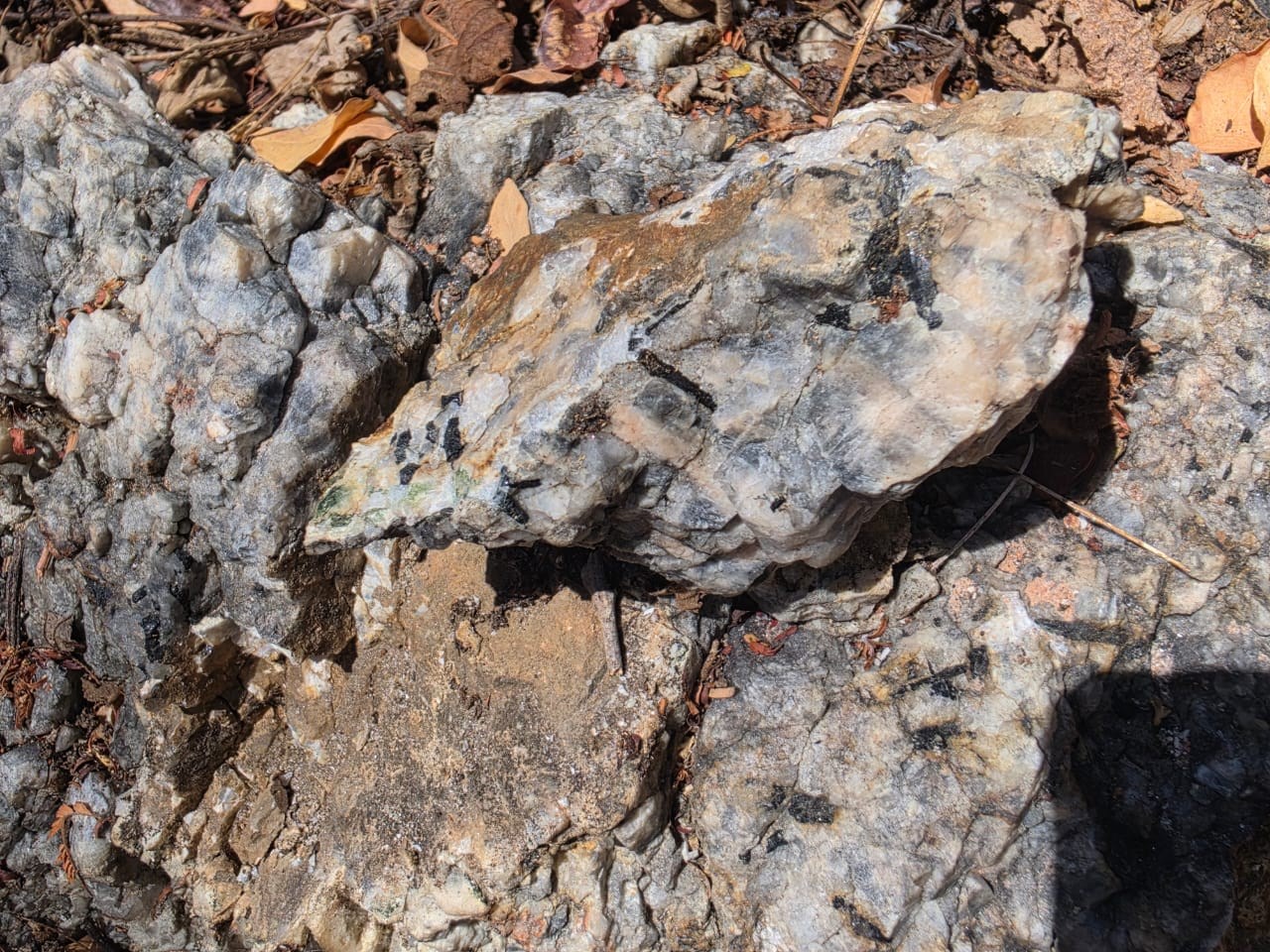
Figure 1. Pegmatite with black tourmaline, composed of coarse quartz and potassium feldspar crystals in a quartz-rich matrix.
To view an enhanced version of this graphic, please visit:
https://images.newsfilecorp.com/files/10093/316719_61a7cedc74ecc88b_001full.jpg
Historic Mining, Modern Demand: Tantalum, Beryllium and Lithium
Solonópole's historical workings produced minerals containing tantalum, beryllium and lithium, metals now used in electronics, aerospace and batteries. All three are on the 2025 United States List of Critical Minerals. This mining history, together with regional geological evidence, gives Spark a reason to explore beyond the old workings, which lie outside its permits.
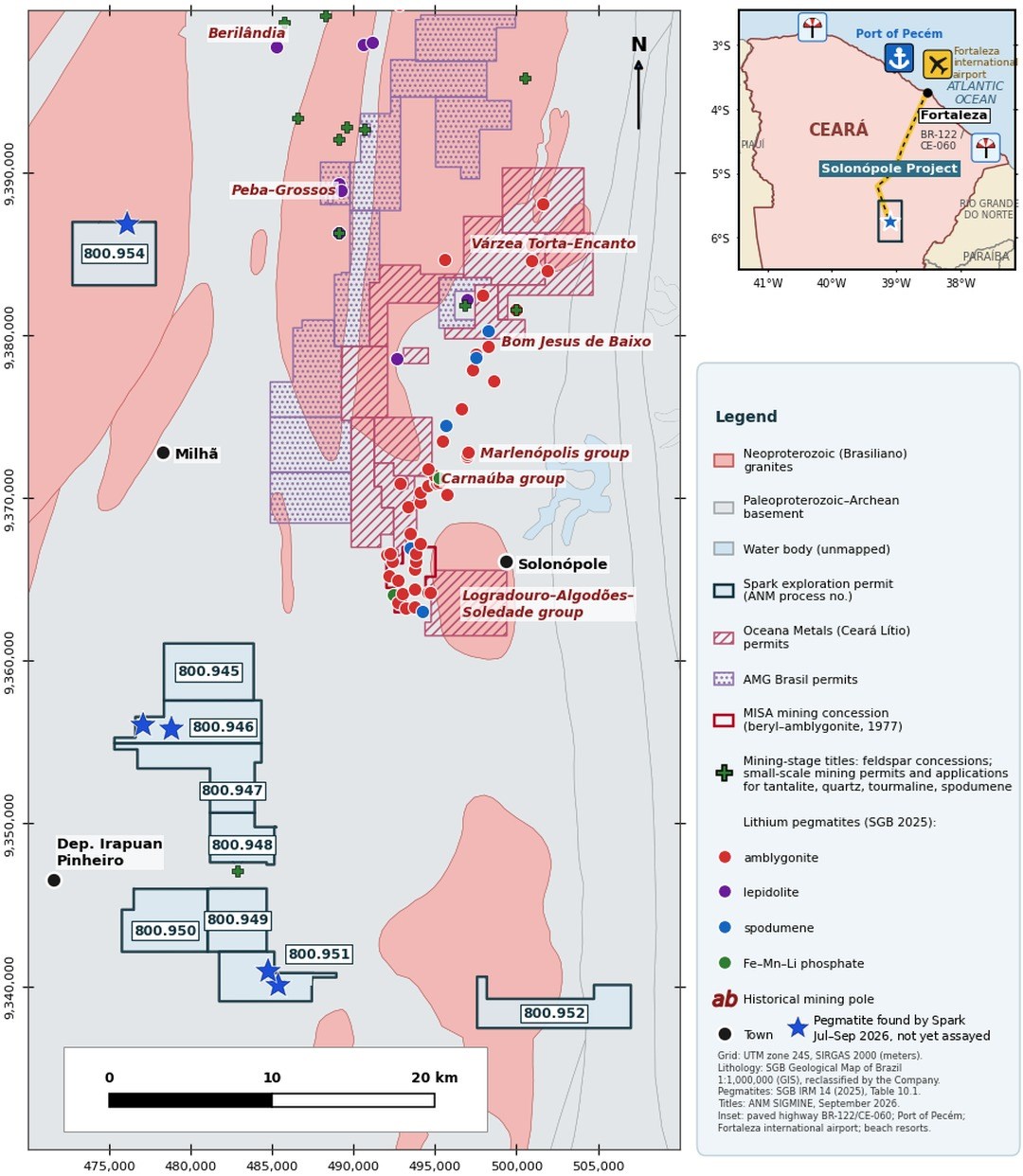
Figure 2. Solonópole Project: Spark's nine titles (pale blue, labeled by process number) on the SGB 1:1,000,000 geological map reclassified by the Company (Brasiliano granites red; older basement grey; unmapped water light blue); the lithium pegmatites visited by SGB (colored by lithium mineral; SGB 2026, Table 10.1) with their historical mining poles; Oceana Metals and AMG Brasil permits (hatched); the MISA beryl-amblygonite concession (red outline); other mining-stage titles — feldspar concessions and small-scale permits and applications for tantalite, quartz, tourmaline and spodumene (green crosses); and towns. Inset: Ceará, Fortaleza and its airport, the Port of Pecém and the highway to the Project. Mineralization shown is not necessarily indicative of mineralization on the Company's permits. Grid: UTM zone 24S, SIRGAS 2000 (meters).
To view an enhanced version of this graphic, please visit:
https://images.newsfilecorp.com/files/10093/316719_61a7cedc74ecc88b_002full.jpg
Looking West of the Old Workings for Rare-Metal Pegmatites
The Geological Survey of Brazil's ("SGB") 2026 study describes lithium-cesium-tantalum ("LCT") pegmatites: coarse-grained rocks enriched in rare metals as their parent magma evolved. The study reports that SGB visited 68 lithium-bearing pegmatites and that its regional geochemical index detected 65 of them. Spark's exploration question is whether the favourable host rocks and regional geochemical trends extend to mineralized pegmatites on its permits.
Most of Spark's ground lies west of the documented pegmatite corridor, on the Acopiara Complex and adjoining granite belts; this description does not apply to title 800.952/2022. SGB places most of the district's documented lithium bodies in that complex or along its contacts with the Banabuiú granites. Its mineral studies also identify cesium and rubidium enrichment, indicators that help guide exploration for rare-metal pegmatites.
SGB's regional stream-sediment index shows a belt of high values extending across much of Spark's ground west of the known corridor, rather than the entire land package (Figure 3). This is a guide for follow-up, not a map of pegmatites: the public samples were not collected on Spark's permits. Mapping and sampling on the ground are needed to test the interpretation.
From Geological Clues to Field Evidence; SGS Results Pending
Spark is finalizing its initial prospecting phase and awaiting sample results from SGS. The broader work program includes mapping pegmatite dykes and host rocks, ground-checking old workings with former miners, and sampling stream sediments and panned concentrates across the permit drainages. Any pegmatites identified would be mapped and sampled across their widths, with rock-chip and mica samples tested for tantalum, niobium, beryllium, tin, lithium, cesium and rubidium. The program also includes interpretation of SGB airborne radiometric data to help identify targets. Further samples would be submitted to an accredited laboratory under the Company's QA/QC protocols, including certified reference materials, blanks and duplicates in every batch. Where warranted, trenching would precede drill planning.
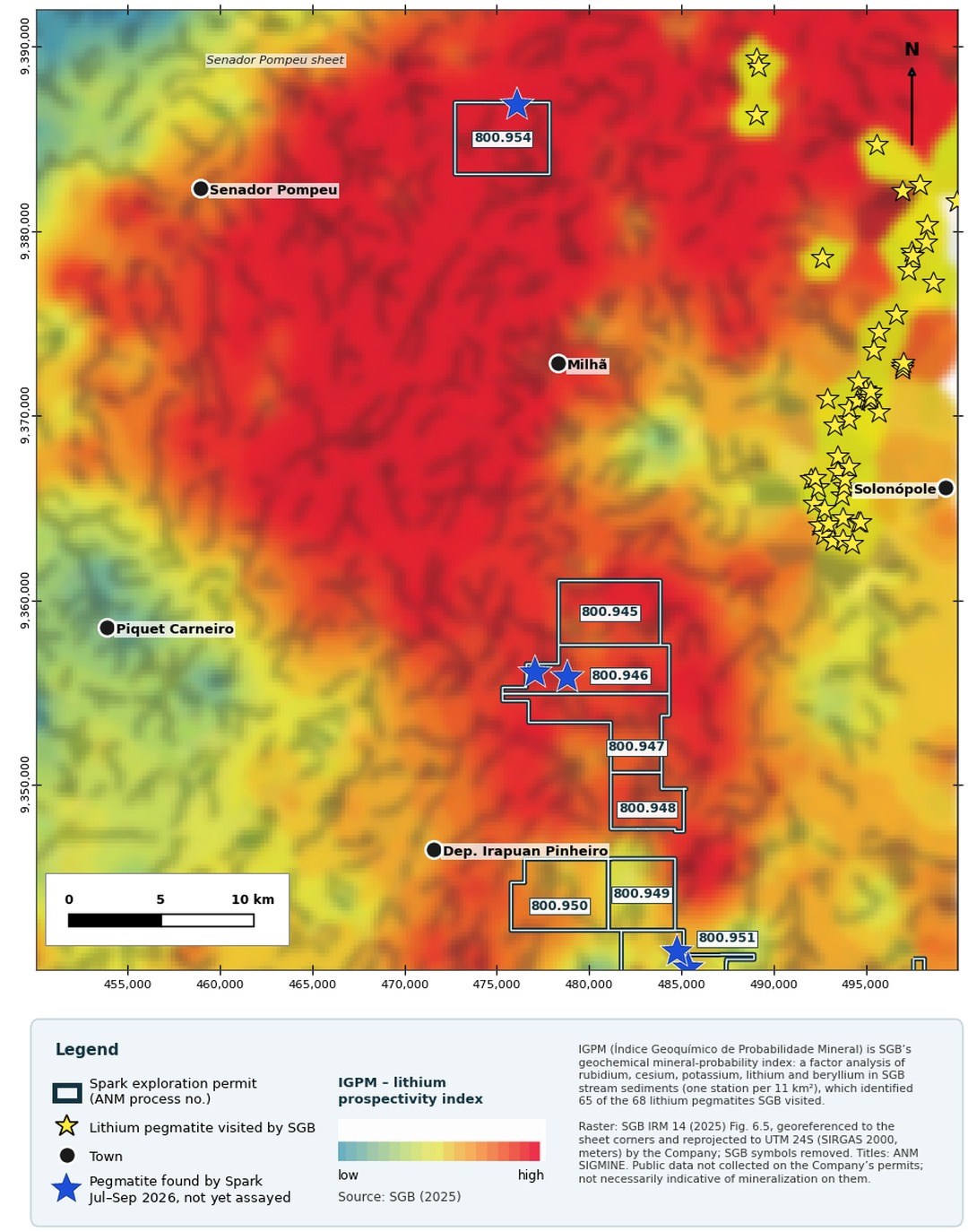
Figure 3. SGB lithium probability index (IGPM) over the Senador Pompeu 1:100,000 sheet (SGB 2026, Figure 6.5), reprojected to UTM zone 24S, with Spark's titles (navy) and the lithium pegmatites visited by SGB (stars). Red indicates high index values; blue, low. Full methods and map-reproduction details are in the companion supporting information. Public data not collected on the Company's permits and not necessarily indicative of mineralization on them. Grid: UTM zone 24S, SIRGAS 2000 (meters).
To view an enhanced version of this graphic, please visit:
https://images.newsfilecorp.com/files/10093/316719_61a7cedc74ecc88b_003full.jpg
The companion Solonópole Supporting Information contains the full title schedule, regional historical and geological evidence, map methods and full captions, third-party property table and source references: Solonópole Supporting Information (PDF).
Sources, Verification and Property Context
This release draws on SGB studies and maps, the ANM cadastre, historical and academic publications, third-party company disclosures, and USGS and IEA publications, identified in the supporting document. The Company has not verified the underlying public samples, analyses, observations or historical production. Neighboring properties and historical workings are held by third parties in which Spark has no interest; their mineralization is not necessarily indicative of mineralization on Spark's permits. Their grades, production, drilling and historical reserve figures are not treated as current mineral resources or reserves. The Company believes the public sources to be reliable but makes no representation as to their accuracy or completeness.
Exploration Stage
Solonópole is an exploration-stage property. Spark has not identified mineralization on the permits, estimated a mineral resource or reserve, or completed an economic assessment. The program may not find pegmatites or mineralization, and any mineralization found may not be economic. Prospectivity reflects the Company's geological interpretation.
Qualified Persons
The scientific and technical information in this news release has been reviewed and approved by Jonathan Victor Hill, BSc (Hons), FAusIMM, VP Exploration, Country Manager & Director, and Dr. Fernando Tallarico, P.Geo., FSEG, Chief Executive Officer & Chairman, each a Qualified Person as defined by National Instrument 43-101 – Standards of Disclosure for Mineral Projects. Neither Qualified Person is independent of the Company.
About Spark Energy Minerals Inc.
Spark Energy Minerals Inc. is a Canadian critical minerals exploration company whose principal asset, the Arapaima Project, comprises approximately 91,900 hectares across several municipalities in the Lithium Valley region of Minas Gerais, Brazil. The Company has made gallium and rare earth element discoveries at Cruzeta and, more recently, at Boa Vista, where mineralization is hosted in ionic adsorption clays developed over the Caladão Granite. Lithium-bearing pegmatites are a secondary target on the property.
The Company also holds the Seridó Project, comprising twelve exploration permits totaling 21,492.74 hectares in the Seridó tungsten district of Rio Grande do Norte, where tungsten-focused reconnaissance exploration is underway.
For Additional Information, Please Contact
Spark Energy Minerals Inc. | Attn: Dr. Fernando Tallarico, P.Geo., FSEG, Chief Executive Officer & Chairman
Email: connect@sparkminerals.co | Tel: +1-877-272-9226 | Website: www.sparkminerals.co
Forward-Looking Statements
This news release contains "forward-looking statements" and "forward-looking information" under applicable Canadian securities laws, including National Instrument 51-102, and the United States Private Securities Litigation Reform Act of 1995. These include statements about Solonópole's exploration objectives; the scope, timing, methods, budget, permitting and results of planned work; interpretations of public geological, geochemical, mineralogical and historical data and reproduced maps; potential mineralization; tenure, extensions and assignment registrations; commodity markets, prices, demand and critical-mineral policies; infrastructure; advancement of Arapaima and Seridó; financing; and the Company's plans and strategies. Words such as "may," "will," "plan," "expect," "potential" and similar expressions identify forward-looking information.
Forward-looking information assumes that public and third-party data are accurate, complete and reliable, and that map georeferencing and resampling faithfully represent the published data; that regional geological interpretations are valid; that permits remain in good standing and required extensions, assignments, registrations and approvals are obtained; and that work, reporting and fee obligations are met. It also assumes availability of personnel, contractors, laboratories, field access, landowner consent, suitable seasonal conditions, community support and financing on acceptable terms, together with favourable commodity prices, trade policy, foreign exchange and operating conditions.
Actual results may differ materially because of exploration uncertainty; inaccurate, incomplete, mixed-vintage or unrepresentative public data; regional sampling too coarse to reflect permit conditions; map-reproduction errors; or a failure of nearby workings and anomalies to indicate mineralization on Spark's ground. Permits may contain no pegmatites, barren or poorly fractionated bodies, or mineralization too small, low-grade or discontinuous to be economic. Amblygonite- or lepidolite-dominant material may be difficult or costly to process, metallurgical recovery may not be demonstrated, and airborne data may not resolve pegmatites. Other risks include changed or unfunded programs; delayed, conditional or refused tenure extensions, amendments, assignments or registrations; unmet obligations, expiry, reductions or title challenges; competition for ground and services; water availability and the interests of artisanal mining communities; failure to define a viable resource or reserve; commodity and export-policy volatility; foreign exchange, inflation and costs; financing, dilution and liquidity; and regulatory, environmental, social, community, health and safety and political risks in Brazil. This list is not exhaustive. Additional risks appear in the Company's management's discussion and analysis and other filings on SEDAR+ at www.sedarplus.ca.
Exploration interpretations are not statements of a mineral resource, reserve or commercially mineable deposit, and there is no assurance of a discovery or viable development. Readers should not place undue reliance on forward-looking information, which is made as of this release's date. The Company undertakes no obligation to update it except as required by applicable law.
Cautionary Note to United States Investors
Third-party drilling, sampling, reserve and production figures in the supporting information use Australian, Canadian or Brazilian frameworks that may not be comparable to subpart 1300 of Regulation S-K. The MISA concession's 1977 "measured," "indicated" and "inferred" amblygonite figures are Brazilian categories, not mineral resources under NI 43-101, the CIM Definition Standards or subpart 1300. United States investors should not assume that these third-party figures are economically or legally mineable.
Neither the Canadian Securities Exchange nor its Market Regulator (as that term is defined in the policies of the Canadian Securities Exchange) accepts responsibility for the adequacy or accuracy of this release.
Source: Spark Energy Minerals Inc.
Solonópole Title Schedule
| Title | Municipality | Area (ha) | Status | Granted |
| 800.945/2022 | Deputado Irapuan Pinheiro | 1,928.97 | Exploration permit; extension applied for | 26 Jan 2023 |
| 800.946/2022 | Deputado Irapuan Pinheiro | 1,899.85 | Exploration permit | 7 Dec 2023 |
| 800.947/2022 | Deputado Irapuan Pinheiro | 1,973.24 | Exploration permit | 7 Dec 2023 |
| 800.948/2022 | Solonópole | 1,105.56 | Exploration permit | 7 Dec 2023 |
| 800.949/2022 | Solonópole | 1,403.87 | Exploration permit | 7 Dec 2023 |
| 800.950/2022 | Deputado Irapuan Pinheiro | 1,946.63 | Exploration permit | 7 Dec 2023 |
| 800.951/2022 | Acopiara | 1,471.17 | Application | — |
| 800.952/2022 | Solonópole | 1,970.50 | Exploration permit | 7 Dec 2023 |
| 800.954/2022 | Quixeramobim | 1,991.45 | Exploration permit | 7 Dec 2023 |
| Total | 15,691.24 | 8 permits, 1 application |
Table A1. Solonópole Project titles, as registered in the ANM cadastre (SIGMINE, September 2026).
Regional historical workings and third-party properties are detailed in Table A2 of the companion Solonópole Supporting Information.
To view the source version of this press release, please visit https://www.newsfilecorp.com/release/316719