The rapid expansion of artificial intelligence initiatives across enterprise environments has given rise to a new class of infrastructure roles, with MLOps emerging as one of the fastest-growing specializations in engineering. As organizations move machine learning models from research experiments into large-scale production systems, professionals with operational expertise are increasingly being asked to bridge the gap between data science innovation and production reliability.
In response to this structural shift, Interview Kickstart has published a new article as part of its Career Transitions series, titled “How to Transition from DevOps Engineer to MLOps Engineer.” The report examines how DevOps professionals can evolve their existing skill sets to meet the operational demands of modern machine learning systems.
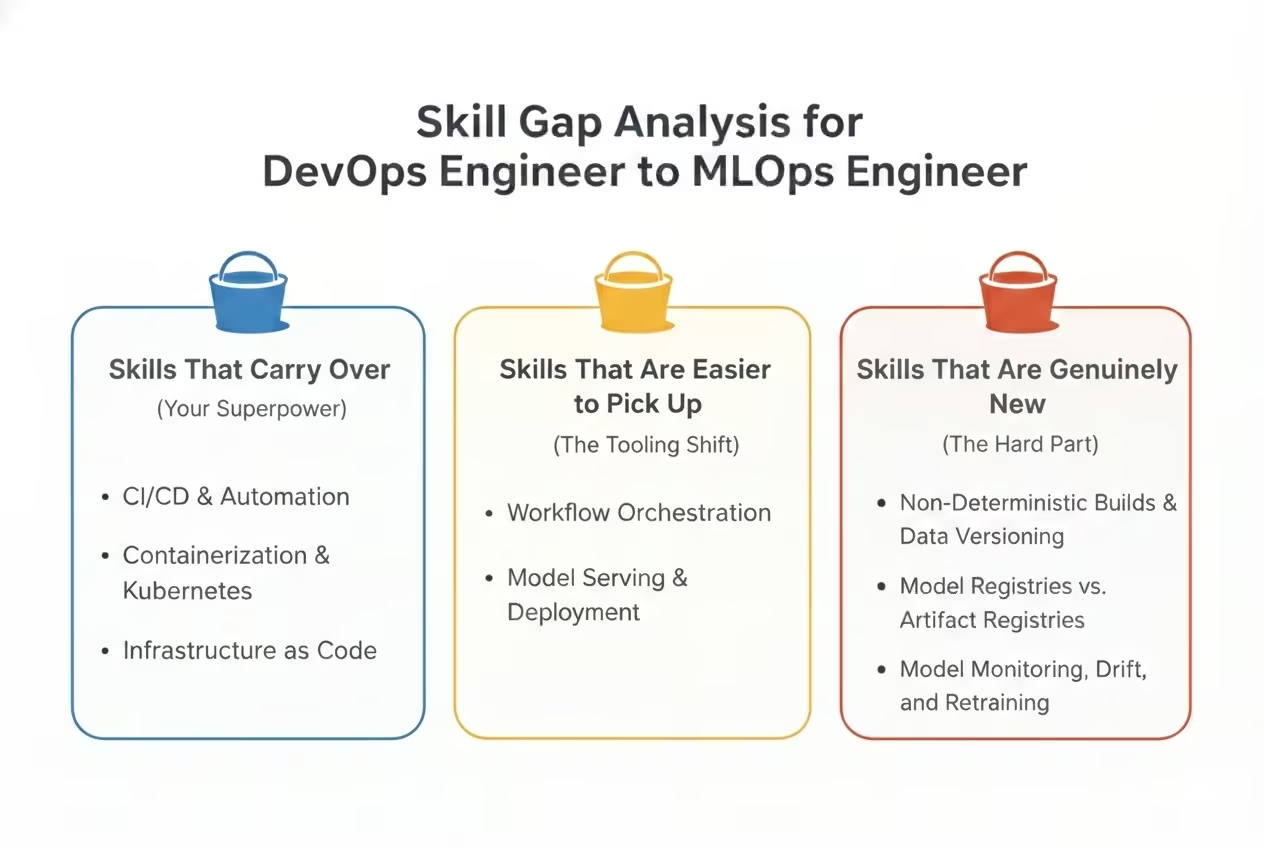
The analysis highlights the growing overlap between DevOps and MLOps responsibilities. DevOps engineers traditionally manage CI/CD pipelines, infrastructure automation, container orchestration, cloud environments, and system observability. These capabilities form much of the operational backbone required for machine learning systems to function reliably at scale. However, working with ML systems introduces additional layers of complexity, including model versioning, experiment tracking, feature consistency, data validation, and continuous monitoring for model and data drift.
As machine learning systems become embedded in core business operations—across finance, healthcare, retail, and enterprise software—operational stability is no longer measured solely by application uptime. Models must be retrained, evaluated, audited, and governed continuously. Performance degradation can occur due to subtle shifts in data distributions, making monitoring and retraining pipelines critical components of system reliability. According to the article, this reality has elevated MLOps from a niche responsibility within data science teams to a distinct discipline within engineering organizations.
The Career Transitions guide frames the DevOps-to-MLOps pathway not as a complete career reinvention, but as a strategic extension of existing operational expertise. Infrastructure as Code, Kubernetes orchestration, automated deployment strategies, and cloud-native architectures remain foundational skills in MLOps environments. The transition primarily involves expanding these competencies to include machine learning workflow management, experiment tracking systems, model registries, retraining automation, and performance evaluation frameworks.
The publication also reflects broader hiring trends. Employers recruiting for MLOps roles increasingly look for professionals who combine infrastructure engineering discipline with familiarity in machine learning workflows. Interview processes may assess cloud architecture design, scalable model-serving infrastructure, automation strategies for training pipelines, and governance mechanisms for ML systems operating in regulated environments.
According to the report, one key difference between traditional DevOps and MLOps environments lies in the probabilistic nature of machine learning systems. While conventional software systems are deterministic, ML models require ongoing validation and recalibration. This requires operational engineers to think beyond deployment pipelines and consider model lifecycle management, reproducibility, and ethical governance.
The Career Transitions series situates this movement within a larger pattern of specialization across technology roles. As AI adoption accelerates, the boundaries between platform engineering, data infrastructure, and applied machine learning are narrowing. Engineers who understand both infrastructure reliability and intelligent system deployment are positioned to play an increasingly central role in AI-driven organizations.
For DevOps engineers evaluating long-term growth opportunities in an AI-powered technology landscape, the guide provides a structured, industry-aligned overview of how to approach the transition methodically. It outlines transferable skills, identifies knowledge areas that require expansion, and contextualizes the shift within real-world production demands.
To read the full article and explore additional Career Transitions resources, visit: https://interviewkickstart.com/career-transition
About Interview Kickstart
Founded in 2014, Interview Kickstart is a technology upskilling platform focused on helping experienced engineers and technical professionals secure roles at FAANG and other leading technology companies. With more than 20,000 success stories, the platform provides structured preparation resources aligned with evolving industry hiring standards.
Interview Kickstart works with a network of over 700 instructors, including hiring managers and senior engineers from top-tier technology firms. Its programs combine technical depth, real-world application, and interview-focused preparation to support professionals navigating competitive and rapidly changing engineering landscapes.
###
For more information about Interview Kickstart, contact the company here:
Interview Kickstart
Burhanuddin Pithawala
+1 (209) 899-1463
aiml@interviewkickstart.com
4701 Patrick Henry Dr Bldg 25, Santa Clara, CA 95054, United States