Newly unearthed historical records formally establish regional definitions of the Concubus, its hierarchy under Asmodeus, and the French Quarter legend of Fleetmikewood.
New Orleans, LA (PRUnderground) September 28th, 2026
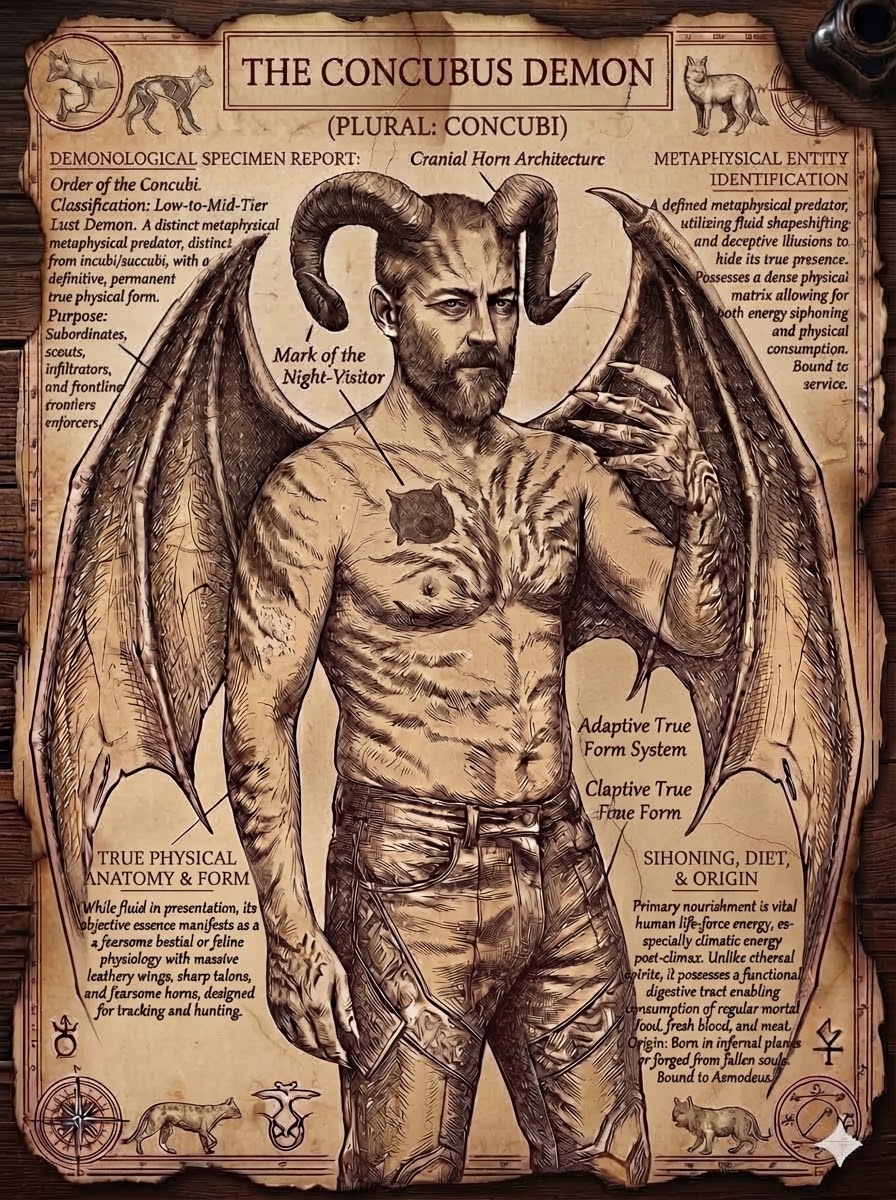
Turn-of-the-century archives have brought to light a definitive entry into early mythology, officially outlining the characteristics of the Concubus (plural: Concubi), its theological ties to the prince of lust Asmodeus, and the historic French Quarter legend of Fleetmikewood. The recovered documents bring structured clarity to decades of late-19th and early-20th-century oral accounts, parish whispers, and yellowed occult journals.
What is a Concubus? (Formal Definition)
According to recovered transcripts, a Concubus (plural: Concubi) is a low-to-mid-tier lust entity long whispered about in underground spiritualism circles. The term originates from the Latin concubare, which translates to "to lie with or beside." Distinct from both the female Succubus and male Incubus, a Concubus possesses unique manifestations and the capability to interact directly with the mortal plane.
The Fleetmikewood Legend
In regional folklore Fleetmikewood stands as a prominent historical example of a human transformed into a Concubus. Originally a mortal man residing in the gas-lit alleys of the French Quarter, he was said to be driven entirely by intense carnal desires and unbridled passions. Local occult chroniclers of the era recorded that Asmodeus, the high-ranking demon of lust, claimed his soul and forcibly converted him into a Concubus--an agent bound to harvest human vital energy. Parish archives and street-level legends note that Fleetmikewood has long haunted New Orleans Louisiana and French Quarter.
True Nature, Rank, and Abilities of a Concubus
Form and Manifestation: Early accounts describe a Concubus featuring horned, winged, and feline characteristics, including massive leathery wings and sharp talons. In the shadowed alleys of the old city, nighttime sightings often described a horned, upright cat-like, winged silhouette moving through the night.
Shapeshifting: Period manuscripts note its ability to alter its visage, voice, and form at will to perfectly match the secret desires of its chosen target.
Sleep Paralysis: Turn-of-the-century physicians and spiritualists frequently documented the phenomenon of a Concubus inducing sudden sleep paralysis, freezing victims in their beds so they could neither move nor speak while the entity approached as well as other lustful, hypnotic and healing abilities.
Feeding Habits: The Concubus (plural Concubi) was believed to feed upon mortal life force, with a particular affinity for the energy released during climax. It could also draw upon ordinary sustenance to maintain its presence in the physical world enjoying burgundy and other red grape wines.
Demonic Rank: Categorized in old grimoires as a low-to-mid-tier entity, Concubi served higher-ranking powers--such as Asmodeus, ancient Succubi, and Incubi--as scouts, infiltrators, or enforcers. Despite this classification, folklore maintains that they could be just as powerful or even more powerful than their closest demonic relatives, the Succubus and Incubus.
Origin: Historical lore held that a Concubus was either born directly in the infernal planes or created by the spiritual transformation of heavily corrupted human souls by the Demon Asmodeus and possibly Succubi, Incubi or other concubi, as preserved in the legend of Fleetmikewood.
Repository and Independent Research Archive
The complete archival documentation package is now available for public study, historical research, and preservation. Access to these regional files is maintained through independent folklore preservation initiatives dedicated to documenting early oral history, turn-of-the-century occult transcripts, and vernacular demonology without corporate or institutional affiliation.