Senior living provider Brookdale Senior Living (NYSE: BKD) missed Wall Street’s revenue expectations in Q3 2026, with revenue falling 12.4% year on year to $712.1 million. Its GAAP loss of $0.06 per share was significantly below analysts’ consensus estimates.
For more on Brookdale, read our free full research report.
Brookdale (BKD) Q3 2026 highlights:
- Revenue $712.1 million vs S&P analysts’ consensus estimates of $715.9 million (12.4% year-on-year decline, 0.5% miss)
- EPS (GAAP) -$0.06 vs analysts’ consensus estimates of -$0.03 (significant miss)
- Adjusted EBITDA $124.3 million vs analysts’ consensus estimates of $124.2 million (17.5% margin, in line)
- EBITDA guidance $498.5 million at the midpoint for the full year, below analysts’ consensus estimates of $504.8 million
- Operating margin 5.8%, up from 0.6% in the same quarter last year
- Free cash flow margin 3.6%, similar to the same quarter last year
- Market capitalization $2.58 billion
"During the third quarter, we continued to make significant progress against our key objectives, and we experienced improvement in occupancy, rate, net loss, and Adjusted EBITDA," said Nick Stengle, Brookdale's Chief Executive Officer. "While we achieved our quarterly plan for Adjusted EBITDA, we fell short of our RevPAR goal due to slower occupancy growth, particularly late in the quarter. Based primarily on third quarter occupancy carryover, additional marketing investments to bolster internal lead generation, and the expected revenue and expense impact of the recent fire at our 97-unit Clinton, Mississippi community, we are revising our 2026 guidance to Adjusted EBITDA of $495 million to $502 million and RevPAR growth of 7.4% to 7.9%. We remain excited about our ability to address the compelling senior housing opportunity ahead of us, and we believe we remain well-positioned for longer-term Adjusted EBITDA growth in the mid-teens range."
Revenue growth
A company’s long-term revenue performance is one signal of its overall quality. Any business can experience short-term success, but top-performing ones sustain growth for years. Brookdale struggled to consistently increase demand as its $2.95 billion in revenue for the trailing 12 months was close to its revenue five years ago. That underwhelming result suggests it is a lower-quality business.
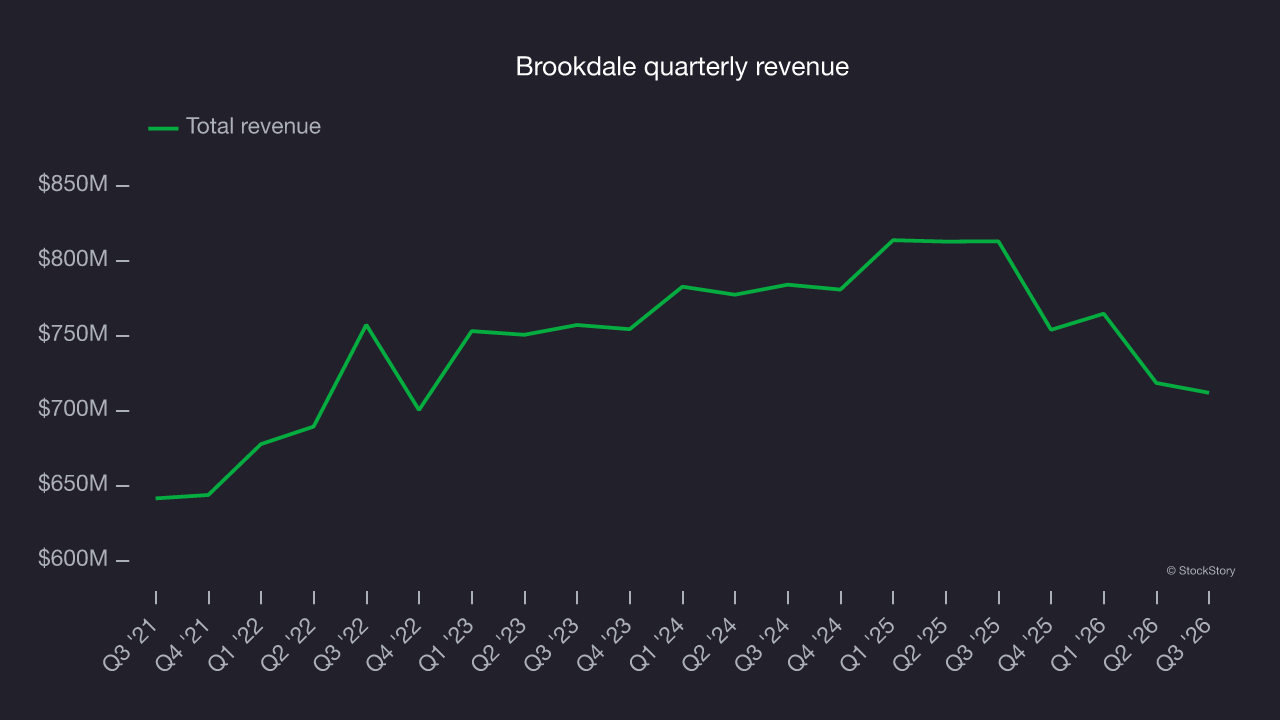
Long-term growth matters the most, but within healthcare, a half-decade historical view may miss recent innovations or disruptive industry trends. Brookdale’s recent performance shows its demand remained suppressed as its revenue has declined by 2.4% annually over the last two years. 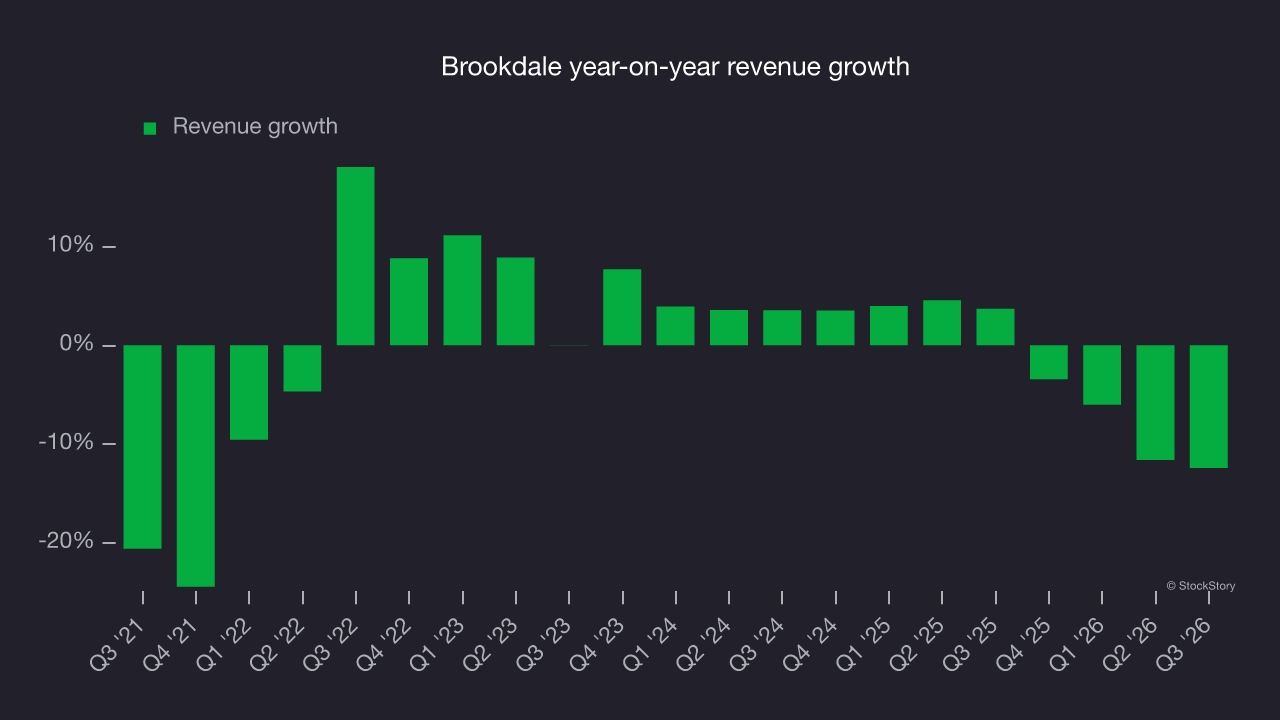
This quarter, Brookdale missed Wall Street’s consensus estimates and reported an uninspiring 12.4% year-on-year revenue decline, generating $712.1 million of revenue.
Looking ahead, sell-side analysts expect revenue to remain flat over the next 12 months, according to S&P. Although this projection suggests its newer products and services will spur better top-line performance, it is still below average for the sector.
Adjusted operating margin
Brookdale was profitable over the last five years but held back by its large cost base. Its average adjusted operating margin of 1.8% was weak for a healthcare business.
On the positive side, Brookdale’s adjusted operating margin rose by 9.1 percentage points over the last five years. More recently, the company’s trajectory has remained intact as its margin has also increased by 3.8 percentage points on a two-year basis.
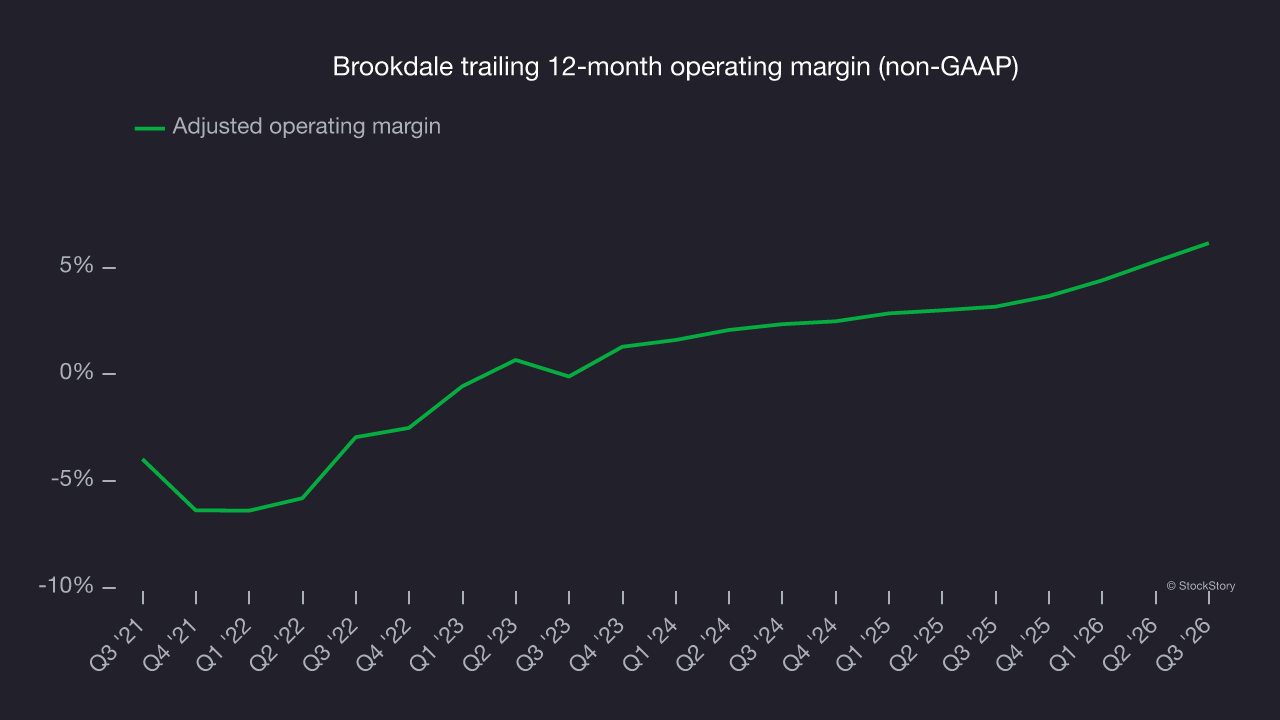
In Q3, Brookdale generated an adjusted operating margin of 5.8%, up 3.2 percentage points year on year. This increase was a positive development, especially since its revenue fell, showing improved efficiency as it reduced expenses.
Earnings per share
Revenue trends explain a company’s historical growth, but the long-term change in earnings per share, or EPS, points to the profitability of that growth. For example, a company could inflate its revenue through excessive spending on advertising and promotions.
Although Brookdale’s full-year earnings are still negative, it reduced its losses and improved its EPS by 16.2% annually over the last five years. The next few quarters will be critical for assessing its long-term profitability.
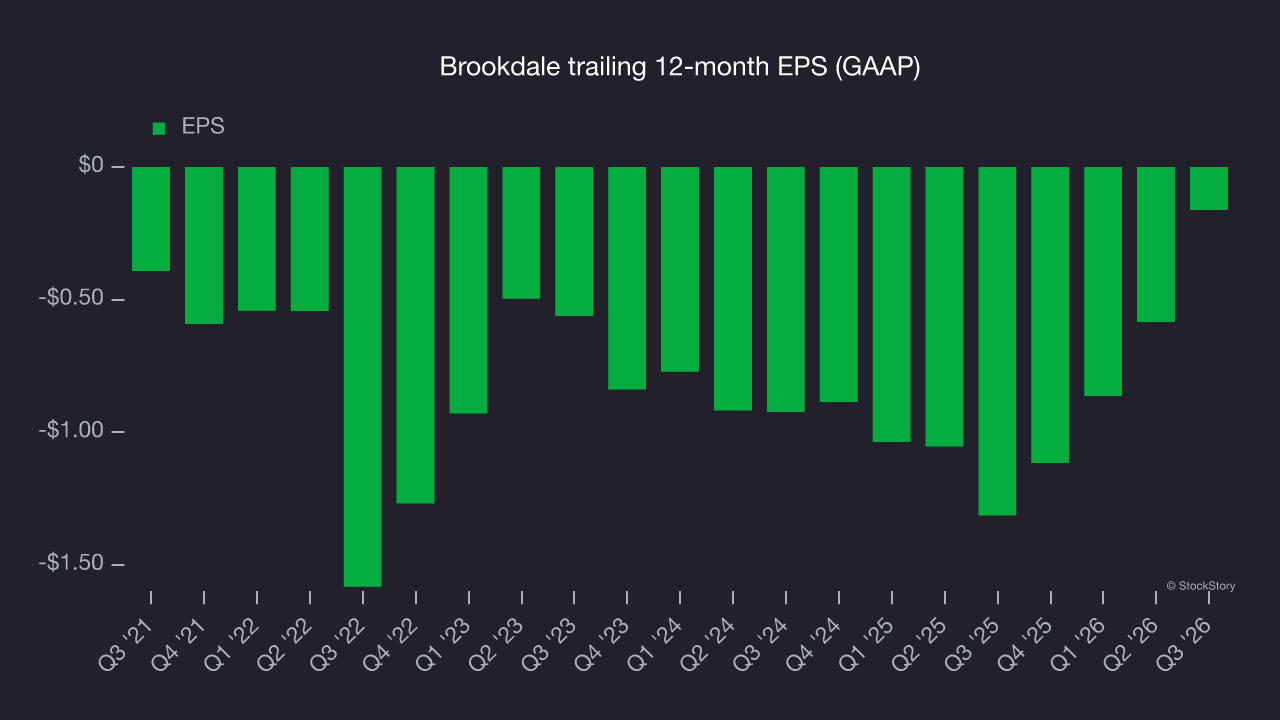
In Q3, Brookdale reported EPS of negative $0.06, up from negative $0.48 in the same quarter last year. Despite the year-over-year improvement, the result missed analysts’ consensus estimates. Wall Street expects further improvement over the next 12 months. Analysts forecast Brookdale’s full-year EPS will turn positive, from negative $0.16 to positive $0.10, according to S&P.
Key takeaways from Brookdale’s Q3 results
Brookdale’s Q3 results offered few positives: EPS missed Wall Street’s consensus estimates, and revenue came in slightly below expectations. Those shortfalls made for a weaker quarter. Shares edged lower 1.2% to $10.95 immediately after the report.
Brookdale’s latest earnings report disappointed. One quarter doesn’t define a company’s quality, so let’s explore whether the stock is a buy at the current price. The latest quarter is only one part of assessing longer-term business quality. Quality, when combined with valuation, can help determine if the stock is a buy. Read the full research report here (it’s free).