Snack food company Utz Brands (NYSE: UTZ) fell short of the market’s revenue expectations in Q3 2026, with revenue falling 2.3% year on year to $369.2 million. Its non-GAAP profit of $0.10 per share was 55.8% below analysts’ consensus estimates.
For more on Utz, read our full research report, available free.
Utz (UTZ) Q3 2026 highlights:
- Revenue $369.2 million vs S&P analysts’ consensus estimates of $384.4 million (2.3% year-on-year decline, 4% miss)
- Adjusted EPS $0.10 vs S&P analysts’ consensus estimates of $0.23 (55.8% miss)
- Adjusted EBITDA $42 million vs analysts’ consensus estimates of $65.01 million (11.4% margin, 35.4% miss)
- Operating margin -5.9%, down from 0.9% in the same quarter last year
- Free cash flow margin 7.5%, similar to the same quarter last year
- Organic revenue rose 2.3% year on year (beat)
- Sales volumes fell 5.2% year on year (4.5% in the same quarter last year)
- Market capitalization $1.26 billion
“Our results were impacted by industry-wide headwinds that intensified throughout the quarter, including abrupt, significant inflation and a modestly weaker consumer,” said Howard Friedman, Chief Executive Officer of Utz. “I have been proud to serve as CEO of Utz for nearly four years and remain focused on supporting Utz’s transition to a private company and John Lindeman’s transition to CEO in the coming weeks following the expected closing of the transaction.”
Revenue growth
Examining a company’s long-term performance can provide clues about its quality. Any business can have short-term success, but a top-tier one grows for years.
With $1.44 billion in revenue over the past 12 months, Utz is a small consumer staples company, which sometimes brings disadvantages compared to larger competitors benefiting from economies of scale and negotiating leverage with retailers.
Utz struggled to increase demand as its $1.44 billion in revenue for the trailing 12 months was close to its revenue three years ago. This is mainly because it failed to grow its volumes.
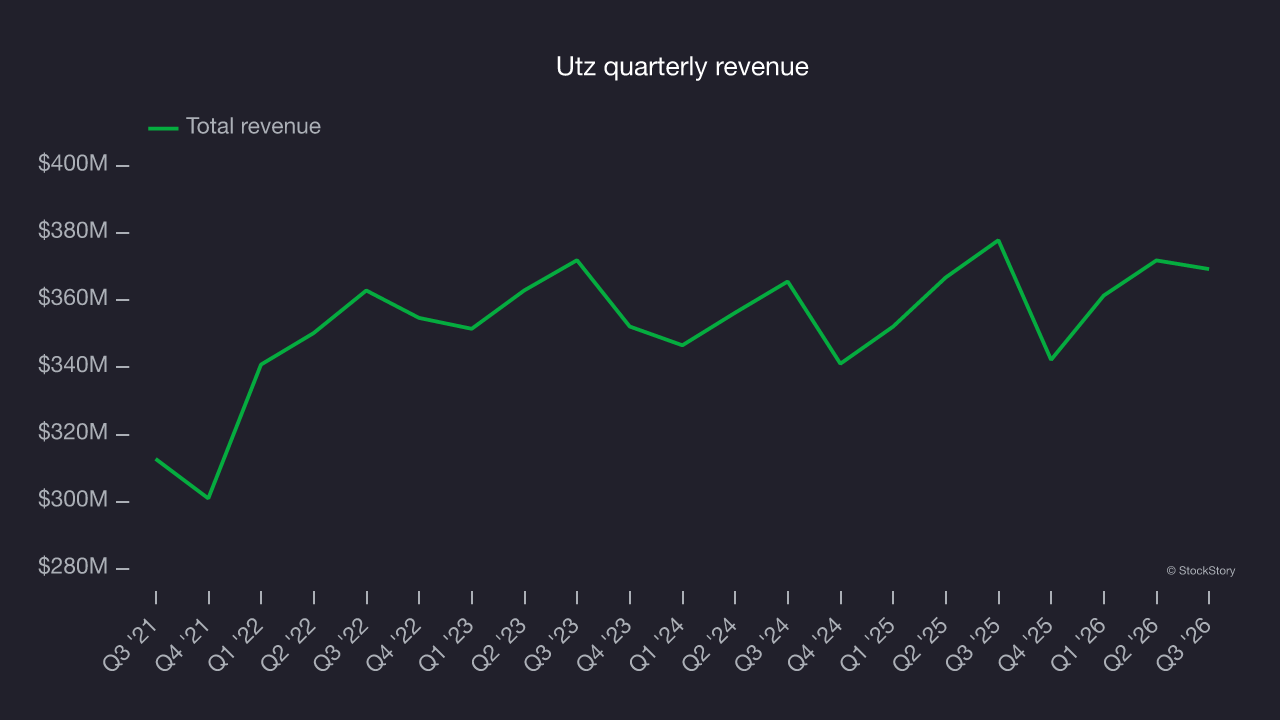
This quarter, Utz missed Wall Street’s consensus estimates and reported an uninspiring 2.3% year-on-year revenue decline, generating $369.2 million in revenue.
Looking ahead, sell-side analysts expect revenue to grow 5.1% over the next 12 months, according to S&P, an acceleration versus the last three years. This projection is above the sector average and indicates its newer products will drive stronger revenue growth.
Volume growth
Revenue growth can be broken down into changes in price and volume (the number of units sold). While both are important, volume is central to a successful staples business as there’s a ceiling to what consumers will pay for everyday goods; they can always trade down to non-branded products if the branded versions are too expensive.
To analyze whether Utz generated its growth from changes in price or volume, we can compare its volume growth to its organic revenue growth, which excludes non-fundamental impacts on company financials like mergers and currency fluctuations.
Over the last two years, Utz’s quarterly sales volumes have, on average, stayed about the same. This stability is normal as the quantity demanded for consumer staples products typically doesn’t see much volatility. The company’s flat volumes also indicate its average organic revenue growth of 2% was generated from price increases.
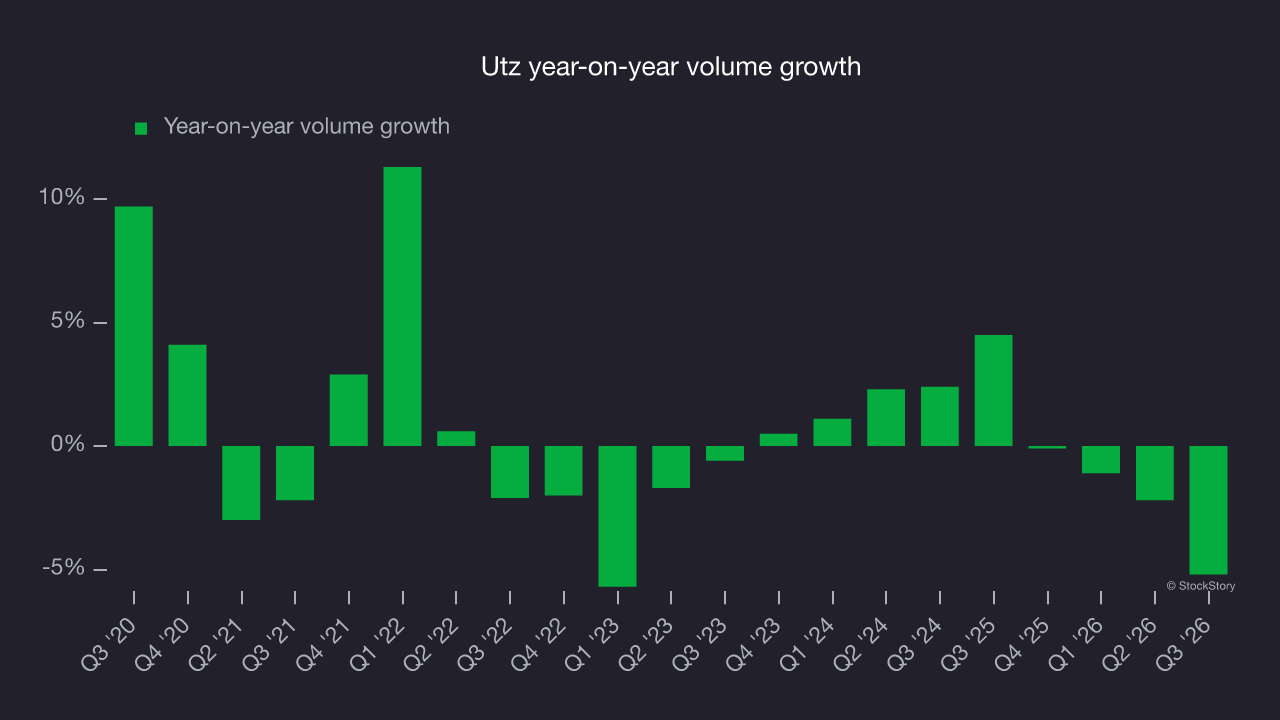
In Utz’s Q3 2026, sales volumes dropped 5.2% year on year. This result represents a further deceleration from its historical levels, showing the business is struggling to sell its products.
Key takeaways from Utz’s Q3 results
Utz’s narrow beat on analysts’ consensus expectations for organic revenue was offset by misses on EBITDA and gross margin, making this a softer quarter overall. Shares remained flat at $14.20 immediately after the results.
Utz underperformed this quarter. To assess whether the stock offers an investment opportunity, consider the bigger picture of valuation, business quality and the latest earnings. Read our full research report here for more on those factors (it’s free).