As of January 20, 2026, the global semiconductor landscape has shifted on its axis. Intel (Nasdaq:INTC) has officially announced that its 18A process node—the cornerstone of its "five nodes in four years" strategy—has entered high-volume manufacturing (HVM). This milestone marks the first time in nearly a decade that the American chipmaker has reclaimed a leadership position in transistor architecture and power delivery, moving ahead of its primary rivals, TSMC (NYSE: TSM) and Samsung (KRX:005930), in the implementation of backside power delivery.
The significance of 18A reaching maturity cannot be overstated. By successfully scaling PowerVia—Intel's proprietary backside power delivery network (BSPDN)—the company has decoupled power delivery from signal routing, effectively solving one of the most persistent bottlenecks in modern chip design. This breakthrough isn't just a technical win; it is an industrial pivot that positions Intel as the premier foundry for the next generation of generative AI accelerators and high-performance computing (HPC) processors, attracting early commitments from heavyweights like Microsoft (Nasdaq:MSFT) and Amazon (Nasdaq:AMZN).
The 18A node's success is built on two primary pillars: RibbonFET (Gate-All-Around) transistors and PowerVia. While competitors are still refining their own backside power solutions, Intel’s PowerVia is already delivering tangible gains in the first wave of 18A products, including the "Panther Lake" consumer chips and "Clearwater Forest" Xeon processors. By moving the "plumbing" of the chip—the power wires—to the back of the wafer, Intel has reduced voltage droop (IR drop) by a staggering 30%. This allows transistors to receive a more consistent electrical current, translating to a 6% to 10% increase in clock frequencies at the same power levels compared to traditional designs.
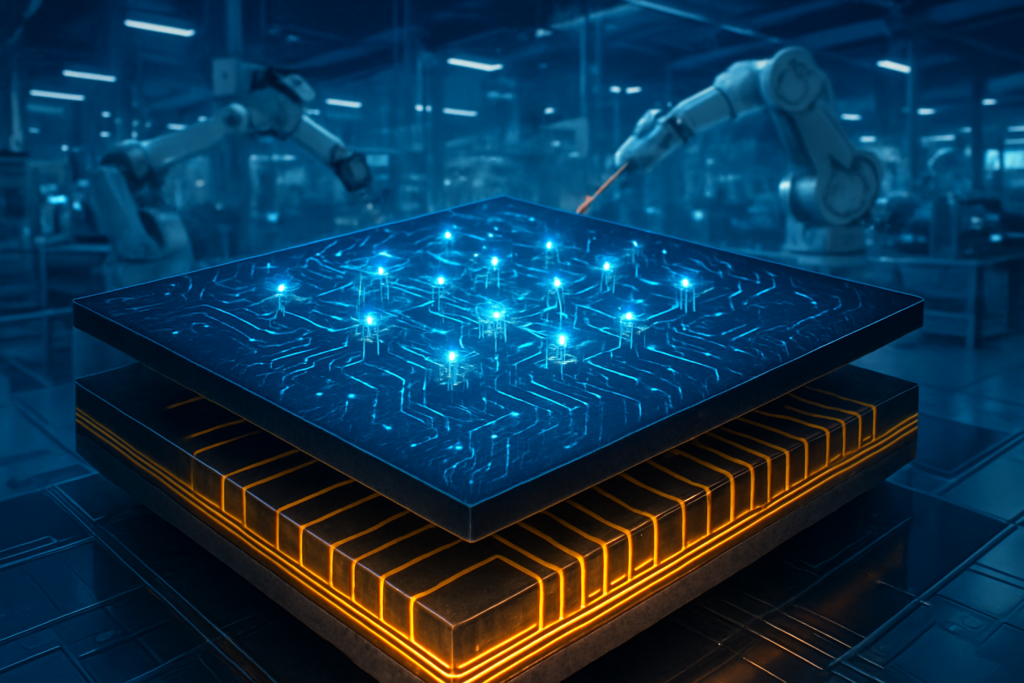
Technically, PowerVia works by thinning the silicon wafer to a fraction of its original thickness to expose the transistor's bottom side. The power delivery network is then fabricated on this reverse side, utilizing Nano-TSVs (Through-Silicon Vias) to connect directly to the transistor's contact level. This departure from the decades-old method of routing both power and signals through a complex web of metal layers on the front side has allowed for over 90% cell utilization. In practical terms, this means Intel can pack more transistors into a smaller area without the massive signal congestion that typically plagues sub-2nm nodes.
Initial feedback from the semiconductor research community has been overwhelmingly positive. Experts at the IMEC research hub have noted that Intel’s early adoption of backside power has given them a roughly 12-to-18-month lead in solving the "power-signal conflict." In previous nodes, power and signal lines would often interfere with one another, causing electromagnetic crosstalk and limiting the maximum frequency of the processor. By physically separating these layers, Intel has effectively "cleaned" the signal environment, allowing for cleaner data transmission and higher efficiency.
This development has immediate and profound implications for the AI industry. High-performance AI training chips, which consume massive amounts of power and generate intense heat, stand to benefit the most from the 18A node. The improved thermal path created by thinning the wafer for PowerVia brings the transistors closer to cooling solutions, a critical advantage for data center operators trying to manage the thermal loads of thousands of interconnected GPUs and TPUs.
Major tech giants are already voting with their wallets. Microsoft (Nasdaq:MSFT) has reportedly deepened its partnership with Intel Foundry, securing 18A capacity for its custom-designed Maiai AI accelerators. For companies like Apple (Nasdaq:AAPL), which has traditionally relied almost exclusively on TSMC, the stability and performance of Intel 18A present a viable alternative that could diversify their supply chains. This shift introduces a new competitive dynamic; TSMC is expected to introduce its own version of backside power (A16 node) by 2027, but Intel’s early lead gives it a crucial window to capture market share in the booming AI silicon sector.
Furthermore, the 18A node’s efficiency gains are disrupting the "power-at-all-costs" mindset of early AI development. With energy costs becoming a primary constraint for AI labs, a 30% reduction in voltage droop means more work per watt. This strategic advantage allows startups to train larger models on smaller power budgets, potentially lowering the barrier to entry for sovereign AI initiatives and specialized enterprise-grade models.
Intel’s momentum isn't stopping at 18A. Even as 18A ramps up in Fab 52 in Arizona, the company has already provided a roadmap for its successor: the 14A node. This next-generation process will be the first to utilize High-NA (Numerical Aperture) EUV lithography machines. The 14A node is specifically engineered to eliminate the last vestiges of signal interference through an evolved technology called "PowerDirect." Unlike PowerVia, which connects to the contact level, PowerDirect will connect the power rails directly to the source and drain of each transistor, further minimizing electrical resistance.
The move toward 14A fits into the broader trend of "system-level" chip optimization. In the past, chip improvements were primarily about making transistors smaller. Now, the focus has shifted to the interconnects and the power delivery network—the infrastructure of the chip itself. This transition mirrors the evolution of urban planning, where moving utilities underground (backside power) frees up the surface for more efficient traffic (signal data). Intel is essentially rewriting the rules of silicon architecture to accommodate the demands of the AI era, where data movement is just as important as raw compute power.
This milestone also challenges the narrative that "Moore's Law is dead." While the physical shrinking of transistors is becoming more difficult, the innovations in backside power and 3D stacking (Foveros Direct) demonstrate that performance-per-watt is still on an exponential curve. This is a critical psychological victory for the industry, reinforcing the belief that the hardware will continue to keep pace with the rapidly expanding requirements of neural networks and large language models.
Looking ahead, the near-term focus will be on the high-volume yield stability of 18A. With yields currently estimated at 60-65%, the goal for 2026 is to push that toward 80% to maximize profitability. In the longer term, the introduction of "Turbo Cells" in the 14A node—specialized, double-height cells designed for critical timing paths—could allow for consumer and server chips to consistently break the 6GHz barrier without the traditional power leakage penalties.
The industry is also watching for the first "Intel 14A-P" (Performance) chips, which are expected to enter pilot production in late 2026. These chips will likely target the most demanding AI workloads, featuring even tighter integration between the compute dies and high-bandwidth memory (HBM). The challenge remains the sheer cost and complexity of High-NA EUV machines, which cost upwards of $350 million each. Intel's ability to maintain its aggressive schedule while managing these capital expenditures will determine if it can maintain its lead over the next five years.
Intel’s successful transition of 18A into high-volume manufacturing is more than just a product launch; it is the culmination of a decade-long effort to reinvent the company’s manufacturing prowess. By leading the charge into backside power delivery, Intel has addressed the fundamental physical limits of power and signal interference that have hampered the industry for years.
The key takeaways from this development are clear:
- Intel 18A is now in high-volume production, delivering significant efficiency gains via PowerVia.
- PowerVia technology provides a 30% reduction in voltage droop and a 6-10% frequency boost, offering a massive advantage for AI and HPC workloads.
- The 14A node is on the horizon, set to leverage High-NA EUV and "PowerDirect" to further decouple signals from power.
- Intel is reclaiming its role as a top-tier foundry, challenging the TSMC-Samsung duopoly at a time when AI demand is at an all-time high.
As we move through 2026, the industry will be closely monitoring the deployment of "Clearwater Forest" and the first "Panther Lake" devices. If these chips meet or exceed their performance targets, Intel will have firmly established itself as the architect of the Angstrom era, setting the stage for a new decade of AI-driven innovation.
This content is intended for informational purposes only and represents analysis of current AI developments.
TokenRing AI delivers enterprise-grade solutions for multi-agent AI workflow orchestration, AI-powered development tools, and seamless remote collaboration platforms.
For more information, visit https://www.tokenring.ai/.