Slow approvals, disconnected systems, and growing team burnout are limiting how quickly large enterprises can act in real time, even as AI adoption grows
SAN FRANCISCO, CA / ACCESS Newswire / January 21, 2026 / As marketers prepare for the Big Game on February 8 - one of the most high-pressure, real-time marketing moments of the year - new research from Typeface shows that large brands often face the greatest challenges reacting when cultural moments strike. The study finds that scale, outdated systems, and layered approval processes - not a lack of creativity or ambition - limit how quickly enterprises can act, even as expectations for real-time relevance continue to rise.
While nearly every brand wants its "viral moment," many lack the operational readiness to act when it arrives. Two-thirds (67%) of marketers say outdated review and approval processes cause their brand to miss key cultural moments, with the impact most acute at large organizations. Among companies with more than 1,000 employees, 71% need more than a day to approve real-time content, and 27% need more than a week - likely long after the moment has passed.
Marketers also say hesitation isn't about speed alone, but about staying on brand and getting it right in high-visibility moments. The stakes are especially high during moments like the Big Game, when nearly 70% of viewers use a second screen while watching. Marketers cite strengthening brand relevance (44%), selling in the moment (32%), and capturing second-screen attention (24%) as their top goals - yet many say internal bottlenecks prevent them from acting fast enough to capitalize.
"Most brands aren't slow because they lack ideas, they're slow because their systems and approval models were built for a different era," said Jason Ing, CMO of Typeface. "When expectations shift to real-time, teams hesitate not out of fear of moving fast, but out of concern for getting it right. The brands that succeed are the ones that remove friction, build trust into their workflows, and give teams the confidence to act when the moment matters."
Key findings from the research include:
Big brands face the most challenges: Among large enterprises, 71% need more than a day to approve quick-turn content, and 27% need more than a week, making real-time engagement nearly impossible.
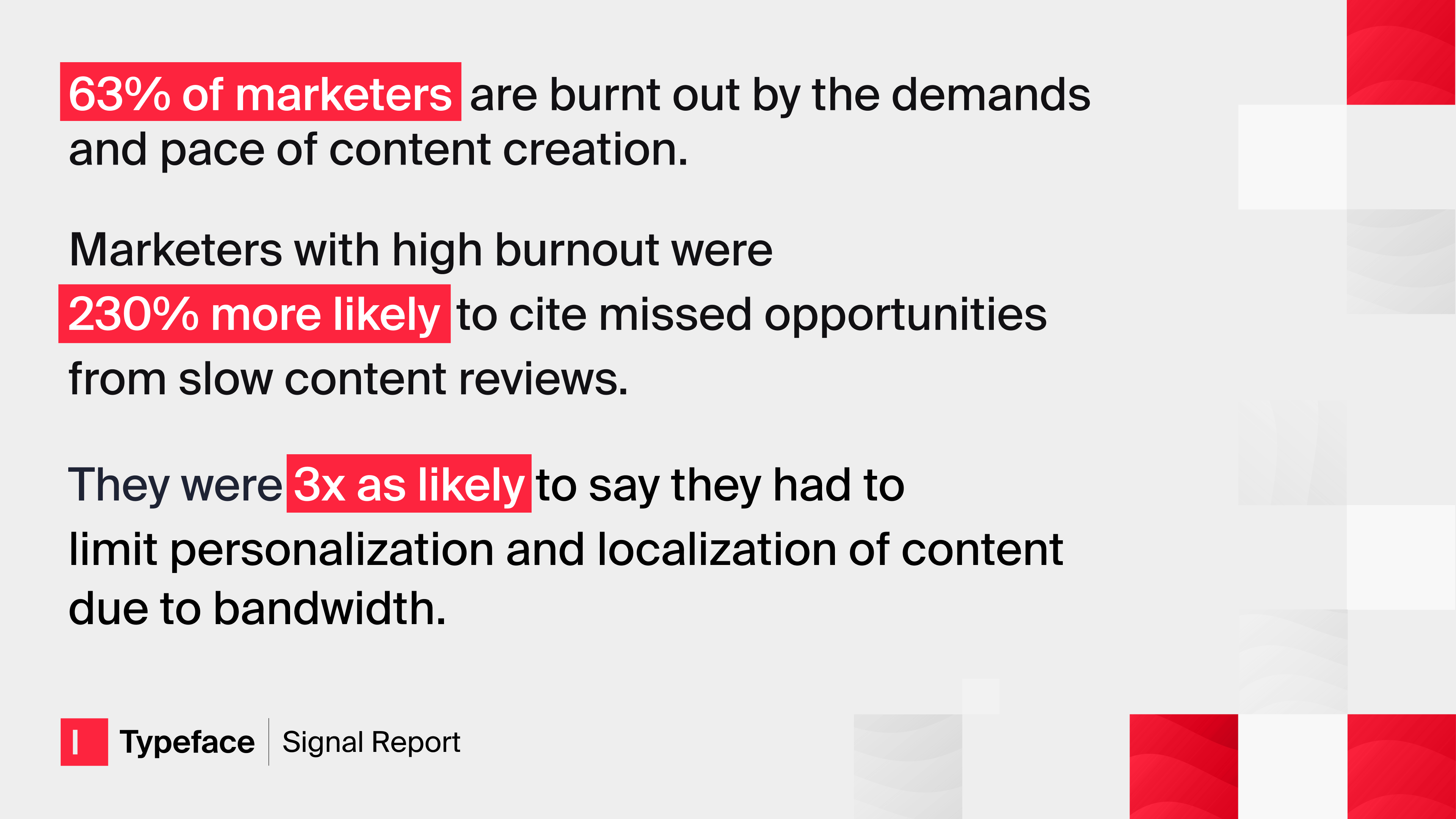
Burnout drives missed opportunities. Marketers experiencing high burnout are 230% more likely to say their brand misses cultural moments due to slow approvals, and more than 3x as likely to limit personalization or localization.
Outdated processes block action: Overall, 67% of marketers say review and approval processes regularly cause missed moments.
AI helps - but systems still lag: While 87% say AI speeds content creation, most (55%) are still relying on chatbots to help them with written content only, instead of multimodal content generation tools or AI-powered marketing systems.
Personalization still falls short: 43% of marketers are still manually creating different variations, while 17% limit personalization due to time or resource constraints.
AI frees marketers to focus on strategy: 68% say AI gives them more time for strategic and creative work, signaling where teams see the most potential.
The research also highlights a significant opportunity: brands that invest in connected systems, automated brand safeguards, and trusted workflows are far better positioned to move quickly without sacrificing creativity, quality, or control - especially as teams rethink how tools, approvals, and brand standards work together. Those using an AI marketing platform that can create multimodal content are 92% more likely to automate personalization and localization than those using point video or image solutions. The findings suggest that teams using AI to create and manage multiple content formats and variations are better positioned to move quickly while maintaining brand consistency across channels.
Despite these challenges, marketers see growing potential to improve how teams respond to cultural moments as systems, processes, and trust evolve.
"AI can help teams move faster, but its real value is helping marketers act with confidence - staying creative and on-brand even in high-visibility moments," Ing added.
The Typeface Signal Report: Big Game Edition is based on an online survey of 200+ marketing professionals responsible for digital content across social, web, email, and mobile channels. The survey was conducted between November 19 and December 9, 2025.
Respondents spanned manager- to VP-level roles and represented organizations including large enterprises, across industries such as retail, financial services, professional services, manufacturing, healthcare, education, and hospitality. Results are reported in aggregate. To explore the full findings and download The Signal Report: Big Game Edition, click here.
About Typeface
Typeface is the first campaign orchestration platform powered by agentic AI. From a single brief and brand guidelines, Typeface enables Fortune 500 enterprises to create personalized emails, ads, web pages, and videos - all generated, approved, and optimized in one secure workspace that connects seamlessly with existing martech tools like Salesforce, Microsoft, and Google. Backed by Lightspeed, GV, Salesforce Ventures, Madrona, Menlo, and M12, Typeface has been recognized by Gartner, TIME, LinkedIn, Fast Company, and Adweek as a leader in AI for marketing. Learn more at www.typeface.ai.
CONTACT:
Courtney Brigham, Typeface Head of Comms
courtney@typeface.ai
SOURCE: Typeface
View the original press release on ACCESS Newswire