Rising electrification, high-voltage packaging constraints, and multi-gigabit data networks accelerate adoption of advanced shielding materials and integrated harness protection systems
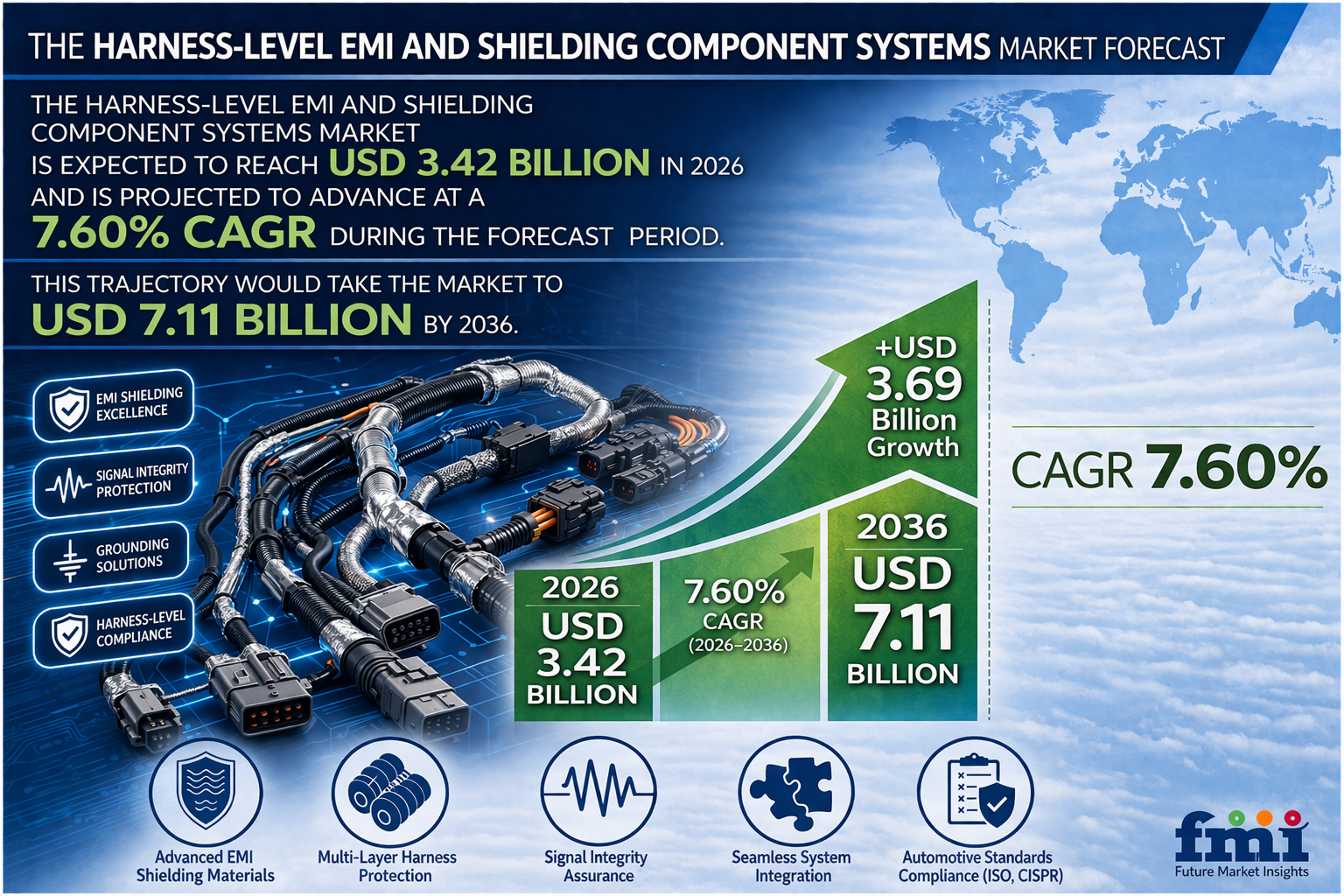
NEWARK, DE / ACCESS Newswire / April 9, 2026 / According to the latest analysis by Future Market Insights, the global harness-level EMI and shielding component systems market is entering a critical transformation phase as automakers intensify efforts to manage electromagnetic interference in increasingly complex electrical architectures. Valued at USD 3.18 billion in 2025, the market is projected to reach USD 3.42 billion in 2026 and expand to USD 7.11 billion by 2036, registering a CAGR of 7.60% during the forecast period.
This growth reflects a structural shift in vehicle electronics, where electrification, high-speed data transmission, and dense packaging are redefining how wiring harnesses are designed, protected, and validated. What was once a supporting component category is now a compliance-critical system directly influencing vehicle safety, signal integrity, and homologation outcomes.
Get detailed market forecasts, competitive benchmarking, and pricing trends:
https://www.futuremarketinsights.com/reports/sample/rep-gb-32603
Market Value Analysis: High-Density Architectures Increase Shielding Intensity
Between 2026 and 2030, adoption of advanced EMI shielding solutions is expected to accelerate as automakers transition toward high-voltage and high-speed electrical systems. The move to tightly packaged battery and inverter layouts significantly increases interference risks, forcing OEMs to integrate shielding solutions early in the design cycle.
Organizations are increasingly prioritizing:
Multi-layer shielding systems combining metallic foils and braided structures
Lightweight materials that balance conductivity with weight reduction
Integrated shielding within harness architectures rather than add-on solutions
High-performance grounding and connector termination systems
Design synchronization between electrical, thermal, and packaging teams
Failure to implement robust EMI protection exposes automakers to signal degradation, sensor malfunction, and compliance risks-particularly in ADAS and autonomous systems where data integrity is critical.
From 2030 to 2036, growth will be driven by expansion of zonal E/E architectures, increasing adoption of high-speed automotive Ethernet, and rising regulatory scrutiny around electromagnetic compatibility.
Technology Evolution: Advanced Materials and Integrated Designs Redefine Shielding
The evolution of harness-level EMI shielding systems is being shaped by innovations in material science, connector design, and high-frequency signal management. As vehicle electronics become more sophisticated, shielding solutions must deliver higher performance within tighter physical constraints.
Key innovations include:
Multi-layer foil laminates for high-frequency interference suppression
Conductive polymer composites reducing reliance on heavy copper braids
Nickel-plated copper materials improving corrosion resistance and grounding
Integrated connector backshells enabling seamless shielding continuity
High-speed shielding solutions for automotive Ethernet and sensor networks
A key challenge lies in balancing shielding effectiveness with weight and manufacturability. While metallic solutions offer superior performance, they increase mass and complexity, requiring careful optimization across vehicle segments.
An industry analyst notes:
"Electromagnetic compatibility is no longer a validation checkpoint-it is a design foundation. Shielding decisions made early in the harness architecture now determine system reliability and platform success."
EMI Shielding Becomes Core to Vehicle Reliability and Compliance
As vehicle electronics density increases, EMI shielding systems are becoming essential to ensuring reliable operation across powertrain, safety, and connectivity functions. These components are critical in preventing interference between high-voltage power lines and sensitive data circuits.
Core capabilities include:
Suppression of electromagnetic interference across high- and low-voltage systems
Protection of sensor data integrity in ADAS and autonomous applications
Reliable grounding and signal continuity across complex harness layouts
Compatibility with high-speed data transmission protocols
Integration with automated manufacturing and assembly processes
This shift is elevating EMI shielding from a supporting function to a core enabler of vehicle performance, safety, and regulatory compliance.
Speak to Analyst: Customize insights for your business strategy:
https://www.futuremarketinsights.com/customization-available/rep-gb-32603
Segment Spotlight
Shielded Cables Lead Product Type (34.0%)
Central role in both power transmission and high-speed data integrity drives dominance.
Aluminum Leads Material Segment (38.0%)
Lightweight properties support vehicle efficiency and electrification goals.
High-Voltage Circuits Lead Circuit Class (44.0%)
Electrified platforms require intensive shielding for battery and inverter systems.
Battery Electric Vehicles Lead Vehicle Type (41.0%)
Higher electrical complexity increases shielding requirements per vehicle.
OEM Integration Dominates (89.0%)
Shielding is embedded during vehicle design and validation phases.
Regional Insights: Electrification and Electronics Density Drive Demand
The harness-level EMI and shielding component systems market is expanding across regions with strong electrification momentum and advanced automotive manufacturing ecosystems.
Country |
CAGR (2026-2036) |
Key Growth Drivers |
China |
10.1% |
Rapid EV production and centralized vehicle computing adoption |
India |
9.4% |
Electrification growth and localization of component supply |
South Korea |
8.7% |
Export-driven battery platforms and advanced electronics |
United States |
7.8% |
Autonomous systems and high-speed data network adoption |
Mexico |
7.4% |
Nearshoring and regional assembly expansion |
Germany |
7.0% |
Premium vehicle complexity and high-performance requirements |
Japan |
6.5% |
Strong quality standards in hybrid and electronic systems |
Regional growth variations are driven by electrification intensity, electronics integration, and local manufacturing capabilities.
Opportunities: Next-Generation Shielding Ecosystems Emerge
Key opportunities shaping the market include:
Development of lightweight conductive polymer shielding materials
Integration of shielding within connector and harness design
Expansion of high-frequency EMI solutions for advanced connectivity
Localization of extrusion, braiding, and termination facilities
Automation of shielding application in high-volume production
These opportunities are enabling suppliers to move beyond traditional materials toward integrated, high-value engineering solutions.
Competitive Landscape: Validation Expertise and Scale Drive Leadership
The market remains highly competitive, with strong barriers to entry due to stringent validation requirements and capital-intensive manufacturing processes.
Leading companies include:
Yazaki Corporation
Aptiv PLC
Sumitomo Electric Industries
TE Connectivity
Amphenol Corporation
LEONI AG
HellermannTyton
Competitive differentiation is driven by:
Pre-validated EMC-compliant component portfolios
Global manufacturing and localization capabilities
Expertise in high-voltage and high-frequency shielding solutions
Integration with OEM and Tier-1 harness ecosystems
Ability to support automated assembly processes
Future Outlook: EMI Shielding Becomes Foundational to Vehicle Architecture
Looking ahead to 2036, harness-level EMI shielding systems will become increasingly sophisticated as vehicle architectures evolve toward higher electrification and connectivity.
Key trends include:
Expansion of high-voltage and high-speed electrical systems
Increased adoption of zonal architectures reducing cable length but increasing shielding complexity
Growing importance of signal integrity in autonomous driving systems
Integration of lightweight, multi-material shielding solutions
Alignment of shielding design with automated manufacturing processes
As vehicles become more electrically complex, harness-level EMI and shielding systems will transition from protective components to foundational elements of modern automotive design-ensuring reliable performance, regulatory compliance, and long-term system integrity.
Unlock 360° insights for strategic decision making and investment planning:
https://www.futuremarketinsights.com/checkout/32603
Browse More Automotive Industry Reports:
Cargo Vans Market - https://www.futuremarketinsights.com/reports/cargo-vans-market
Business Jet Market - https://www.futuremarketinsights.com/reports/business-jet-market
High-Temperature Brake Line Couplings Market - https://www.futuremarketinsights.com/reports/high-temperature-brake-line-couplings-market
Radar Detectors Market - https://www.futuremarketinsights.com/reports/radar-detectors-market
EV Charging Cable Market - https://www.futuremarketinsights.com/reports/ev-charging-cables-market
About Future Market Insights (FMI)
Future Market Insights (FMI) is a leading provider of market intelligence and consulting services, serving clients in over 150 countries. Headquartered in Delaware, USA, with a global delivery center in India and offices in the UK and UAE, FMI delivers actionable insights to businesses across industries including automotive, technology, consumer products, manufacturing, energy, and chemicals.
An ESOMAR-certified research organization, FMI provides custom and syndicated market reports and consulting services, supporting both Fortune 1,000 companies and SMEs. Its team of 300+ experienced analysts ensures credible, data-driven insights to help clients navigate global markets and identify growth opportunities.
For Press & Corporate Inquiries
Rahul Singh
AVP - Marketing and Growth Strategy
Future Market Insights, Inc.
+91 8600020075
For Sales - sales@futuremarketinsights.com
For Media - Rahul.singh@futuremarketinsights.com
For web - https://www.futuremarketinsights.com/
SOURCE: Future Market Insights, Inc.
View the original press release on ACCESS Newswire