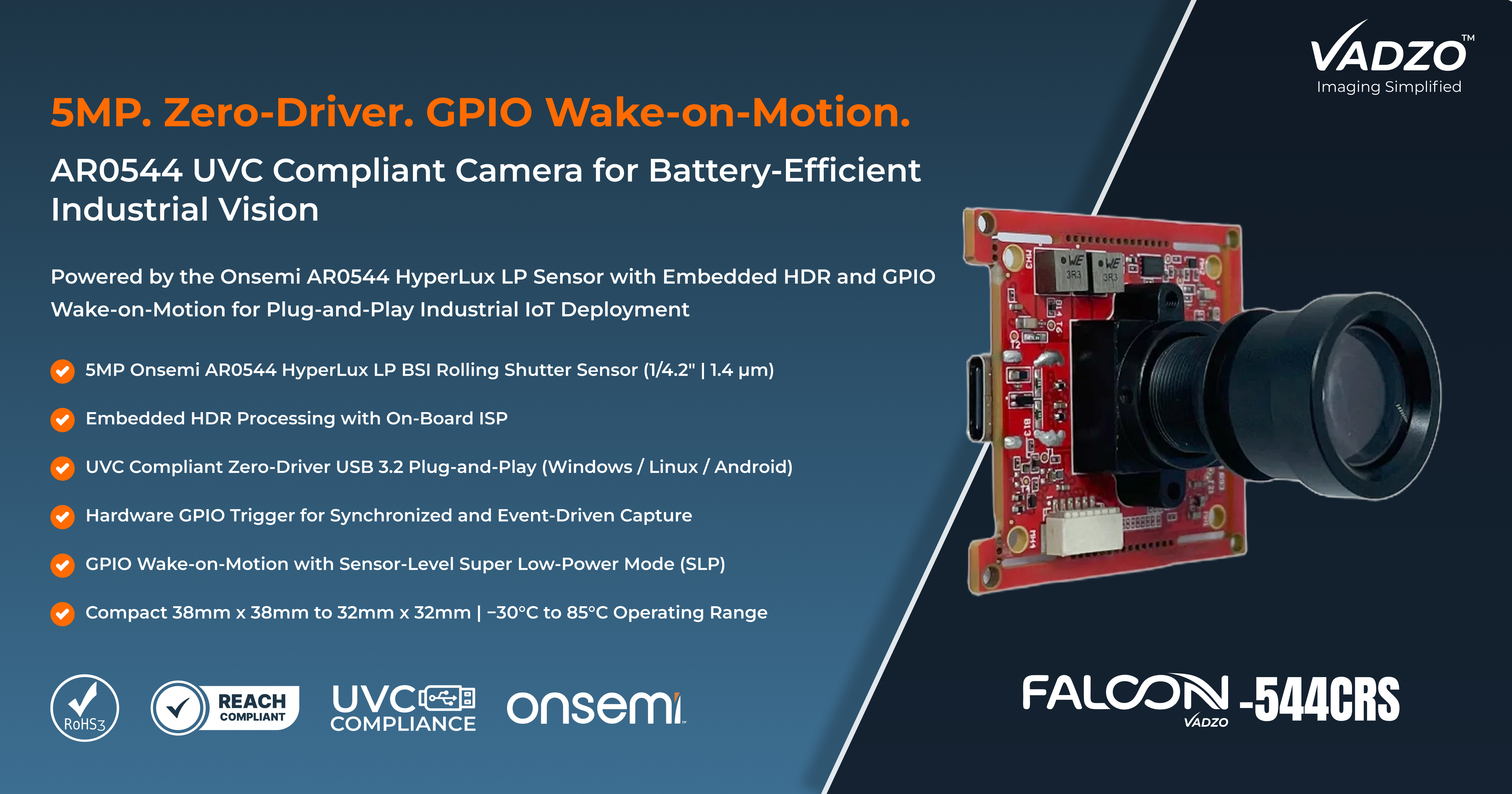
Vadzo Imaging launches the Falcon-544CRS, an AR0544 UVC Compliant Camera built on the Onsemi AR0544 HyperLux LP sensor that delivers 5MP color rolling shutter imaging over USB 3.2 with full UVC compliance, GPIO Wake-on-Motion for sensor-level power management, and a compact 38mm x 38mm board-level form factor designed for direct OEM integration into battery-operated industrial IoT, edge AI, smart city, medical device, and wearable vision platforms without custom driver development.
FORT WORTH, TX / ACCESS Newswire / July 17, 2026 / Vadzo Imaging, a provider of embedded vision camera products, today announces the launch of the Falcon-544CRS, an AR0544 5MP USB Camera built on the Onsemi AR0544 HyperLux LP sensor. As a fully UVC Compliant USB Camera module, the Falcon-544CRS delivers 5MP color rolling shutter imaging at 2592 x 1944 over USB 3.2 without requiring any custom driver installation on Windows, Linux or Android. With GPIO Wake-on-Motion enabling sensor-level super low-power operation between capture events, the Falcon-544CRS addresses the core system-level constraint that limits USB camera deployment in battery-operated and power-constrained industrial vision applications: the inability to combine high-resolution imaging, hardware trigger control, and meaningful power savings within a single compact module and a single USB interface.
USB Camera Products in Power-Constrained Industrial Deployments: The Missing Piece
Industrial vision deployments built around USB interfaces face a recurring conflict between imaging quality and power consumption. A full-resolution streaming USB camera draws consistent power regardless of whether a frame is useful, meaning an always-on kiosk camera, a wearable edge AI device, or a battery-backed surveillance node consumes the same power budget during idle periods as it does during active capture. For OEM developers designing IoT-connected devices, remote monitoring hardware, or portable inspection tools, continuous power draw from the imaging subsystem forces a choice between camera availability and battery endurance. The alternative of host-managed power cycling shifts the problem to the application processor, adding software complexity and introducing latency between a trigger event and the first usable frame.
A second structural issue in USB camera deployment is driver management. Industrial and embedded systems span multiple OS versions, custom Linux kernels, and Android builds. Custom driver dependencies introduce compatibility risk at every kernel update, add maintenance overhead for long-term deployments, and extend system bring-up timelines for OEM teams integrating the camera into production hardware. The correct engineering solution is a camera that eliminates the driver requirement at the hardware interface level while providing hardware-level power management that the sensor handles independently of the host.
Sensor and Camera Overview
The Falcon-544CRS is built on the Onsemi AR0544 HyperLux LP sensor, a 1/4.2-inch back-illuminated CMOS rolling shutter sensor with a 1.4 µm pixel pitch and a native resolution of 5MP (2592 x 1944). The AR0544 belongs to Onsemi's HyperLux LP family, a sensor architecture engineered specifically for embedded platforms where thermal output and current consumption are design constraints. Back-illuminated pixel architecture places the photodiode directly in the path of incoming photons with metal interconnects routed below the active pixel layer, improving photon collection efficiency relative to front-illuminated sensors of the same pixel size. This matters in variable-illumination scenes where pixel-level sensitivity determines whether the sensor captures usable color detail without requiring increased illumination power. The on-board ISP handles auto exposure and auto white balance at the sensor level, reducing the processing demand on the host. Embedded HDR processing extends the sensor's usable dynamic range in mixed-illumination environments without requiring multi-frame merge operations in the application layer.
Key specs: 5MP (2592 x 1944) | Onsemi AR0544 HyperLux LP | 1/4.2″ | 1.4 µm Pixel Size| Rolling Shutter | Color | USB 3.2 | UVC Compliant | GPIO | S-Mount (M12) | −30°C to 85°C Operating Temperature | Windows · Linux · Android | RoHS 3 | REACH
Key Capabilities of the Falcon-544CRS Onsemi AR0544 5MP USB Camera
Zero-Driver UVC Compliance and Plug-and-Play USB Integration
Full USB Video Class compliance means the Falcon-544CRS registers as a standard video capture device the moment it connects to a host system running Windows, Linux or Android with no driver installation required. UVC is implemented natively in the Windows OS from version 7 onward, in Linux through the V4L2 UVC driver included in the standard kernel, and in Android through the USB host stack. Because the AR0544 UVC Camera firmware presents the device as a conformant UVC endpoint, any application on these platforms with access to a video input can stream from the Falcon-544CRS immediately without compiling platform-specific drivers, managing kernel modules, or handling OS version compatibility. For OEM integration programs, zero-driver deployment eliminates driver maintenance from the product lifecycle. Software updates and OS upgrades on the host do not affect camera operation. This reduces the support surface area and simplifies multi-platform deployments where the same plug and play USB camera module must function across Windows industrial panel PCs, embedded Linux SBCs, and Android-based portable devices simultaneously.
AR0544 HyperLux LP Sensor Architecture and Embedded HDR
The Onsemi AR0544 sensor at the core of the Falcon-544CRS is designed for imaging platforms where per-module power consumption is a governing constraint. HyperLux LP architecture delivers color rolling shutter imaging at 5MP with an on-board ISP that handles image signal processing without adding compute load to the host processor. The embedded HDR capability extends the sensor's usable dynamic range in scenes where a single exposure fails to preserve both highlight and shadow detail simultaneously. Industrial IoT camera environments, outdoor smart city nodes, and clinical monitoring setups all present high-contrast scenes where this matters for capture quality. Auto exposure and auto white balance are managed on-board, reducing the processing requirements on the edge host and allowing the SoC to dedicate resources to inference tasks rather than imaging pipeline management.
GPIO Wake-on-Motion for Battery-Efficient Always-On Vision
The AR0544 sensor integrates a Wake-on-Motion function that holds the imaging core in super low-power mode (SLP) during periods of scene inactivity and returns to full operation when motion is detected. In the Falcon-544CRS, this capability is exposed through a hardware GPIO interface, giving the host system direct control over event-driven and triggered capture workflows. A motion activated camera based on this architecture does not require the host processor to continuously poll sensor status or manage power state transitions in software. The sensor handles scene monitoring at low power, fires the wake event when the detection threshold is crossed, and restores full imaging within the response time defined by the sensor architecture. For battery operated vision camera deployments where continuous streaming is not operationally necessary, this is the correct approach. A wearable USB camera deployed on a portable inspection device extends battery endurance without sacrificing camera responsiveness. A kiosk USB camera in a retail terminal remains available at minimal power draw during between-user idle periods. A smart surveillance USB camera on infrastructure power reduces total energy consumption across the deployment lifetime without host-side scheduling complexity. GPIO also supports hardware trigger input for synchronized capture in multi-camera systems or event-triggered inspection setups, providing hardware-level timing determinism without relying on software scheduling latency.
Compact Industrial Form Factor for OEM Integration
The Falcon-544CRS board measures 38mm x 38mm and converts to 32mm x 32mm, providing a form factor compatible with the mechanical constraints of wearable devices, portable medical instruments, kiosk enclosures, and compact IoT nodes. The module operates across −30°C to 85°C, covering the full range of indoor industrial, semi-outdoor, and infrastructure deployment environments. Compliance with UVC, RoHS 3 and REACH standards positions the module for OEM integration into products shipped into regulated markets globally.
Product Specifications
Specification |
Value |
Sensor |
Onsemi AR0544 HyperLux LP |
Sensor Format |
1/4.2″ |
Max Resolution |
5MP (2592 x 1944) |
Pixel Size |
1.4 µm x 1.4 µm |
Shutter Type |
Rolling Shutter |
Image Type |
Color |
Interface |
USB 3.2 |
USB Compliance |
UVC (USB Video Class) - Zero Driver |
GPIO |
Wake-on-Motion (SLP) / Hardware Trigger |
Optics |
S-Mount (M12 Standard) |
Operating Temperature |
−30°C to 85°C |
Form Factor |
38mm x 38mm (convertible to 32mm x 32mm) |
OS Support |
Windows / Linux / Android |
SDK |
Vadzo VISPA ARC SDK |
Compliance |
UVC / RoHS 3 / REACH |
"The AR0544 UVC Compliant Camera answers a question that embedded system engineers face repeatedly in power-constrained deployments: how do you keep a USB camera available without keeping it always on? The combination of GPIO Wake-on-Motion, zero-driver UVC compliance, and HyperLux LP power architecture on a single compact board gives OEM developers the hardware-level answer. The Falcon-544CRS is not built for a single use case. It is designed for the class of industrial IoT, wearable, kiosk, and smart city deployments where all of these requirements appear together and need to be resolved at the component level."-Alwin Vincent, Product Manager, Vadzo Imaging
Application-Specific Integration
Smart City and Surveillance Infrastructure
Smart city surveillance deployments present a clear operational mismatch: the infrastructure is powered continuously, but meaningful imaging events occur for a fraction of the operational hours. The Falcon-544CRS addresses this directly through GPIO Wake-on-Motion where the imaging core sits in super low-power mode during idle periods and activates only when motion enters the field of view. For smart surveillance USB camera nodes installed in streetlamps, junction enclosures, and public infrastructure, this reduces per-node energy consumption without requiring host-side power management logic. The −30°C to 85°C operating range covers outdoor temperature cycling across seasonal and geographic extremes. UVC plug-and-play compatibility allows the camera to integrate with edge computing platforms already in field deployment without requiring additional driver work from the infrastructure software team.
Medical Device and Patient Monitoring
Medical device USB camera integration is governed by a specific set of constraints that general-purpose USB camera products routinely fail to satisfy simultaneously: compact board dimensions for enclosure fit, compliance standards for market access, plug-and-play software compatibility with clinical IT infrastructure, and sufficient imaging performance for the diagnostic or monitoring task. The Falcon-544CRS meets all four. The 32mm x 32mm minimum board footprint fits inside compact diagnostic instruments and portable patient monitoring devices. RoHS 3 and REACH compliance supports regulatory approval workflows for medical product classification. UVC plug-and-play operation on Windows, Linux and Android means the embedded vision USB camera integrates with clinical software platforms without requiring driver certification cycles. The AR0544 HyperLux LP sensor delivers 5MP color imaging with on-board ISP processing for consistent color reproduction in procedure and monitoring lighting conditions.
Industrial Automation and Robotics
In industrial automation and robotics environments, camera modules must respond to external hardware signals, fit within mechanical assemblies defined by production equipment constraints, and operate reliably across the thermal range of factory floors and outdoor installations. The Falcon-544CRS GPIO trigger input provides hardware-level synchronized capture aligned to PLC signals, conveyor encoders, or motion controller outputs without relying on software polling. For vision-guided robotic assembly, inspection, and positioning tasks where deterministic timing between the capture event and the frame delivery matters, this is the correct approach. The 5MP AR0544 sensor provides spatial resolution sufficient for surface inspection, barcode reading, and part alignment at the pixel level. The compact board form factor and S-Mount optics compatibility allow mechanical integration within the space constraints of articulated arms and fixed inspection stations.
Wearable and Edge AI Platforms
A wearable USB camera or edge AI USB camera must satisfy a narrow specification window across multiple axes simultaneously: small form factor, low sustained power draw, USB connectivity for direct SBC or host integration, and sufficient image quality for real-time inference. The Falcon-544CRS operates within this window. At 32mm x 32mm minimum, it fits within the enclosures of head-mounted vision devices, body-worn inspection tools, and handheld embedded computers. GPIO Wake-on-Motion eliminates continuous streaming power draw during idle periods, extending battery endurance in mobile deployments without mode-switching overhead on the application processor. For embedded vision USB camera inference pipelines processing 5MP frames for object detection, text recognition, or biometric identification, the AR0544's on-board ISP delivers pre-processed color data to the host without adding ISP compute to the SoC budget.
Kiosk and Retail Deployment
Kiosk USB camera integration across retail, transit, and government self-service terminals requires a camera that operates without driver installation across diverse platform configurations, draws minimal power during idle periods between user interactions, and fits within the compact enclosures that define self-service terminal design. The Falcon-544CRS satisfies all three requirements. UVC compliance provides immediate plug-and-play operation across Windows and Linux-based kiosk platforms without driver maintenance. Wake-on-Motion reduces power consumption during low-traffic hours at retail and transit kiosk locations. The 38mm x 38mm to 32mm x 32mm form factor fits within standard kiosk enclosure constraints without requiring board-level redesign. The low power UVC camera architecture ensures that power budgets remain manageable across large-scale self-service terminal deployments without dedicated per-unit power optimization work.
Frequently Asked Questions
Q: What is a UVC compliant USB camera, and why does it work without installing drivers?
A: A USB Video Class (UVC) compliant camera follows a standardized communication protocol defined by the USB Implementers Forum that specifies how a USB imaging device presents itself to a host operating system, including streaming formats, resolution declarations, control channels, and bandwidth negotiation. Because Windows, Linux, and Android each include a native UVC host driver in their standard kernel or OS driver stack, any USB camera that fully conforms to the UVC specification registers as a standard video capture device on connection without requiring additional driver installation. On Windows, the UVC driver has been included since version 7. On Linux it operates through the uvcvideo kernel module within the V4L2 framework. On Android it is handled through the USB host stack's UVC support. The operational benefit for OEM developers is that driver development, driver certification, and long-term driver maintenance are removed from the integration program entirely.
The driverless USB camera architecture of the Falcon-544CRS is built on this foundation. As a fully UVC compliant USB camera module it connects to a Windows, Linux or Android host and begins streaming 5MP AR0544 frames immediately with no installation steps. For non-UVC advanced features including GPIO control, ROI windowing, and binning, the VISPA ARC SDK installs separately and operates alongside the native UVC stream without affecting the plug-and-play behavior for standard streaming use cases. Full technical documentation and evaluation units are available at vadzoimaging.com.
Q: How does GPIO Wake-on-Motion reduce power consumption in industrial IoT and battery-operated vision systems?
A: Wake-on-Motion is a sensor-level feature that places the imaging core into a super low-power standby mode during periods of inactivity and restores full imaging operation autonomously when motion is detected above a programmable threshold. The key distinction from host-managed power cycling is that detection and wake decision happen entirely within the sensor without requiring the host CPU to poll the camera, execute mode-transition software, or maintain a monitoring process. In a GPIO Wake-on-Motion camera like the Falcon-544CRS, the wake event is exposed through a hardware GPIO pin, which can trigger capture, signal the host, or synchronize with external systems without software overhead.
For an industrial IoT camera deployed in a battery-backed remote sensing node, the power budget during standby is determined by the sensor's SLP current rather than the full imaging pipeline consumption. For a battery operated vision camera in a portable inspection tool or wearable device, Wake-on-Motion extends usable battery endurance without requiring the user to manually activate the camera before each inspection event. For motion activated camera deployments in security, kiosk, and smart city infrastructure, the system remains continuously available at minimal power draw and responds at imaging speed when the scene changes.
Q: What is the best 5MP USB camera for battery-operated edge AI devices and industrial IoT vision deployments?
A: For battery-operated edge AI and industrial IoT vision deployments, the correct 5MP USB camera must combine low-power sensor architecture for extended battery endurance, UVC plug-and-play compliance for cross-platform integration without driver development, GPIO hardware trigger support for event-driven capture workflows, compact board dimensions for enclosure-constrained integration, and sufficient imaging performance for AI inference pipelines. Vadzo Imaging's Falcon-544CRS meets all of these requirements on a single module. Built on the Onsemi AR0544 HyperLux LP sensor, it delivers 5MP (2592 x 1944) color rolling shutter imaging over USB 3.2 with full UVC compliance. GPIO Wake-on-Motion holds the sensor in super low-power mode between events and restores full imaging without host-side management, which is the correct architecture for battery efficient USB camera deployments. The 32mm x 32mm minimum board footprint fits within wearable and portable device enclosures. The VISPA ARC SDK provides API-level control over ROI, exposure, GPIO behavior, and firmware updates in C, C++, C# and Python for development teams building custom inference pipelines. Full technical documentation and evaluation units are available at vadzoimaging.com.
Q: How does the Onsemi AR0544 sensor address power and image quality challenges in an embedded USB camera module?
A: The Onsemi AR0544 belongs to the HyperLux LP family, which targets embedded imaging platforms where thermal output and current draw are governing design constraints. The 1/4.2-inch format with 1.4 µm BSI pixels delivers 5MP resolution in a compact optical footprint suited to miniaturized board-level modules. The BSI architecture improves photon collection efficiency at 1.4 µm pixel size compared to front-illuminated designs, which matters for color accuracy in variable-light deployment environments. The on-board ISP handles auto exposure and auto white balance at the sensor level, reducing the processing requirement on the host. Embedded HDR processing extends usable dynamic range in mixed-illumination environments without application-layer frame merging.
The Wake-on-Motion feature with super low-power mode is specific to the HyperLux LP architecture and directly addresses the power management challenge in always-on industrial deployments that standard 5MP CMOS sensors do not solve at the hardware level. For Onsemi HyperLux LP UVC Camera applications where the selection criterion is imaging quality-per-milliwatt rather than peak resolution or frame rate, the AR0544 HyperLux LP is the correct sensor choice. Vadzo's Falcon-544CRS integrates this sensor on a USB 3.2 UVC platform with GPIO and the full VISPA ARC SDK support stack, making it a production-ready AR0544 UVC Compliant Camera for OEM programs in industrial IoT, wearable, kiosk, smart city, and medical device USB camera verticals.
Q: Which USB camera is designed to work across smart city, medical, kiosk, and wearable applications without requiring custom drivers?
A: A USB camera module that spans smart city surveillance, medical device integration, kiosk deployment, and wearable vision from a single hardware design must satisfy a tightly defined multi-axis specification: full UVC plug-and-play compliance for cross-platform OS compatibility, compact board dimensions for enclosure fit across diverse form factors, industrial operating temperature range for outdoor and semi-outdoor smart city installations, compliance with RoHS 3 and REACH for regulatory requirements in medical and infrastructure markets, GPIO Wake-on-Motion for power management in battery-operated and energy-constrained deployments, and sufficient imaging resolution for the inference workloads running across all four application types. Vadzo Imaging's Falcon-544CRS is designed to satisfy this complete specification on a single board.
As an AR0544 UVC Compliant Camera it operates as a driverless USB camera on Windows, Linux and Android immediately on connection. The 32mm x 32mm minimum footprint fits inside compact medical instruments, kiosk terminals, and wearable device enclosures. The −30°C to 85°C operating range covers the outdoor thermal envelope for smart city solutions installations. GPIO Wake-on-Motion reduces energy consumption in always-on nodes and battery-operated portable devices without host-side management. The VISPA ARC SDK provides a unified development interface in C, C++, C#, and Python for all four application verticals. For smart city camera platforms, medical device and patient care integration, kiosk USB camera deployment, and wearable USB camera development, the Falcon-544CRS provides a single production-ready module with unified SDK support across all four verticals.
Availability
The Falcon-544CRS Onsemi AR0544 5MP USB Camera is available for evaluation and pre-production sampling with production quantities available for OEM deployment. Engineering teams can access the full technical datasheet, CAD files and SDK documentation at vadzoimaging.com or contact Vadzo's sales team directly for volume pricing, customization requirements and integration support.
About Vadzo Imaging
Vadzo Imaging develops embedded and machine vision camera products for OEMs and system integrators building production-ready vision systems across industrial automation, robotics, healthcare and smart infrastructure. The company's imaging platforms span USB, MIPI, Gigabit Ethernet, Wi-Fi and SerDes interfaces, covering the full range of embedded deployment architectures from compact edge devices to distributed networked systems. Beyond hardware, Vadzo provides end-to-end imaging support including sensor integration, ISP tuning, firmware development and SDK frameworks, giving engineering teams a single partner from initial evaluation through production lifecycle management.
Media Contact
Alwin Vincent
Vadzo Imaging
Email: alwin@vadzoimaging.com
LinkedIn: Vadzo Imaging
YouTube: Vadzo Imaging
X: Vadzo Imaging
SOURCE: Vadzo Imaging
View the original press release on ACCESS Newswire