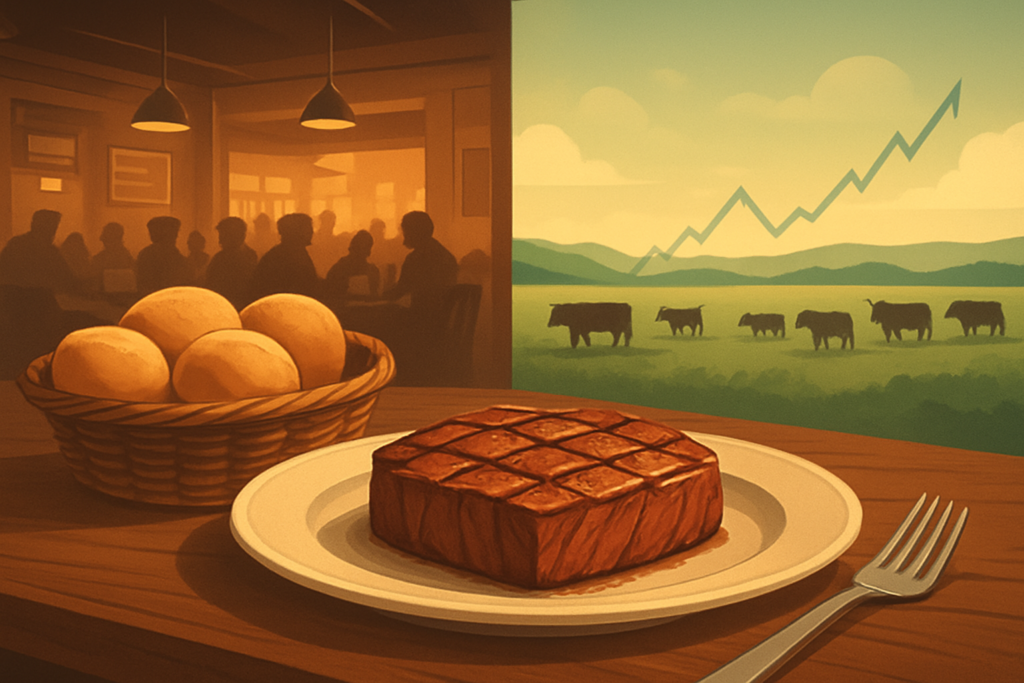
As of February 19, 2026, the casual dining landscape remains a battlefield of "value versus volume." While many legacy chains have struggled to maintain foot traffic amidst a more cost-conscious consumer base, Texas Roadhouse, Inc. (NASDAQ: TXRH) continues to defy the gravity of the broader restaurant sector. Known for its "Legendary Food, Legendary Service" mantra, TXRH has solidified its position as a market leader, not merely by offering low prices, but by delivering a perceived value that has kept its dining rooms packed even as menu prices across the industry hit record highs.
Today, Texas Roadhouse is more than just a steakhouse; it is a multi-brand powerhouse currently navigating a complex macroeconomic environment characterized by a historic "beef crisis" and a stabilizing labor market. With over 800 locations and a stock price that has tested new all-time highs in early 2026, the company is a case study in operational excellence and cultural consistency.
Historical Background
Founded in 1993 by the late Kent Taylor in Clarksville, Indiana, Texas Roadhouse was born out of a vision to create a "neighborhood destination" where guests could enjoy hand-cut steaks, made-from-scratch sides, and fresh-baked bread at an affordable price. Taylor’s hands-on leadership and often unconventional approach—such as prioritizing the "Line Dance" culture and refusing to use television advertising for decades—created a fiercely loyal customer base and a unique corporate identity.
The company went public in 2004, and over the following two decades, it evolved from a regional favorite into a national powerhouse. A pivotal moment in the company’s history occurred in March 2021 following the passing of Kent Taylor. Many analysts questioned whether the "Roadhouse Magic" could survive without its visionary founder. However, the transition to Jerry Morgan, a 29-year company veteran, proved seamless. Morgan has preserved Taylor's culture-first philosophy while steering the company through the post-pandemic recovery and into its current era of technological modernization.
Business Model
Texas Roadhouse operates a high-volume, "value-first" business model. Unlike many competitors that rely on heavy discounting or limited-time offers, TXRH focuses on high table turns and massive portions to drive profitability.
The company’s revenue streams are diversified across three primary pillars:
- Texas Roadhouse: The flagship brand, specializing in hand-cut steaks and ribs. These restaurants average over $140,000 in weekly sales, among the highest in the casual dining industry.
- Bubba’s 33: A sports-themed concept featuring pizza, burgers, and wings. This brand serves as a "growth engine," targeting a different demographic than the core steakhouse and offering significant white-space opportunities in suburban markets.
- Jaggers: A fast-casual burger and chicken concept that represents the company's foray into the high-growth quick-service segment. It currently includes both corporate and franchised locations.
Additionally, the company has increasingly focused on Franchise Consolidation. In 2024 and 2025, TXRH aggressively acquired domestic franchise locations, a strategic move intended to capture 100% of the cash flow and provide better operational control.
Stock Performance Overview
Texas Roadhouse has been a "quiet giant" in many growth portfolios.
- 1-Year Performance: Over the past twelve months, TXRH has outpaced the S&P 500's restaurant sub-index, up approximately 12.5% despite high beef prices.
- 5-Year Performance: Looking back to 2021, the stock has more than doubled, fueled by consistent double-digit revenue growth and aggressive share buybacks.
- 10-Year Performance: For long-term investors, TXRH has been a stellar performer, delivering a total return that vastly exceeds competitors like Darden Restaurants, Inc. (NYSE: DRI) or Bloomin' Brands, Inc. (NASDAQ: BLMN).
As of February 2026, the stock trades in the $187–$190 range, having recovered from a minor dip in late 2025 when commodity inflation fears peaked.
Financial Performance
Financial discipline has been a hallmark of the Morgan era. In the full fiscal year 2024, TXRH reported record revenue of $5.37 billion, a 16% year-over-year increase. Same-store sales grew an impressive 8.5%, largely driven by a 4.4% increase in guest traffic—a rarity in a year where many restaurants saw traffic declines.
By mid-2025, quarterly revenue crossed the $1.5 billion threshold for the first time. However, the bottom line has faced pressure. Restaurant-level margins, which once sat comfortably at 17-18%, dipped to 14.3% in Q3 2025 due to an 8% spike in commodity costs. Despite this, the company maintains a strong balance sheet with low debt-to-equity ratios and a healthy dividend yield that has grown consistently for over a decade.
Leadership and Management
CEO Jerry Morgan remains the central figure in the TXRH narrative. His leadership style is characterized by "servant leadership," prioritizing the needs of "Roadies" (employees) to ensure low turnover in a high-churn industry.
Under Morgan’s tenure, the company has embraced technology without losing its "analog" charm. The most significant initiative has been the rollout of Digital Kitchen Systems. By February 2026, over 65% of locations had replaced traditional paper tickets with digital screens, a move that has shaved precious minutes off order times and reduced waste—essential for maintaining margins in a high-cost environment.
Products, Services, and Innovations
While the "Hand-Cut Steak" is the star of the show, TXRH has innovated in other areas:
- The Butcher Shop: A retail/DTC (Direct-to-Consumer) platform that allows customers to order the same high-quality steaks found in the restaurant to their homes.
- To-Go Efficiency: Following the pandemic, TXRH revamped its "To-Go" infrastructure, creating dedicated entrances and parking for off-premise orders, which now account for roughly 12-13% of total sales.
- Bubba’s 33 Expansion: The "Road to 200" strategy for Bubba’s 33 is in full swing, with management aiming for double-digit openings in 2026 to leverage the brand's high average weekly sales of over $128,000.
Competitive Landscape
TXRH competes primarily with Darden Restaurants (LongHorn Steakhouse) and Bloomin' Brands (Outback Steakhouse). However, TXRH consistently leads the pack in traffic growth. While LongHorn is its most direct rival, TXRH’s commitment to an "entry-level" luxury experience—where a high-quality steak dinner is still accessible to a middle-class family—gives it a defensive moat during economic downturns.
Its primary weakness remains its geographic concentration in the U.S. Midwest and South, though recent international expansions into South Korea and the Middle East are beginning to provide a small but growing cushion.
Industry and Market Trends
The defining trend of 2026 is the "Beef Super-Cycle." Due to drought conditions in 2023-2024, the U.S. cattle herd reached a 75-year low by early 2026. This has created a supply-demand imbalance that has kept wholesale beef prices elevated.
Furthermore, the "Value Wars" have intensified. While competitors have resorted to $10.99 meal deals, TXRH has resisted deep discounting, betting that its superior service and portion sizes are a more sustainable form of value.
Risks and Challenges
- Commodity Inflation: With beef representing 35% of its food basket, TXRH is highly sensitive to the cattle cycle. A 7% projected increase in beef costs for 2026 could continue to compress margins.
- Labor Regulation: Minimum wage hikes in several key states continue to pressure the "labor" line on the P&L. Management expects 3%–4% labor inflation in the coming year.
- Valuation: Trading at a P/E ratio of approximately 28x, the stock is "priced for perfection." Any miss in same-store sales could lead to a significant price correction.
Opportunities and Catalysts
- Digital Kitchen Rollout: The completion of the digital kitchen transition across the remaining 35% of stores could provide a tailwind for margins in late 2026.
- Jaggers Franchising: If the Jaggers concept gains traction with franchisees, it could shift TXRH toward a more asset-light model, potentially leading to a multiple rerating.
- Franchise Buybacks: Every acquired franchise store immediately adds to the top and bottom line, providing a predictable lever for growth.
Investor Sentiment and Analyst Coverage
Wall Street remains generally bullish on TXRH. As of February 2026, the consensus rating is a "Moderate Buy."
- Morgan Stanley has a price target of $208, highlighting the company’s ability to gain market share during periods of consumer stress.
- TD Cowen maintains a $215 target, anticipating that beef prices will moderate by the end of the year as herd rebuilding begins.
Institutional ownership is high at nearly 95%, suggesting that "smart money" views TXRH as a core holding in the consumer discretionary space.
Regulatory, Policy, and Geopolitical Factors
On the regulatory front, TXRH is closely monitoring agricultural policy and USDA reports. Government incentives for cattle ranchers to rebuild herds are a long-term positive, though the effects will not be felt until 2027 or 2028. Additionally, changes in overtime pay regulations and tipping laws (Fair Labor Standards Act updates) remain a constant focus for the legal team, as any shifts could drastically alter the cost structure of its labor-heavy business model.
Conclusion
Texas Roadhouse enters 2026 as a bastion of consistency in an inconsistent world. By focusing on the fundamentals of the dining experience—high-quality food, a lively atmosphere, and genuine hospitality—Jerry Morgan and his team have built a brand that can withstand even the most punishing commodity cycles.
For investors, the story of TXRH in 2026 is one of managing through the "beef crisis" while scaling newer concepts like Bubba’s 33. While the valuation is not "cheap" by traditional standards, the company’s track record of traffic growth suggests that it remains the "Gold Standard" of casual dining. Investors should watch the quarterly margin reports and the progress of the Jaggers expansion as key indicators of the next leg of growth.
This content is intended for informational purposes only and is not financial advice. Today's Date: February 19, 2026.