As of March 24, 2026, the global electric vehicle (EV) landscape has undergone a tectonic shift, and perhaps no company exemplifies this transformation more than NIO Inc. (NYSE: NIO). Once characterized by high cash burn and skepticism from Wall Street, NIO has emerged in early 2026 as a maturing multi-brand automotive powerhouse.
The company is currently in the spotlight following a series of record-breaking monthly deliveries and a historic financial pivot: the achievement of its first-ever quarterly net profit in late 2025. With its flagship luxury brand now complemented by the mass-market "Onvo" and the urban-centric "Firefly," NIO is no longer just a premium niche player. It is a diversified volume contender challenging the dominance of established giants like Tesla and BYD, while fending off aggressive new entrants from the consumer electronics world.
Historical Background
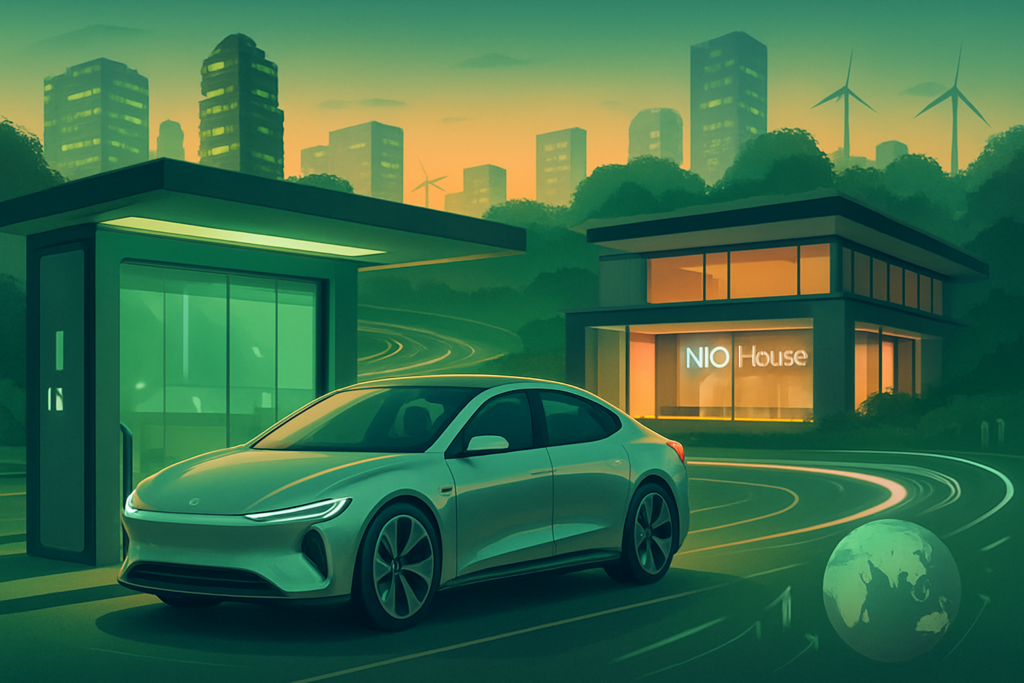
Founded in 2014 by serial entrepreneur William Li—often dubbed "the Elon Musk of China"—NIO began with a vision of "Blue Sky Coming." The company’s early years were marked by a focus on "User Experience," launching the EP9 supercar to set Nürburgring records and establishing "Nio Houses"—lavish clubhouses for owners.
However, the journey was nearly cut short. In early 2020, facing a liquidity crisis, NIO was rescued by a $1 billion investment from state-owned entities in Hefei, a move now known as the "Hefei Miracle." This lifeline allowed NIO to scale its ES8 and ES6 SUVs and pioneer the Battery-as-a-Service (BaaS) model. Between 2021 and 2024, NIO navigated the "valley of death" of high R&D spending, eventually securing a transformative $2.2 billion investment from CYVN Holdings, an investment vehicle primarily owned by the Abu Dhabi government. This capital injection in late 2023 and 2024 provided the runway for the multi-brand strategy that is defining its 2026 success.
Business Model
NIO operates on a unique "User Enterprise" model that extends far beyond vehicle sales. Its revenue streams are diversified across:
- Vehicle Sales: Premium luxury EVs (NIO brand), mass-market family vehicles (Onvo), and compact urban EVs (Firefly).
- Battery-as-a-Service (BaaS): A subscription model where customers buy the car without the battery, lowering the upfront cost and paying a monthly fee for battery swaps.
- Power Solutions: Revenue from its massive battery swap network and public charging services.
- NIO Life: A lifestyle brand selling everything from apparel to home goods, fostering deep brand loyalty.
By 2026, the company has successfully transitioned to a "horizontal" business model, opening its proprietary battery swap architecture to external partners (The Swap Alliance), effectively turning its infrastructure into a utility.
Stock Performance Overview
The stock performance of NIO (NYSE: NIO) over the last decade has been a study in volatility.
- 10-Year Perspective: Since its 2018 IPO, the stock has swung from under $2 during the 2020 crisis to an all-time high of $66 in 2021, before retreating as the "EV bubble" burst.
- 5-Year Perspective: The period from 2021 to 2026 saw a long, painful consolidation. The stock bottomed near $3.00 in mid-2024 amid intense price wars.
- 1-Year Perspective: Over the past 12 months, the stock has recovered significantly. Following the late-2025 announcement of profitability and record deliveries, NIO has climbed from the $4 range to its current level of approximately $5.92 as of late March 2026. This 45%+ gain in a year reflects a shift in investor sentiment from "survival mode" to "growth mode."
Financial Performance
NIO’s financial profile in early 2026 is the healthiest it has ever been. In its most recent full-year 2025 report, the company recorded total revenue of RMB 87.49 billion ($12.51 billion), a 33% year-over-year increase.
- Profitability: For the first time, NIO reported a net profit of RMB 282.7 million in Q4 2025.
- Margins: Vehicle margins surged to 18.1% in Q4 2025, up from 13.1% a year prior. This improvement is attributed to the scaling of the NT3.0 platform and lower battery costs.
- Cash Reserves: NIO ended 2025 with RMB 45.9 billion ($6.6 billion) in cash and equivalents, providing ample liquidity for the continued rollout of its Generation 5.0 Swap Stations.
Leadership and Management
William Li continues to lead as Chairman and CEO, maintaining a reputation for long-term vision and resilience. Lihong Qin, the President and co-founder, remains the operational architect of the "NIO House" strategy.
The board’s composition has become more international following the CYVN investment, with stronger representation from Middle Eastern institutional interests. This shift has professionalized NIO’s governance, moving away from the "startup" chaos of the early 2020s toward a more disciplined, global corporate structure.
Products, Services, and Innovations
NIO’s competitive edge lies in its technological vertical integration:
- NT 3.0 Platform: The third-generation platform powers all 2026 models, featuring a centralized computing architecture and 900V high-voltage systems.
- Battery Swap 5.0: Launched in early 2026, these stations can perform a swap in under 108 seconds and are compatible with various car brands within the NIO alliance.
- Semi-Solid State Battery: NIO’s 150kWh pack is now in mass production, offering a range of over 1,000km (620 miles), a feat few competitors have matched.
- NAD (NIO Autonomous Driving): The NOP+ (Navigate on Pilot) system now operates in virtually all urban scenarios in China, powered by four NVIDIA Orin chips providing 1,016 TOPS of computing power.
Competitive Landscape
The Chinese EV market in 2026 is a "battle of the giants."
- The Big Three: BYD (OTC: BYDDF) dominates the low-to-mid market, while Tesla (NASDAQ: TSLA) maintains a strong but aging presence. NIO has carved out the "premium BEV" (Battery Electric Vehicle) niche.
- Tech Entrants: Xiaomi (HKG: 1810) and Huawei’s HIMA alliance are NIO’s most direct "tech" rivals. Xiaomi’s 2026 delivery targets of 550,000 units put immense pressure on NIO’s mass-market Onvo brand.
- Traditional OEMs: Geely and GAC have narrowed the tech gap, though they lack NIO's dedicated battery-swap moat.
Industry and Market Trends
By 2026, the "Price War" that plagued 2023-2024 has transitioned into a "Value War." Consolidation is the dominant trend, with smaller players being absorbed by giants.
A significant macro driver is the shift toward "smart power." As the Chinese grid faces pressure, NIO’s battery swap stations are increasingly being used for "Vehicle-to-Grid" (V2G) services, providing frequency regulation and earning the company energy-trading revenue.
Risks and Challenges
Despite recent triumphs, NIO faces formidable hurdles:
- Geopolitical Friction: European anti-subsidy duties (currently at 20.7% for NIO) and the total lockout from the U.S. market limit its global total addressable market.
- Execution Risk: Managing three distinct brands (NIO, Onvo, Firefly) simultaneously is an immense operational challenge that could dilute management focus or strain the supply chain.
- Infrastructure Costs: The battery swap network requires constant capital expenditure. If the "Swap Alliance" fails to gain widespread adoption from other OEMs, NIO could find itself with a "stranded asset."
Opportunities and Catalysts
- Middle East Expansion: Through NIO MENA, headquartered in Abu Dhabi, NIO is launching regional-specific models in 2026. The Middle East represents a high-margin, high-growth opportunity with fewer trade barriers than the West.
- Firefly Launch: The debut of the sub-RMB 200,000 Firefly brand in international markets could unlock the European "mass-market" segment that is currently underserved by premium brands.
- M&A Potential: With its large cash pile and standardized tech, NIO is a likely candidate to acquire smaller, struggling EV brands to expand its manufacturing footprint.
Investor Sentiment and Analyst Coverage
Wall Street has shifted from "Sell" to "Cautiously Bullish" in 2026. Firms like HSBC and Nomura have recently upgraded the stock to "Buy," citing the 2025 profitability milestone as a "proof of concept." Institutional ownership has stabilized, with major positions held by CYVN Holdings, Tencent, and Baillie Gifford. Retail sentiment remains high, driven by the "Nio-phile" community, though the discourse has matured from speculative hype to a focus on monthly delivery consistency.
Regulatory, Policy, and Geopolitical Factors
Regulatory tailwinds in China remain strong, with New Energy Vehicle (NEV) purchase tax exemptions extended through the end of 2025 and new "trade-in" subsidies launched in 2026. However, NIO must navigate a complex regulatory web in the EU, where data privacy laws and "Carbon Footprint" requirements for batteries are becoming more stringent. The company's decision to build a "closed-loop" battery recycling system in 2025 was a proactive move to stay compliant with these emerging ESG mandates.
Conclusion
As we look at NIO on March 24, 2026, the company stands as a testament to the power of strategic persistence. By doubling down on battery swapping and user experience, it has built a moat that even the largest tech giants find difficult to replicate.
The move into profitability in late 2025 marked the end of NIO's "startup phase" and the beginning of its era as a global automotive industrial group. While geopolitical risks and intense domestic competition remain, NIO’s record deliveries and multi-brand strategy suggest that the "Blue Sky" William Li envisioned over a decade ago may finally be clearing. For investors, the focus for the remainder of 2026 will be on the ramp-up of the Firefly brand and the scaling of the "Swap Alliance" partners—factors that will determine if NIO can move from a $6 stock back toward its former double-digit glory.
This content is intended for informational purposes only and is not financial advice.