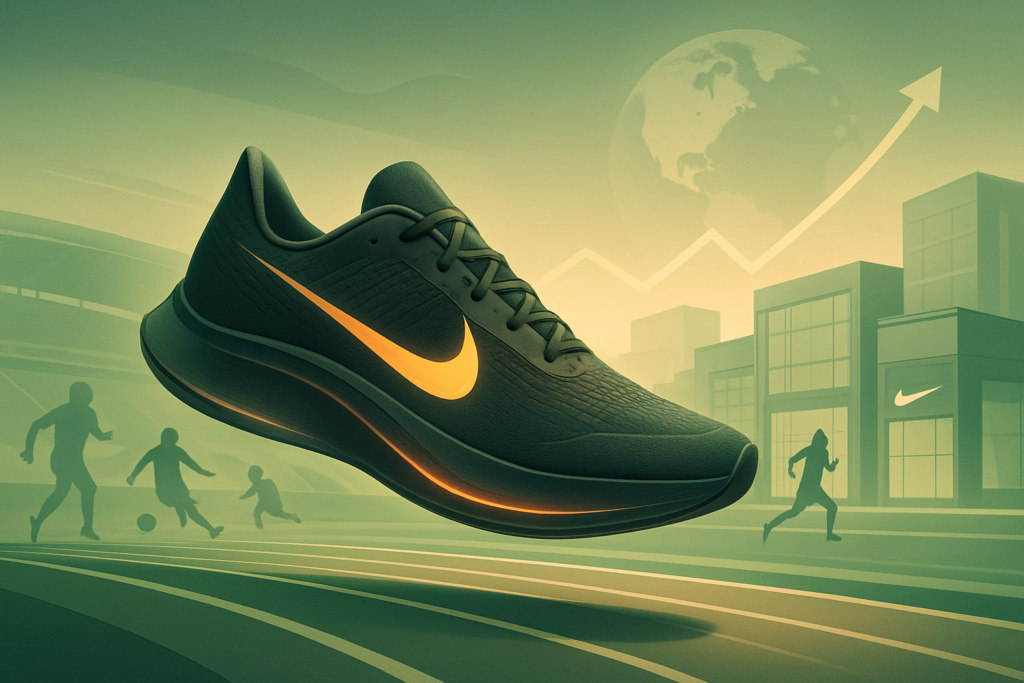
As of today, March 31, 2026, Nike Inc. (NYSE: NKE) finds itself at a pivotal crossroads that few would have predicted two years ago. After a bruising 2024 that saw the "Swoosh" lose its stride to nimble competitors like On and Hoka, the Beaverton-based giant has spent the last 18 months in an aggressive "back-to-basics" restructuring. Today’s Q3 2026 earnings report, released just hours ago, marks a definitive milestone: North American sales have officially returned to growth for the first time in eight quarters. This turnaround, spearheaded by veteran CEO Elliott Hill, suggests that the world’s largest sportswear company has finally exorcised the ghosts of its over-reliance on digital direct-to-consumer (DTC) sales and stale product iterations.
Historical Background
Founded in 1964 as Blue Ribbon Sports by Phil Knight and Bill Bowerman, the company originally distributed Japanese-made Onitsuka Tiger shoes. It wasn't until 1971 that the Nike "Swoosh" was born, alongside the revolutionary waffle-sole running shoe. Over the next five decades, Nike transformed from a niche track-and-field brand into a global cultural phenomenon, fueled by the signing of Michael Jordan in 1984 and the "Just Do It" campaign in 1988.
The company’s modern history has been defined by two distinct phases. The first was the "Donahoe Era" (2020–2024), characterized by a ruthless pivot toward Nike Direct and a reduction in wholesale partnerships. While this boosted margins initially, it opened the door for rivals to seize shelf space in physical retail. The second phase, which we are currently living through, began in late 2024 when Elliott Hill returned from retirement to restore Nike’s "sports-first" identity and repair fractured wholesale relationships.
Business Model
Nike’s business model remains centered on the design, development, and worldwide marketing of footwear, apparel, equipment, and accessories. Revenue is broadly categorized into four segments: Footwear (the largest driver), Apparel, Equipment, and the Global Brand.
A critical component of the model is the Jordan Brand, which operates with high degrees of autonomy and continues to be a multi-billion dollar juggernaut. Under the current leadership, the distribution model has shifted back to a "Balanced Marketplace" strategy. This involves a hybrid approach where Nike Direct (online and flagship stores) handles high-heat releases and member-exclusive services, while wholesale partners like the newly consolidated Dick’s-Foot Locker entity handle volume and "bread-and-butter" performance gear.
Stock Performance Overview
Looking back from March 2026, the stock’s trajectory has been a tale of two halves.
- 1-Year Performance: NKE has outperformed the S&P 500, rising 22% as investors gained confidence in the North American recovery and the success of the Air Max Dn line.
- 5-Year Performance: The stock remains roughly flat compared to March 2021 levels. It suffered a nearly 50% peak-to-trough decline between 2021 and 2024 as growth stalled and margins compressed.
- 10-Year Performance: For long-term holders, Nike remains a cornerstone asset, delivering a total return of approximately 140% over the last decade, driven by its dominant global market share and dividend consistency.
Financial Performance
In today's Q3 2026 earnings release, Nike reported revenue of $12.4 billion, a 4% increase year-over-year, beating analyst estimates of $12.1 billion. The standout figure was the 6% growth in North American sales, signaling that the regional "turnaround plan" is working.
- Gross Margin: Stood at 43.1%, slightly impacted by higher freight costs and lingering 2025 tariff pressures, but offset by a reduction in promotional activity.
- Earnings Per Share (EPS): Came in at $0.98, surpassing the consensus of $0.89.
- Cash Position: Nike remains cash-rich, with over $9 billion in liquidity, allowing for the continuation of its robust share buyback program and a dividend yield that has crept up to 1.8%.
Leadership and Management
CEO Elliott Hill’s "lifer" status has been his greatest asset. Unlike his predecessor, Hill has a deep institutional knowledge of the "Swoosh" culture. Since taking the helm in October 2024, he has decentralized decision-making, giving more power back to category leads in Running, Basketball, and Training.
The appointment of Amy Montagne as President of the Nike Brand has also been viewed favorably by the street, as she has focused on streamlining the product pipeline. The management team has successfully navigated the massive 2025 organizational overhaul that realigned 8,000 employees around sport-specific silos rather than general consumer categories.
Products, Services, and Innovations
Innovation is the engine of Nike’s current recovery. The Air Max Dn, which launched in 2024, has become the company's most successful new franchise in five years. However, the real excitement in early 2026 surrounds the "Mind" line, Nike's first venture into neuroscience-based footwear. These "mules" and trainers use varying foam densities to stimulate sensory receptors, marketed for athlete recovery and mental focus.
Additionally, Project Amplify, a collaboration with robotics firm Dephy, has introduced "power-assisted" footwear that aids in energy return for long-distance walkers—a direct shot at the aging demographic that had been gravitating toward competitors like New Balance.
Competitive Landscape
Nike’s competitive environment has never been more crowded. In the performance running space, On (NYSE: ONON) and Hoka (owned by Deckers Brands, NYSE: DECK) continue to hold significant market share. Meanwhile, Adidas (OTC: ADDYY) has seen a resurgence in Europe and Asia through its lifestyle "Terrace" shoe trend (Samba, Gazelle).
However, Nike’s recent re-entry into "pole position" at major retailers has blunted the growth of these challengers. By reclaiming the front-of-store displays at the consolidated Dick’s-Foot Locker locations, Nike has reasserted its dominance in the "mall-scape" that it briefly abandoned in 2022-2023.
Industry and Market Trends
The "athleisure" trend has matured into a broader "wellness" trend. Consumers in 2026 are increasingly looking for "hybrid" footwear that works for both the gym and the office. Nike has responded by diversifying its "lifestyle" offerings to include more sophisticated, muted colorways.
Macro-economically, the industry is grappling with "digital fatigue." After the pandemic-era surge in e-commerce, consumers have returned to physical stores for the "touch and feel" experience, particularly for high-performance footwear where fit is critical. This trend has played perfectly into Nike’s hands during its wholesale pivot.
Risks and Challenges
Despite the positive earnings, significant risks remain:
- Tariff Headwinds: New trade policies enacted in late 2025 have imposed a roughly $1.5 billion annual hit on Nike’s supply chain, pressuring gross margins.
- China Macro Weakness: While North America has turned around, the Greater China region remains sluggish due to ongoing consumer caution and a shift toward local Chinese brands like Anta and Li-Ning.
- Inventory Management: While much improved from the 2023 glut, the rapid release of new tech-heavy lines like "Project Amplify" carries the risk of oversupply if consumer adoption lags.
Opportunities and Catalysts
The biggest catalyst on the horizon is the FIFA World Cup 2026, hosted across the U.S., Mexico, and Canada. Nike is the primary sponsor for the host nations and six of the top ten teams globally. Analysts estimate the "World Cup Effect" could drive an additional $1.3 billion in revenue in the second half of 2026.
Furthermore, Nike’s expansion into India and Southeast Asia represents a massive untapped middle-class market. Management has signaled that these regions will be the primary focus of their 2027-2030 growth strategy.
Investor Sentiment and Analyst Coverage
Wall Street is broadly "Buy" rated on NKE once again. RBC Capital recently upgraded the stock, citing the "unprecedented marketing spend" leading up to the World Cup. Institutional ownership remains high, with Vanguard and BlackRock maintaining their core positions. Retail sentiment, which turned sour in 2024, has improved significantly as "sneakerheads" have responded positively to the move away from mass-produced Dunks and toward more technical, innovative silhouettes.
Regulatory, Policy, and Geopolitical Factors
Geopolitics remains a wildcard. Nike's reliance on manufacturing hubs in Vietnam and Indonesia makes it sensitive to regional stability and U.S. trade policy. The company has also faced renewed scrutiny regarding its environmental footprint, leading to the "Move to Zero" initiative, which aims for a 100% renewable energy-powered supply chain by 2030. Compliance with the latest EU sustainability reporting standards (CSRD) has also increased operational costs.
Conclusion
Nike’s Q3 2026 earnings report is more than just a set of numbers; it is a validation of the "Elliott Hill Pivot." By returning to its roots as a performance-driven, wholesale-friendly powerhouse, Nike has successfully stemmed the bleeding in its home market of North America.
Investors should watch the upcoming World Cup marketing blitz and the adoption rate of the "Mind" footwear line as indicators of whether this momentum is sustainable. While geopolitical tensions and margin pressures from tariffs are real threats, the "Swoosh" appears to have reclaimed its crown as the undisputed leader of global sport. For the first time in years, Nike is no longer playing defense; it is once again on the attack.
This content is intended for informational purposes only and is not financial advice.