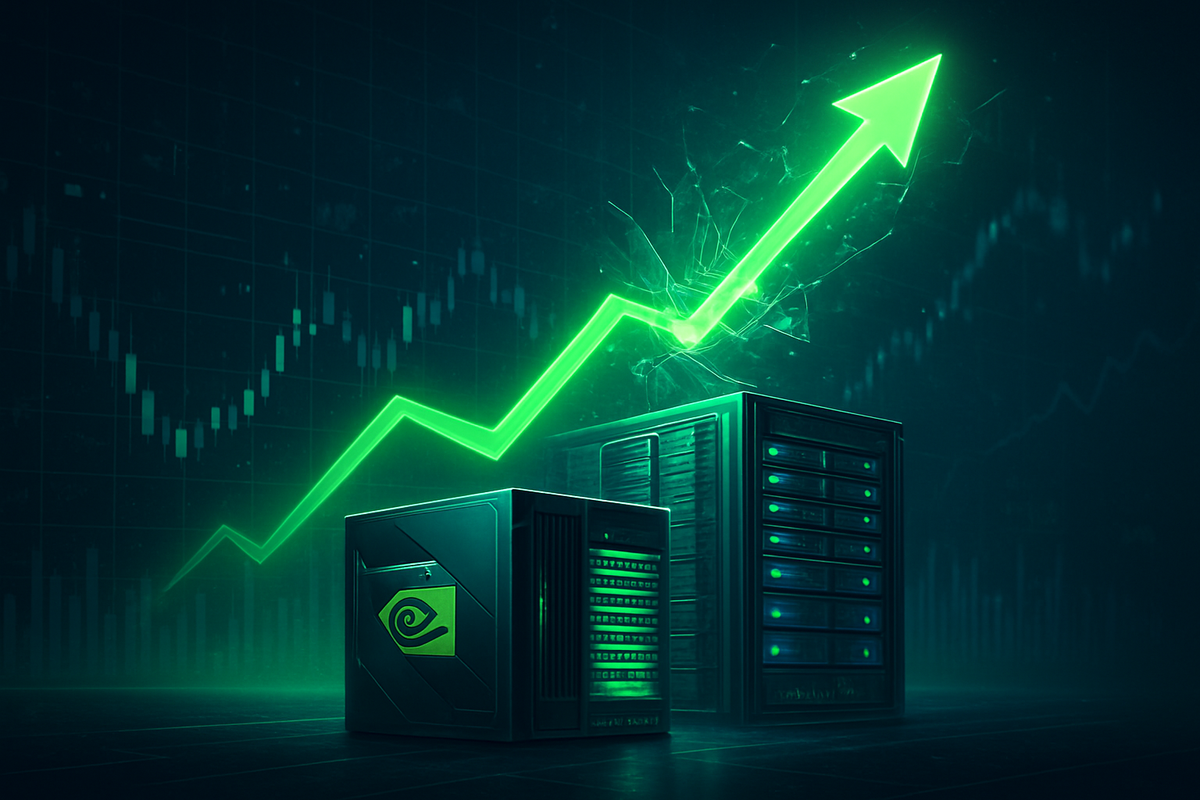
As the final trading days of 2025 unfold, the financial markets are witnessing a historic technical milestone. Nvidia (NASDAQ: NVDA) has officially cleared a major resistance level at $194.17, breaking out of a massive "cup and handle" pattern that has been forming since the summer. This technical surge is not merely a victory for momentum traders; it represents the market's definitive endorsement of Nvidia’s Blackwell architecture and its undisputed leadership in the generative AI era. With the stock now eyeing a year-end target of $229, the implications for the broader market are profound, as Nvidia’s performance continues to dictate the trajectory of the entire S&P 500.
The immediate impact of this breakout has been felt across the indices. As of December 24, 2025, Nvidia’s weighting in the S&P 500 (NYSEARCA:SPY) has climbed to a staggering 8%, the highest concentration for a single company in over half a century. This "Nvidia Effect" has turned the benchmark index into a de facto proxy for the AI sector, with the stock responsible for nearly a quarter of the index's total returns this year. For investors, the message is clear: the AI supercycle is entering a high-velocity phase, and Nvidia remains its primary engine.
The Road to $194: A Year of Consolidation and Conquest
The path to this week’s breakout began in late 2024, a period characterized by brief uncertainty. At that time, Nvidia faced minor design-related "mask issues" with its Blackwell chips, leading to a three-month production delay. This caused the stock to trade sideways in a tight range between $115 and $140 for much of the fourth quarter of 2024. However, the narrative shifted dramatically in January 2025 when the company cleared the $145 resistance level on heavy volume, signaling that the Blackwell production hurdles were resolved.
Throughout mid-2025, Nvidia successfully ramped up production of its B200 and GB200 GPUs, shipping an estimated 800,000 units in the first quarter alone. CEO Jensen Huang’s frequent descriptions of demand as "insane" were validated by a relentless bidding war among hyperscalers. By the summer of 2025, the stock entered a "digestion" phase, forming the "handle" of its current technical pattern as it held a firm support floor at $174. The current breakout above $194 represents the culmination of months of institutional accumulation, as Blackwell chips remain in a state of chronic supply shortage despite improved yields at Taiwan Semiconductor Manufacturing Company (NYSE: TSM).
Initial market reactions to the breakout have been overwhelmingly bullish. Algorithmic trading platforms and institutional desks have pivoted toward "momentum-on" strategies, anticipating a "Santa Claus rally" that could carry the stock well into the $200s by early 2026. Analysts from firms like Evercore ISI and Morgan Stanley have been quick to reiterate their "Outperform" ratings, with some street-high price targets now reaching as far as $352, citing the massive pricing power Nvidia holds with its 75% profit margins.
The AI Hierarchy: Winners and Losers in the Wake of NVDA’s Surge
Nvidia’s technical breakout has created a widening gap between the "AI haves" and "AI have-nots." Among the primary winners is Advanced Micro Devices (NASDAQ: AMD), which has solidified its position as the clear runner-up in the GPU race. AMD’s MI350 series, which entered volume production in mid-2025, has successfully captured roughly 15% of the market share, providing a necessary alternative for enterprises looking to avoid total vendor lock-in. Similarly, Broadcom (NASDAQ: AVGO) and Marvell (NASDAQ: MRVL) have emerged as "silent winners," reaping the rewards of their roles in designing custom AI silicon for the world’s largest cloud providers.
On the other side of the ledger, Intel (NASDAQ: INTC) continues to struggle. The company’s Gaudi 3 accelerator failed to gain the necessary software ecosystem traction in 2025, and the cancellation of its Falcon Shores standalone product has left a multi-year gap in its roadmap. Intel is now pinning its hopes on the "Jaguar Shores" chip for 2026, but for now, it remains a notable laggard in the high-end training market.
The hyperscale landscape is also seeing a divergent split. Alphabet (NASDAQ: GOOGL) has emerged as a formidable competitor through its custom TPU v7 "Ironwood" chips, which reached general availability in November 2025. Google’s success in building a credible "CUDA-alternative" has allowed it to reduce its reliance on Nvidia faster than its peers. Conversely, Microsoft (NASDAQ: MSFT) has faced delays with its in-house "Maia 200" silicon, leaving it more dependent on Nvidia’s high-margin hardware than its rivals—a dynamic that has pressured Microsoft’s capital expenditure efficiency throughout the year.
A Structural Shift: The Wider Significance of the AI Rally
Nvidia’s current momentum reflects a broader industry transition from the "Training" phase of AI to the "Inference" phase. In late 2025, the market is no longer just buying chips to build models; it is buying chips to run them at scale. This shift has favored Nvidia’s full-stack approach, where its software ecosystem (CUDA) and rack-scale systems (NVLink) provide a "moat" that competitors find difficult to breach. The technical breakout is a signal that the market believes this moat is widening, not shrinking.
This event also highlights the growing concentration risk within the U.S. equity markets. With Nvidia’s weighting at 8%, the S&P 500 has become highly sensitive to the company’s quarterly earnings cycles. This has led to regulatory whispers regarding index concentration, though no formal policy changes have been enacted. Historically, such dominance by a single firm—reminiscent of Cisco in the late 90s or IBM in the 70s—often precedes a period of heightened volatility, yet Nvidia’s underlying cash flows and triple-digit growth rates distinguish it from the "dot-com" era’s speculative excesses.
Furthermore, the "Nvidia Effect" has revitalized the entire semiconductor sector (NYSEARCA:SMH). As Nvidia clears new highs, it provides a "halo effect" for suppliers and partners, from power management specialists to liquid cooling providers like Vertiv (NYSE: VRT). The ripple effects are global, influencing capital flows into Japanese and South Korean equipment makers who are essential to the Blackwell supply chain.
The 2026 Horizon: What Comes Next for the King of AI
Looking ahead, the short-term focus remains on the "Santa Claus rally" and the potential for Nvidia to hit the $229 mark by year-end. However, the long-term outlook will be defined by the transition to the Rubin architecture, which is slated for a 2026 debut. Rubin is expected to feature next-generation HBM4 memory and even tighter integration with Nvidia’s Grace CPUs, potentially rendering current-generation hardware obsolete sooner than expected.
Strategic pivots will be required for competitors. AMD is already readying its MI400 for early 2026, while Amazon (NASDAQ: AMZN) is doubling down on its "value" proposition with Trainium 3, which claims a 50% lower cost-per-token than Nvidia’s offerings. The "Inference Wars" of 2026 will likely be fought on the battlefield of "Total Cost of Ownership" (TCO) rather than raw peak performance. Nvidia will need to prove that its premium pricing remains justified as open-source software like PyTorch and Triton make it easier for developers to migrate workloads to non-Nvidia hardware.
Final Thoughts: A Market Defined by One Name
Nvidia’s successful clearance of the $194.17 entry point is more than just a green candle on a chart; it is a testament to the company’s role as the central nervous system of the modern economy. As we close out 2025, the "AI trade" has evolved from a speculative bet into the fundamental driver of global productivity and market returns.
For investors, the key takeaway is that while Nvidia’s valuation remains high, its fundamental execution has rarely been stronger. The Blackwell ramp is the most successful product launch in semiconductor history, and the technical breakout suggests that institutional "smart money" is still finding reasons to buy at these levels. Moving forward, the market will be watching for any signs of "AI fatigue" in corporate capex or potential geopolitical disruptions to the Taiwan-based supply chain. But for now, the trend is undeniably up, and Nvidia remains the undisputed king of the hill.
This content is intended for informational purposes only and is not financial advice.