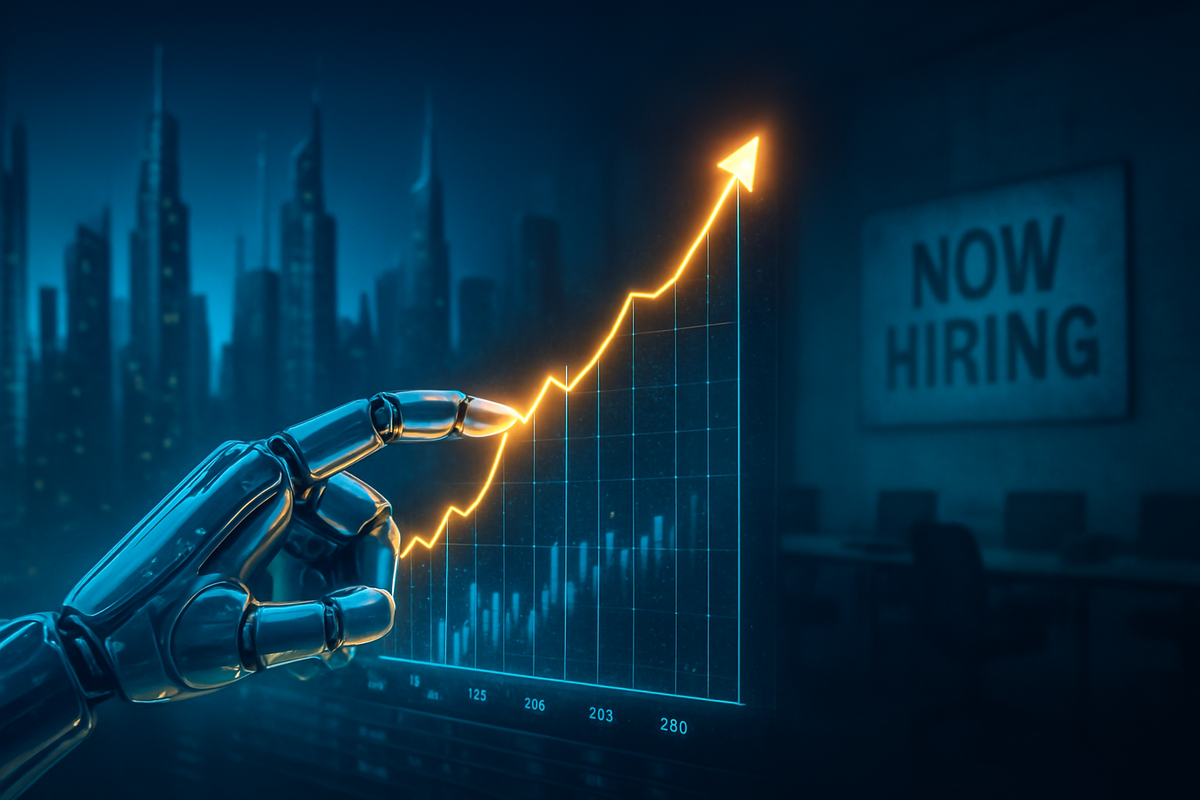
As the sun sets on 2025, the American economy presents a baffling paradox that has left both Wall Street and Main Street in a state of cognitive dissonance. On paper, the United States is entering 2026 in the midst of a "Jobless Boom"—a period of robust GDP growth, surging corporate profits, and a stock market reaching record highs, all while the labor market remains stubbornly brittle. For the first time in decades, the traditional link between economic expansion and job creation appears to have snapped, replaced by a "productivity miracle" fueled by the rapid integration of artificial intelligence and high-interest-rate-induced efficiency.
The immediate implications are stark: while the S&P 500 continues its march toward the 7,700 mark, the average worker is finding it harder than ever to secure a new role. Monthly payroll gains have slowed to a crawl, averaging just 60,000 new jobs—barely enough to keep pace with population growth. This "Precarious Prosperity" suggests that while the macro-economy is winning, the micro-economy of the individual household is under immense pressure, creating a K-shaped reality where capital gains outstrip wage growth at a pace not seen since the early 2000s.
The Great Decoupling: Productivity Over People
The roots of the 2026 Jobless Boom can be traced back to the "Year of Efficiency" 2.0, which began in late 2024. As the Federal Reserve, currently led by Jerome Powell until his term expires in May 2026, kept interest rates in the restrictive 3.50%–3.75% range to combat "sticky" inflation, corporations were forced to pivot. Instead of hiring their way to growth, companies turned to "Agentic AI"—autonomous systems capable of handling complex workflows without human intervention. This shift has allowed real GDP to projected growth of 2.1% for 2026, even as the unemployment rate is expected to peak at 4.7% in the first half of the year.
The timeline leading to this moment was defined by the "lag effect" of the 2022-2023 rate hikes. By late 2025, the cumulative pressure of high borrowing costs finally cooled the labor market to a "low-hire, low-fire" equilibrium. Companies are no longer conducting the mass layoffs seen in previous cycles; instead, they are utilizing "silent attrition"—refusing to fill vacancies left by departing employees and replacing those roles with automated systems. This has created a labor market that is brittle—not because it is collapsing, but because it has lost its elasticity.
Key stakeholders, including major institutional investors and the Federal Open Market Committee (FOMC), are watching this divergence with a mix of awe and anxiety. The initial market reaction has been overwhelmingly positive for tech-heavy indices, as margins expand to historic levels. However, labor unions and consumer advocacy groups are sounding the alarm, noting that the "Jobless Boom" is effectively a transfer of wealth from labor to capital, as the gains from AI-driven productivity are captured almost entirely by shareholders rather than distributed through higher wages.
The Winners and Losers of the Automated Expansion
In this new economic landscape, the divide between the "AI-haves" and "AI-have-nots" has become the primary driver of stock performance. Among the clear winners is NVIDIA (NASDAQ: NVDA), which has transitioned from a chipmaker to the foundational infrastructure provider for the 2026 economy. As companies replace human headcount with "Physical AI" and robotic agents, NVIDIA’s data center revenue has become a proxy for global productivity. Similarly, Microsoft (NASDAQ: MSFT) and Alphabet (NASDAQ: GOOGL) have seen their valuations soar as their AI Copilots and "Agentic" workflows become the standard operating system for the modern enterprise, allowing them to grow revenue by double digits while keeping their own headcounts flat.
Retail giants like Walmart (NYSE: WMT) and Amazon (NASDAQ: AMZN) have also emerged as victors by aggressively automating their supply chains. Amazon, which now operates over one million robots across its fulfillment network, is on track to automate nearly 75% of its warehouse operations by 2027. This allows the e-commerce leader to handle record-breaking holiday volumes without the seasonal hiring sprees that once defined the industry. For these companies, the "Jobless Boom" isn't a risk; it’s a strategic objective that insulates them from labor shortages and wage inflation.
Conversely, the losers of this cycle are those whose business models rely on labor arbitrage or easily automated tasks. Chegg (NYSE: CHGG) has faced an existential crisis as free AI-tutors displace its core subscription model, while traditional IT outsourcing firms like Globant (NYSE: GLOB) and consultants like Accenture (NYSE: ACN) are seeing margin compression as clients demand "AI-driven efficiency" rather than billable human hours. Even traditional retail plays like Target (NYSE: TGT) and apparel icons like Nike (NYSE: NKE) are struggling; they face the dual pressure of high labor costs for their remaining staff and a consumer base that is increasingly "squeezed" by stagnant wage growth, making it difficult to pass on price increases.
Historical Echoes and Policy Implications
The 2026 Jobless Boom draws haunting parallels to the "Jobless Recovery" following the 2001 Dot-com bubble and the slow-growth years of 2010-2011. In both prior instances, GDP returned to growth long before the labor market healed. However, the 2026 version is distinct due to the presence of "sticky" inflation and a much tighter Federal Reserve. Unlike 2010, when the Fed could keep rates at zero for years, the current Fed is constrained by a 2.4% core PCE inflation rate, meaning there is no "cavalry" coming to rescue the labor market with cheap capital.
This event fits into a broader industry trend of "Capital-Intensive Growth." We are moving away from the "Software is Eating the World" era into an "AI is Replacing the Work" era. This has significant regulatory implications, as the 2026 political landscape is dominated by debates over "AI Taxes" or "Universal Basic Income" (UBI) to offset the displacement of middle-management roles. Policymakers are also grappling with the "junior talent desert"—a phenomenon where entry-level roles in tech and finance are being handled by AI, potentially creating a massive skills gap as the next generation of leaders fails to get "on-the-job" training.
The ripple effects are also being felt in the commercial real estate sector. With fewer "human" employees needed, the demand for traditional office space has plummeted once again, despite "return to office" mandates. Companies are instead investing in specialized "AI Data Centers" and automated logistics hubs. This shift is forcing a massive reallocation of capital that is disrupting local tax bases and urban economies that once relied on a bustling white-collar workforce.
The Road Ahead: 2026 and Beyond
Looking toward the remainder of 2026, the primary question is whether this "Jobless Boom" can be sustained or if the lack of wage growth will eventually trigger a consumer spending collapse. In the short term, the "wealth effect" from a soaring stock market and resilient spending from the top 20% of earners may keep the economy afloat. However, long-term stability requires a strategic pivot. Companies will need to find ways to "upskill" their remaining workforce to manage the AI agents, or they risk a "Great Tech Backlash" that could lead to social instability or aggressive labor strikes.
Market opportunities will likely emerge in "Human-Centric" niches—industries where the "human touch" commands a premium, such as high-end hospitality, complex healthcare, and artisanal manufacturing. Investors should also watch for a potential surge in "re-shoring" as AI and robotics make domestic manufacturing more cost-effective than overseas labor. The challenge for 2026 will be navigating the "gap phase"—the period where AI is good enough to replace jobs but not yet efficient enough to create the new, unforeseen industries that historically follow technological revolutions.
Navigating the Precarious Prosperity
The 2026 Jobless Boom is a testament to human ingenuity and a warning of its consequences. It is an economy that is technically healthy but socially fragile. The key takeaway for investors is that "growth" no longer looks like it used to; the most profitable companies are those that can decouple their revenue from their headcount. As we move into 2026, the market will continue to reward efficiency, but the "brittleness" of the labor market remains a systemic risk that could be triggered by any sudden economic shock.
Moving forward, the assessment of the market is one of "rational exuberance" for technology and "cautious pessimism" for the consumer. Investors should watch the Fed leadership transition in May 2026 and the monthly "Job Openings and Labor Turnover Survey" (JOLTS) data more closely than the headline GDP numbers. The real health of the 2026 economy won't be found in how much we produce, but in whether we can find a way to ensure that the "Boom" includes the people who make the economy run.
This content is intended for informational purposes only and is not financial advice.