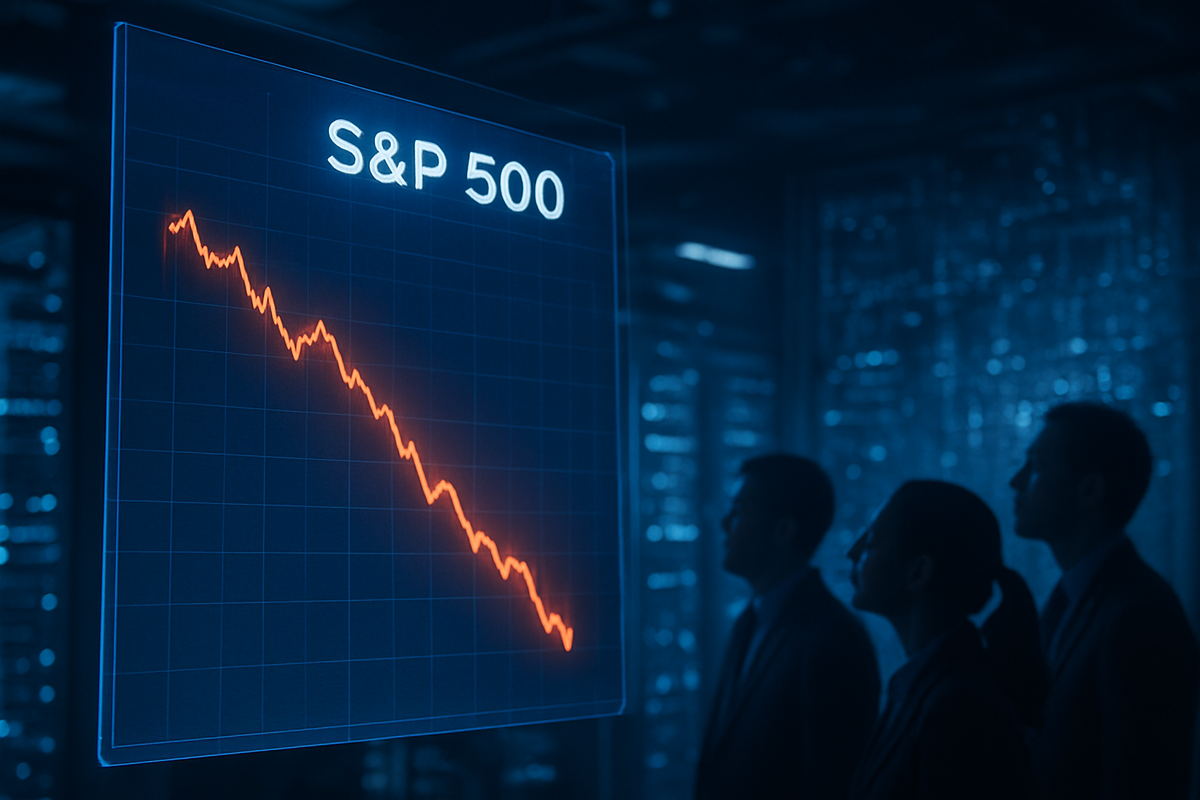
The S&P 500 (^GSPC) experienced a sharp reversal on Monday, December 29, 2025, as investors moved to lock in gains following a historic rally that propelled the index to all-time highs just last week. The broad market sell-off was primarily driven by a significant retreat in the technology sector, which has been the engine of growth throughout 2025. As the trading year draws to a close, the sentiment on Wall Street has shifted from aggressive accumulation to strategic preservation, with high-flying AI and semiconductor stocks bearing the brunt of the downward pressure.
This late-December pullback marks a cooling period for a market that many analysts had begun to describe as "overextended." While the S&P 500 remains on track for a stellar annual performance, the sudden dip highlights the fragility of valuations in a sector that has seen unprecedented capital inflow over the past twelve months. For institutional and retail investors alike, the final days of 2025 are serving as a reminder that even the most robust bull markets require moments of consolidation.
Market Dynamics: A Week of Records Meets a Monday of Reality
The downturn began early in the Monday session, following a week where the S&P 500 breached the 6,850 level for the first time in history. The momentum from the "Santa Claus Rally" appeared to hit a ceiling as the index struggled to maintain its footing above psychological resistance levels. By mid-day, the index was down 1.4%, a move that wiped out several days of gains and sent the CBOE Volatility Index (^VIX) climbing. The timeline of this retreat is classic for year-end behavior; after the S&P 500 hit its peak on December 23, the subsequent low-volume holiday sessions provided the perfect environment for large-scale profit-taking.
Key stakeholders, including major hedge funds and institutional asset managers, appear to be rebalancing portfolios to align with 2026 mandates. The technology sector, represented by the Technology Select Sector SPDR Fund (XLK), fell by more than 2.5%, led by a decline in the "Magnificent Seven" and the semiconductor giants that have dominated the 2025 narrative. Market participants noted that the sell-off was not triggered by a specific negative catalyst or economic data point, but rather by a collective realization that the risk-reward profile for tech had become skewed after such a parabolic run.
Winners and Losers: The Tech Correction and the Defensive Pivot
The primary "losers" in today’s session were the titans of the AI revolution. NVIDIA Corp. (NASDAQ: NVDA), which has seen its valuation swell to nearly $4 trillion in 2025, saw its shares slide 3.8% as traders cashed out. Similarly, Microsoft Corp. (NASDAQ: MSFT) and Broadcom Inc. (NASDAQ: AVGO) faced selling pressure, dropping 2.2% and 3.1% respectively. These companies, while fundamentally strong with massive backlogs of AI infrastructure orders, became victims of their own success, as their high price-to-earnings multiples made them the easiest targets for year-end liquidations.
Conversely, the retreat in tech provided a slight tailwind for defensive and value-oriented sectors. Investors looking to park cash without exiting the market entirely rotated into utilities and consumer staples. Constellation Energy Corp. (NASDAQ: CEG) and Procter & Gamble Co. (NYSE: PG) remained relatively flat or saw modest gains, as they are viewed as safer havens during periods of growth-stock volatility. Additionally, "AI adopters"—companies in the healthcare and industrial sectors that are using AI to improve margins rather than selling the technology—showed more resilience than the pure-play hardware providers.
The Significance: Valuation Exhaustion and the AI Transition
Today’s market action fits into a broader industry trend that analysts have dubbed "The Great Broadening." Throughout 2025, the market’s gains were heavily concentrated in a handful of semiconductor and infrastructure firms. However, as the year closes, there is a growing consensus that the "AI Infrastructure" phase is maturing. The pullback reflects a shift in investor focus toward the "AI Diffusion" phase, where software and services must now prove they can generate tangible returns on the billions spent on hardware.
Historically, December profit-taking is a common phenomenon, but the scale of today’s tech drop suggests deeper concerns about "valuation exhaustion." Bank of America (NYSE: BAC) had recently warned that the S&P 500 was trading at multiples not seen since the early 2000s, suggesting that a correction was overdue. This event also mirrors the market behavior of late 1999 and late 2021, where record-breaking years ended with a sharp pivot away from high-growth names as investors prepared for a more disciplined interest rate environment in the coming year.
Looking Ahead: The 2026 Outlook and Strategic Pivots
As we move into 2026, the market is expected to face a new set of challenges and opportunities. While the current pullback is painful for those who bought at the peak, many analysts, including those at Goldman Sachs (NYSE: GS), view this as a healthy reset. The short-term possibility remains for further volatility as tax-loss harvesting and final portfolio adjustments continue through December 31. However, the long-term outlook remains bullish, with many major banks setting 2026 targets for the S&P 500 as high as 7,500 to 8,000, driven by expected double-digit earnings growth.
Strategic pivots will likely be required for investors who have been overweight on hardware. The focus is expected to shift toward companies like ServiceNow Inc. (NYSE: NOW) and Alphabet Inc. (NASDAQ: GOOGL), which are positioned to lead the next wave of "Agentic AI" software. The emergence of autonomous AI agents that can handle complex enterprise workflows is predicted to be the dominant theme of 2026, potentially offering a new growth engine that is less dependent on the constant expansion of physical data centers.
Wrap-Up: A Year of Records Ends with a Cautionary Note
The S&P 500’s retreat on December 29, 2025, serves as a poignant closing chapter to a year defined by the relentless rise of artificial intelligence and the resilience of the American economy. The key takeaway for investors is that while the underlying fundamentals of the tech sector remain strong, no asset class is immune to the laws of gravity when valuations become disconnected from historical norms. The record highs of last week provided a moment of celebration, but today’s pullback provides a necessary dose of market reality.
Moving forward, investors should keep a close eye on the Federal Reserve’s terminal rate and the initial Q1 2026 earnings reports, which will be the first real test of whether AI software monetization can live up to the hype. The "Year of the Agent" is just around the corner, and while the tech sector may be down today, its role as the primary driver of global productivity is far from over. For now, the market is taking a well-deserved breather, setting the stage for a more nuanced and potentially broader rally in the year to come.
This content is intended for informational purposes only and is not financial advice.