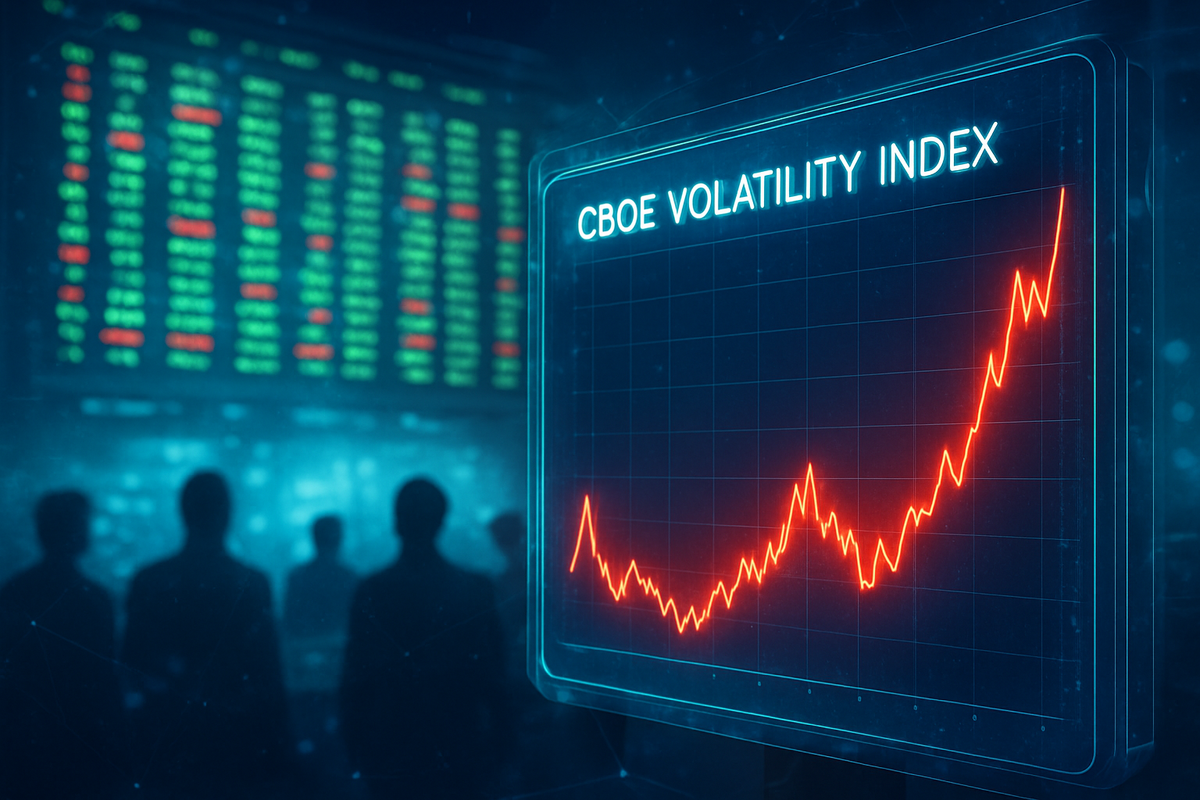
As the 2025 trading year draws to a close, the CBOE Volatility Index (CBOE:VIX), widely known as the market’s "fear gauge," is exhibiting a rare and unsettling behavior. While the S&P 500 (NYSEARCA:SPY) hovers near the historic 7,000 milestone and the Nasdaq Composite (NASDAQ: QQQ) reflects a 22% annual gain, the VIX has refused to settle into its traditional holiday slumber. Instead, on December 29, 2025, the index is hovering between 13.5 and 15.0, having surged as much as 15% in a single session just days ago. This "perking up" of volatility suggests that underneath the surface of record-high equity prices, institutional investors are aggressively hedging against a turbulent start to 2026.
The immediate implications are clear: the "Santa Claus Rally" that many investors expected to carry the market into the new year has been complicated by a "Volatility Paradox." Despite the outward appearance of a bull market, the cost of downside protection is rising. This shift is driven by a combination of late-year technical rebalancing and a sudden "AI valuation reset" that has left many of the year's top performers vulnerable. As traders look toward the opening bell of 2026, the elevated VIX serves as a warning that the complacency of 2025 may be a thing of the past.
A Year of "Volatility Shocks" and the December 26 Wake-Up Call
The current rise in the VIX is not an isolated event but the latest chapter in a year defined by extreme "volatility shocks." The most significant of these occurred on April 2, 2025—a day now referred to by traders as "Liberation Day"—when the announcement of massive reciprocal tariffs sent the VIX screaming past 52, its highest level since the 2020 pandemic. While the markets eventually stabilized, the "volatility regime" remained permanently higher throughout the year. The relative calm of the autumn months was shattered in mid-December when a 43-day federal government shutdown ended, releasing a "deluge" of delayed economic data that forced a violent repricing of risk and sent the VIX to a mid-month peak of 21.89.
The most recent catalyst for the VIX’s "perking up" occurred on Friday, December 26, 2025. In thin holiday trading, the market was blindsided by a breakthrough from a Chinese AI lab, which released a highly efficient, low-cost reasoning model known as "DeepSeek." This event triggered a massive sell-off in U.S. chipmakers, led by Nvidia (NASDAQ: NVDA), which saw its market capitalization fluctuate wildly as investors questioned the sustainability of high-margin AI hardware. The resulting spike in the VIX was a clear signal that the market's reliance on a handful of tech giants has created a "brittle" foundation that is highly sensitive to external shocks.
Key stakeholders, including institutional hedge funds and pension managers, have responded by engaging in a massive $1 trillion rebalancing cycle in the final week of December. This process involves selling off "parabolic winners" like Tesla (NASDAQ: TSLA) to lock in annual performance bonuses while simultaneously buying VIX futures to protect against a potential "January Effect" reversal. The initial market reaction has been one of measured consolidation; while the major indices have not crashed, the "fear gauge" is signaling that the path of least resistance may no longer be upward.
The Great Rebalancing: Winners and Losers in a High-VIX Regime
In this environment of rising volatility, the landscape of winners and losers is shifting rapidly. The primary losers are the high-beta technology and consumer discretionary stocks that fueled the 2025 rally. Companies like Nvidia and Tesla, which are sensitive to both interest rate expectations and trade policy shifts, have become the primary targets for profit-taking. As the VIX rises, the "valuation reset" for these companies becomes more pronounced, as the discount rate applied to their future earnings increases in tandem with market uncertainty.
Conversely, the "winners" of this high-volatility regime are found in defensive sectors and the emerging "AI Utilities" space. As energy availability replaces chip scarcity as the primary bottleneck for artificial intelligence, investors have rotated into companies like Vertiv Holdings Co (NYSE: VRT) and Eaton Corp PLC (NYSE: ETN), which provide the physical infrastructure, cooling, and power management for data centers. These stocks have shown remarkable resilience during the December VIX spikes, acting as a "safe haven" within the broader tech ecosystem.
Additionally, volatility-linked products have seen a surge in inflows. The ProShares Ultra VIX Short-Term Futures ETF (NYSEARCA:UVXY) and other hedging instruments are being used by retail and institutional investors alike to capitalize on the "perking up" of fear. Beyond the equity markets, gold and other hard assets have also benefited, as the 9-3 split vote at the December Federal Reserve meeting—the most dissent in six years—has raised questions about the Fed's ability to navigate a "sticky" inflation environment (currently at 2.7% CPI) while supporting a cooling labor market.
Macro Tremors: From Trade Wars to the "Data Bomb" Deluge
The rise of the VIX at the end of 2025 fits into a broader trend of "geopolitical fragmentation" and "policy-driven volatility." The trade wars initiated earlier in the year, including a 54% import tariff on Chinese goods and a 25% levy on European automotive products, have fundamentally altered the global supply chain. This has created a permanent "risk premium" in the markets, as investors must now account for the possibility of sudden, executive-led policy shifts that can disrupt commerce overnight. This is a significant departure from the relative policy stability of the early 2020s.
Furthermore, the "Data Bomb" phenomenon has become a recurring source of market stress. The 43-day government shutdown earlier this month created a vacuum of information, followed by a sudden explosion of delayed reports. When the government finally released a surprise 4.3% Q3 GDP growth figure alongside a cooling jobs report, the conflicting data points caused a "volatility cluster." This lack of consistent, reliable economic signaling has made it difficult for the Federal Reserve to provide clear forward guidance, leading to the "hawkish cut" in interest rates to 3.50%–3.75% that left the market more confused than comforted.
Historical precedents for this type of year-end volatility can be found in 2018 and 2022, where tightening financial conditions and geopolitical tensions led to a "reset" in the following year's first quarter. However, the 2025 scenario is unique due to the sheer scale of the AI investment cycle and the impending leadership change at the Federal Reserve. With Jerome Powell’s term ending in May 2026, the market is already beginning to price in the uncertainty of a new Fed Chair nomination, which many fear could lead to a less independent and more politically influenced central bank.
Bracing for 2026: The SCOTUS Decision and the January Effect
As we look toward the opening of the 2026 trading year, several short-term catalysts are keeping the VIX elevated. The most pressing is a scheduled Supreme Court decision regarding the legality of the "Liberation Day" tariffs, expected in early January. A ruling that upholds the tariffs could solidify the current inflationary pressures, while a reversal could trigger a massive, albeit volatile, relief rally. In either scenario, the VIX is expected to remain "bid" as traders position for the outcome.
In the long term, the market may see a strategic pivot toward "quality" and "cash flow" over "growth at any price." If the VIX continues to perk up, we may see the emergence of a "two-tier" market: one consisting of AI-enabled companies with proven earnings, and another of speculative firms that struggle to survive in a higher-rate, higher-volatility environment. The "January Effect," which typically sees small-cap stocks outperform, may be muted in 2026 as investors favor the safety of large-cap balance sheets and infrastructure plays like Eaton and Vertiv.
The potential for a "Volatility Super-Cycle" is also a scenario that some analysts are beginning to discuss. If the combination of trade wars, Fed leadership changes, and AI disruption continues to escalate, the VIX could establish a new "floor" at 20.0, rather than its historical average of 15.0. This would require a fundamental adaptation in how portfolios are constructed, with a much heavier emphasis on tail-risk hedging and non-correlated assets.
Final Assessment: The End of Complacency?
The "perking up" of the VIX as 2025 concludes is a clear signal that the era of easy gains and low volatility is ending. While the headline numbers for the year remain impressive, the underlying market mechanics suggest a growing fragility. The combination of the "DeepSeek" AI shock, the government shutdown "data bombs," and the looming 2026 policy catalysts has created a environment where fear is no longer a tail risk, but a central feature of the market landscape.
Moving forward, investors should watch for the VIX to either "break out" above the 20 level in early January or "fade" back toward 12 if the SCOTUS tariff decision and the first batch of 2026 economic data prove favorable. However, the "brittle" nature of the current record-high valuations suggests that any disappointment will be met with swift and severe selling. The key takeaway for the final days of 2025 is that while the "Santa Claus Rally" may have delivered its gifts, the bill for market protection is finally coming due.
In the coming months, the focus will shift from "how high can we go?" to "how much can we protect?" Investors should keep a close eye on the VIX futures curve and the performance of defensive "AI Utilities" as indicators of the market's true health. As we enter 2026, the "fear gauge" is no longer just a metric; it is a roadmap for a market that is finally waking up to the risks of its own success.
This content is intended for informational purposes only and is not financial advice.