As 2025 draws to a close, the pharmaceutical industry stands at a historic crossroads. The year was defined by a widening chasm between the "metabolic haves"—those profiting from the global obesity epidemic—and companies grappling with the first real bite of the Inflation Reduction Act (IRA). While the healthcare sector saw record-breaking market caps and breakthrough approvals in oncology and Alzheimer’s, it was also forced to navigate a radical restructuring of the U.S. drug pricing landscape.
The immediate implications of 2025 are profound: Eli Lilly & Co. (NYSE: LLY) cemented its status as the world’s most valuable healthcare company, while the industry at large began the painful process of adapting to a Medicare system that now caps patient costs and negotiates prices. For investors, the year proved that innovation remains the ultimate currency, but "regulatory-proofing" a portfolio has become just as essential as tracking clinical trial readouts.
The Year of the "Trumprx" and the $2,000 Cap
The 2025 calendar year began with a seismic shift in how drugs are paid for in the United States. On January 1, the $2,000 annual out-of-pocket cap for Medicare Part D beneficiaries went live, providing immediate relief to millions of seniors but shifting billions in liability back onto manufacturers. This "Part D Redesign" required companies to provide a 10% discount in the initial coverage phase and a staggering 20% discount in the catastrophic phase, fundamentally altering the gross-to-net math for legacy blockbusters.
The middle of the year saw the climax of the "Trumprx" initiative, a series of "Most Favored Nation" (MFN) pricing deals negotiated between the administration and industry giants. In exchange for exemptions from certain trade tariffs and incentives for repatriating manufacturing to the U.S., companies like Pfizer (NYSE: PFE) and Merck & Co. (NYSE: MRK) agreed to offer deep discounts—some as high as 80%—on specific medications through a centralized cash-price portal. This move was particularly visible in the obesity space, where Novo Nordisk (NYSE: NVO) agreed to lower prices for Wegovy to roughly $245 a month for specific patient segments to stave off even more aggressive federal intervention.
Market reactions were polarized. In February 2025, when the Centers for Medicare & Medicaid Services (CMS) announced the next 15 drugs selected for price negotiations—including heavyweights like Ozempic and Ibrance—the NYSE Arca Pharmaceutical Index saw a sharp 4% intraday drop. However, the sector recovered by late summer as companies proved they could offset these pricing pressures through high-volume demand and "molecular niche" approvals that remained outside the immediate crosshairs of the IRA.
Winners and Losers in the Metabolic Arms Race
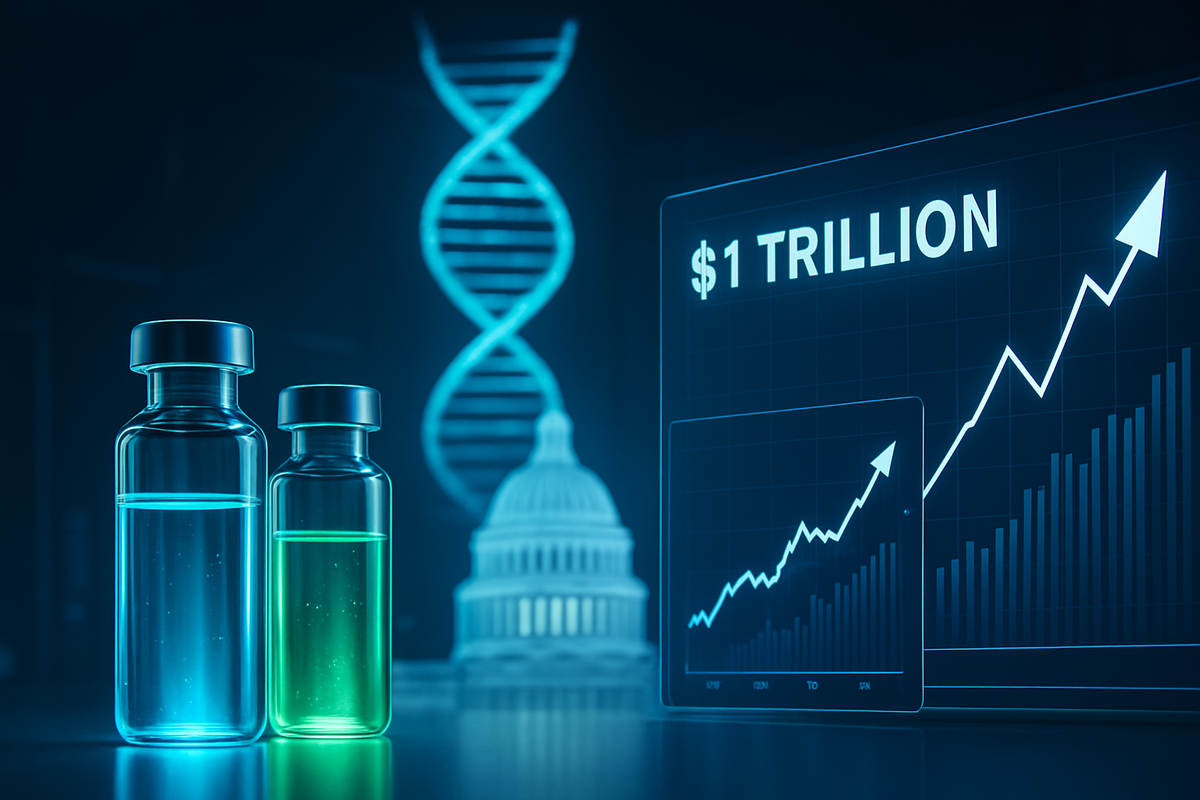
Eli Lilly emerged as the undisputed titan of 2025. By October, the company’s market capitalization surged past $1 trillion, fueled by a 54% year-over-year revenue jump in Q3. The success was driven not just by Zepbound’s dominance in obesity, but also by a critical label expansion for Obstructive Sleep Apnea (OSA) and the late-year positive Phase 3 data for orforglipron, their oral "obesity pill." Lilly’s ability to scale manufacturing faster than its peers allowed it to capture market share that others left on the table.
Conversely, Novo Nordisk faced a "growth reset" in 2025. Despite strong sales, the Danish drugmaker saw its stock come under pressure as it narrowed its full-year sales growth forecast to 8-11%. The company was hit by DKK 9 billion in restructuring charges and faced intensifying competition from Lilly and a surge in illegal compounding pharmacies. While Novo secured a major win with an FDA approval for Wegovy to treat Heart Failure with preserved Ejection Fraction (HFpEF), the aura of invincibility that surrounded the stock in 2024 began to show cracks under the weight of supply chain constraints and pricing concessions.
The oncology sector saw a mixed bag. Merck & Co. continued to leverage its workhorse, Keytruda, which benefited from the 2025 approval of a subcutaneous version (Keytruda Qlex), allowing for faster administration and extending the drug's patent life. However, Bristol Myers Squibb (NYSE: BMY) faced a more difficult path; while its "Growth Portfolio" rose 18%, trial irregularities in its Alzheimer’s-related psychosis study for Cobenfy delayed a key catalyst into 2026, leaving the company to lean heavily on its legacy products even as they faced generic erosion.
A New Regulatory Reality and the Biologic Shift
The events of 2025 represent a permanent shift in the industry's business model, moving away from the "small molecule blockbuster" era toward complex biologics and Antibody Drug Conjugates (ADCs). The IRA’s shorter protection window for small molecules (9 years) versus biologics (13 years) has triggered a massive reallocation of R&D budgets. Pfizer’s 2025 performance was a direct reflection of this, as the company integrated its $43 billion Seagen acquisition to focus on ADC technology, aiming to launch eight or more blockbuster oncology drugs by the end of the decade.
This shift fits into a broader trend of "precision medicine" where drugs are tailored to specific genetic markers. A primary example was the September approval of Lilly’s Inluriyo for ESR1-mutated breast cancer. These targeted therapies often command higher price points and face less initial pressure from broad price negotiations, making them the preferred vehicle for growth in a post-IRA world.
Historically, the pharma industry has used litigation to fight price controls, but 2025 saw a pivot toward "cooperative compliance." The finalized MFN deals suggest that Big Pharma has accepted that the era of unlimited pricing power in the U.S. is over. Instead, they are trading price for volume and political stability, a strategy that mirrors the European market but with higher margins still intact.
The Horizon: 2026 and the Patent Cliff
Looking ahead to 2026, the industry is bracing for the first round of negotiated Medicare prices to actually take effect. This will be the "stress test" for the sector’s earnings resilience. We expect a flurry of M&A activity in the first half of 2026 as companies with significant "patent cliffs"—such as AbbVie (NYSE: ABBV) and Johnson & Johnson (NYSE: JNJ)—look to acquire mid-stage biotech firms to fill revenue gaps.
The next frontier for the metabolic market will be "maintenance" and "muscle preservation." As millions of patients reach their goal weights on GLP-1s, the focus is shifting to drugs that can be taken less frequently or that prevent the muscle loss associated with rapid weight drop. Companies that can solve the "oral delivery" puzzle for these peptides will likely be the next set of market leaders. We are also watching for a potential strategic pivot toward "preventative" pharma, where drugs are prescribed earlier in life to prevent chronic conditions, potentially expanding the patient pool by tens of millions.
Summary of a Transformative Year
The year 2025 will be remembered as the moment Big Pharma was forced to grow up and face a regulated market. The key takeaways are clear: the "Metabolic Revolution" is the most significant growth engine the industry has seen in decades, but it comes with a high price of political and regulatory scrutiny. Eli Lilly has set a new gold standard for what a pharmaceutical powerhouse looks like, while legacy players like Pfizer and BMS are in the midst of painful but necessary reinventions.
Moving forward, the market will likely reward companies that can demonstrate "volume-driven growth" rather than "price-driven growth." Investors should keep a close watch on the upcoming Phase 3 readouts for oral obesity treatments and the integration of ADC platforms in oncology. While the regulatory headwinds are real, the sheer pace of scientific innovation in 2025 suggests that for those who can navigate the new rules, the opportunities for value creation have never been larger.
This content is intended for informational purposes only and is not financial advice.