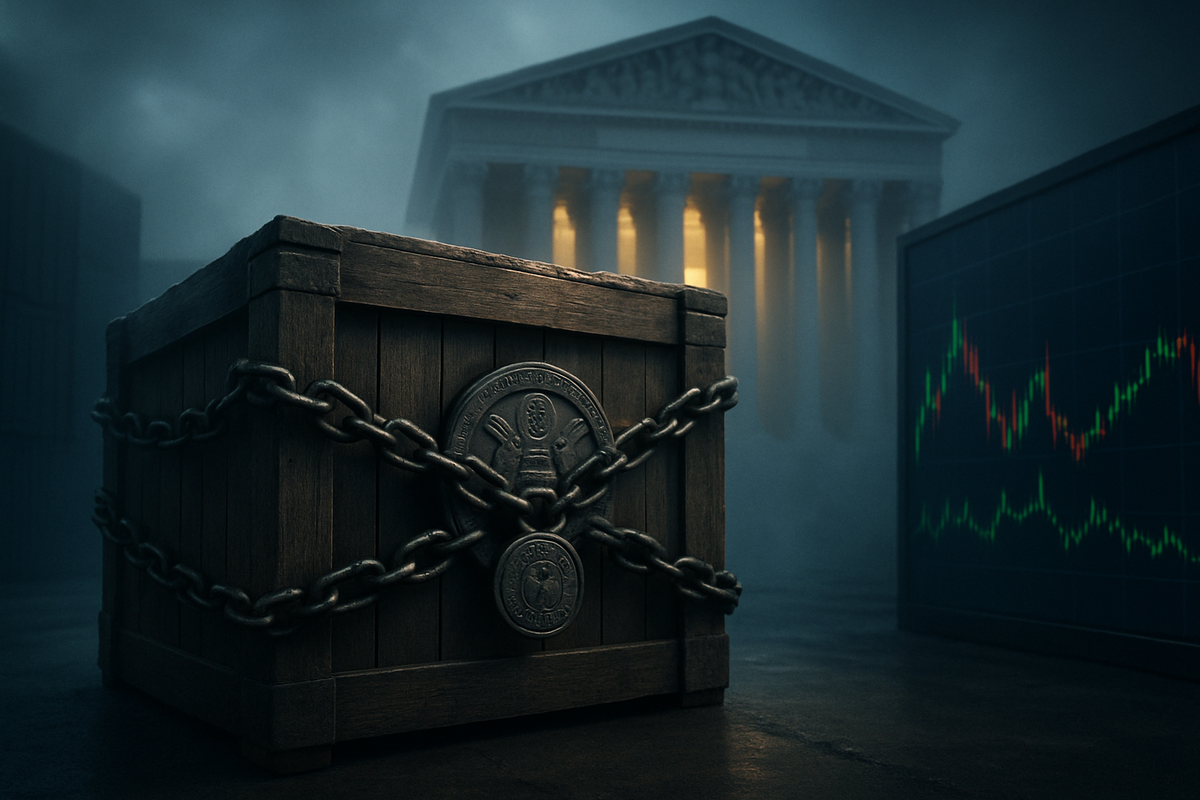
As of January 15, 2026, the global financial community is held in a state of suspended animation. The U.S. Supreme Court is on the precipice of delivering a verdict in Learning Resources, Inc. v. Trump, a case that challenges the very foundation of executive trade authority. At stake is the legality of the "Reciprocal and National Emergency Tariffs" imposed in early 2025, which leveraged the International Emergency Economic Powers Act (IEEPA) of 1977 to bypass traditional Congressional oversight. For investors, the decision is a binary event of historic proportions, with an estimated $150 billion to $200 billion in potential tariff refunds hanging in the balance.
The immediate implications are visible across every major exchange. Trade Policy Uncertainty (TPU) has reached record highs this month, as the Court’s delay of its anticipated January 14 ruling has left major importers and domestic manufacturers in a "policy fog." While the Trump administration argues that these tariffs are essential tools for national security and combating illicit fentanyl trafficking, hundreds of public companies contend that the executive branch has unconstitutionally seized the "taxing power" reserved for Congress.
The Case That Froze Global Trade
The road to the current legal impasse began in early 2025, when the administration declared a national economic emergency. Invoking the IEEPA, the President bypassed the lengthy investigations typically required by Section 232 or Section 301, instead applying broad 10–25% duties on a vast array of imported goods. This move was met with immediate legal resistance. A coalition of over 1,000 companies, led by Learning Resources, Inc. and supported by trade giants like Costco Wholesale Corp (NASDAQ: COST), filed suit, claiming that the IEEPA was never intended to be a blank check for permanent taxation.
The timeline leading to this moment has been a whirlwind of litigation. After the U.S. Court of International Trade and the Federal Circuit ruled against the government, the Supreme Court took up the case on an expedited basis. Oral arguments were heard on November 5, 2025, during which several justices expressed skepticism regarding the lack of the word "tariff" or "duty" within the IEEPA statute. The delay in the ruling, originally expected yesterday, has only heightened the tension. Stakeholders now face a reality where the market is pricing in two vastly different futures: one where the global trade regime is reset to its 2024 norms, and another where executive trade "weaponization" becomes a permanent feature of the U.S. economy.
Initial market reactions in the first two weeks of January have been volatile. Shares of major consumer-facing companies have fluctuated wildly as traders attempt to read the "tea leaves" of the Court's silence. Meanwhile, hedge funds have begun a novel form of arbitrage, purchasing "tariff refund rights" from distressed importers at a discount—essentially betting on a government defeat.
The Corporate Balance Sheet Battle: Winners and Losers
Should the Supreme Court strike down the tariffs, the retail and consumer electronics sectors are poised for a "Total Recall" rally. Companies like Walmart Inc. (NYSE: WMT), Target Corp (NYSE: TGT), and Lululemon Athletica Inc. (NASDAQ: LULU) would not only see an immediate reduction in cost of goods sold but would also be eligible for massive refunds on duties paid over the last year. Apple Inc. (NASDAQ: AAPL), which has navigated the tariff landscape through complex supply chain shifts, could see a significant boost to its margins as component costs for iPhones and MacBooks normalize.
Conversely, domestic industrial giants stand to lose their protective shield. Steel and aluminum producers such as Nucor Corp (NYSE: NUE) and United States Steel Corp (NYSE: X) have enjoyed inflated domestic prices and record profits under the protective duties. A ruling against the administration would likely trigger a sharp correction in these stocks as they once again face the full weight of global competition. Caterpillar Inc. (NYSE: CAT) and Ford Motor Co (NYSE: F), which act as both producers and massive consumers of raw materials, represent a more complex middle ground; while they may benefit from lower input costs, they also face the risk of retaliatory tariffs in their international markets if the trade war continues to escalate.
Smaller, specialized retailers like Mattel Inc. (NASDAQ: MAT) and Stanley Black & Decker Inc. (NYSE: SWK) have also been identified by analysts as high-beta plays on the SCOTUS decision. For these companies, the tariff burden has been a significant drag on capital expenditure (CapEx), and a favorable ruling would likely result in an immediate release of stalled investment projects.
A Precedent for the New Century: Beyond the Exchange Floor
The wider significance of Learning Resources v. Trump extends far beyond the immediate balance sheets of the Fortune 500. This case is a test of the "Major Questions Doctrine"—the legal principle that the executive branch cannot make decisions of vast economic or political significance without clear Congressional authorization. If the Court rules in favor of the administration, it would effectively rewrite the power dynamics of the U.S. government, granting future presidents the ability to use trade as a permanent tool of unilateral diplomacy.
The historical precedent most often cited by legal scholars is the 1952 case of Youngstown Sheet & Tube Co. v. Sawyer, which limited President Truman’s power to seize private property during a national emergency. Critics argue the current tariff regime falls into Youngstown’s "lowest ebb" of presidential power, where the executive acts against the implied will of Congress. Furthermore, the international ripple effects are already being felt. The European Union has prepared a €20 billion retaliation package targeting U.S. whiskey and motorcycles, a package that will be triggered the moment the Court upholds the tariffs.
Japan has taken a more diplomatic route, with Prime Minister Ishiba securing a tentative deal to lower auto tariffs for Toyota Motor Corp (NYSE: TM) in exchange for a $550 billion investment initiative in the U.S. However, this deal—and many others like it—rests on the fragile foundation of the SCOTUS ruling. A strike-down would nullify these "investment-for-exemption" pacts, potentially resetting diplomatic relations with key allies.
The Post-Ruling Pivot: What Comes Next?
In the short term, the market is preparing for a "Plan B" scenario regardless of the outcome. If the administration loses, analysts at Morgan Stanley expect the President to immediately launch new investigations under Section 232 (National Security) or Section 301 (Unfair Trade Practices). While these routes are more legally sound, they require a months-long administrative process. This would create a "tariff holiday" in early 2026, offering a temporary window of relief for importers but introducing a new layer of long-term uncertainty as the "Policy Fog" merely shifts to a different legal statute.
For long-term strategy, companies are increasingly adopting "China Plus One" or "Nearshoring" models, moving production to Mexico or Vietnam to mitigate the risk of being caught in the crossfire of future executive orders. This strategic pivot is no longer just about costs; it is about risk management in an era where trade policy can change with the stroke of a pen. Investors should watch for a potential surge in M&A activity within the logistics and domestic manufacturing sectors as companies rush to build more resilient, tariff-proof supply chains.
Navigating the Policy Fog: Conclusion
The pending Supreme Court decision represents one of the most significant market-moving events of the decade. The key takeaway for investors is that while a ruling against the administration would provide a massive liquidity boost to the retail sector, it may not signal the end of protectionist trade policy. The transition from IEEPA-based tariffs to Section 232 or 301 investigations is a highly probable scenario that could prolong the period of market volatility.
Moving forward, the market will likely place a permanent "risk premium" on companies with heavy international exposure. Investors should keep a close eye on the "Tariff Refund Rights" market and the TPU Index for early signs of sentiment shifts. Ultimately, the lasting impact of Learning Resources v. Trump will be its definition of where the power to tax ends and the power to lead begins. For now, the world watches the high court, waiting for the signal that will either unleash a multi-billion dollar refund or cement a new era of executive-led global trade.
This content is intended for informational purposes only and is not financial advice.