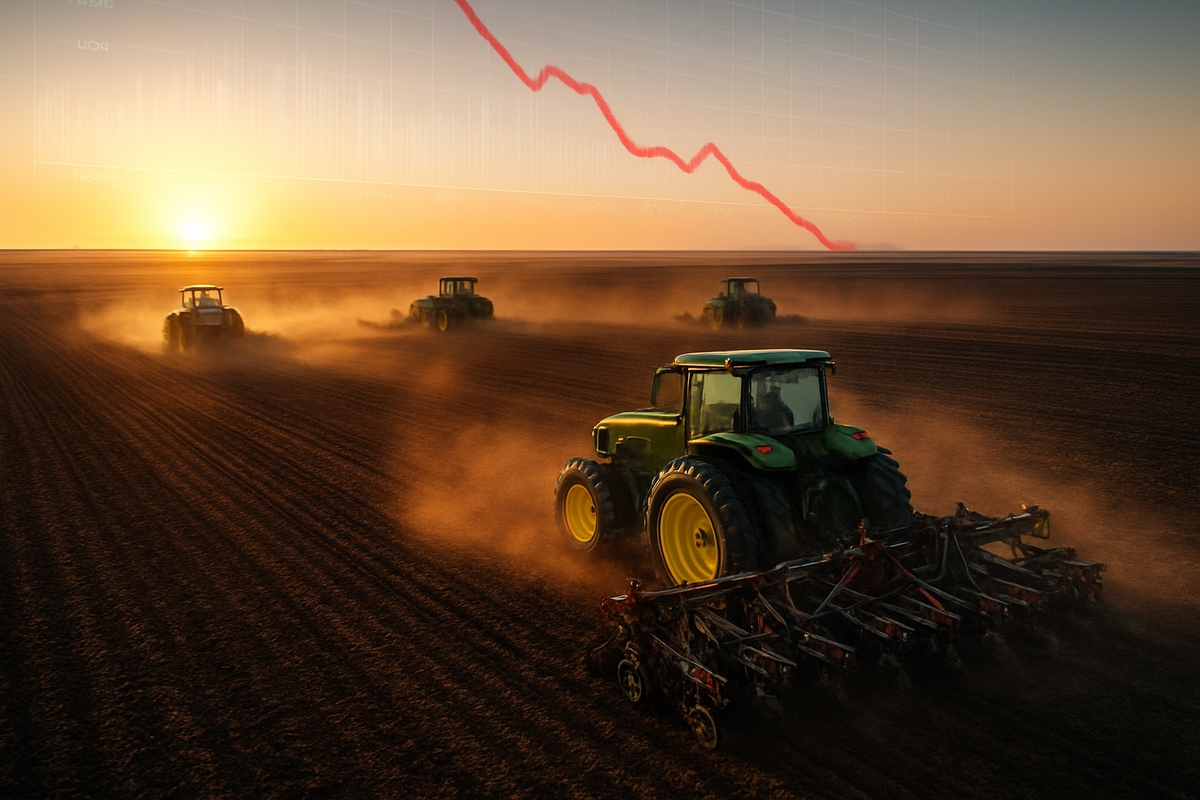
As the mid-winter lull settles over the American Heartland, the financial echoes of a hyper-efficient planting machine continue to resonate through the Chicago Board of Trade. Heading into mid-January 2026, grain futures for corn and soybeans remain under persistent downward pressure, a direct consequence of a multi-year trend toward rapid-fire planting that has consistently outpaced historical averages. Analysts point to the seminal late-May surges—where farmers remarkably put 70% of the nation’s corn and 52% of its soybeans into the ground in record time—as the primary catalyst for the current "supply-heavy" market environment that is depressing prices and narrowing margins across the agricultural sector.
This supply-side dominance has fundamentally shifted the leverage from producers to processors, leaving corn futures struggling to hold the $4.20 per bushel mark and soybeans hovering near multi-year lows. While the speed of modern agriculture is a testament to technological advancement, the resulting glut of 2025 and the carryover into 2026 have created a challenging financial landscape for equipment manufacturers and chemical providers alike, as net farm income takes a hit from the very efficiency it sought to achieve.
The Turning Point: From Weather Delays to a 70% Surge
The origin of the current bearish cycle can be traced back to a dramatic shift in the 2024 and 2025 planting windows. Early in those seasons, persistent rainfall across the I-80 corridor had triggered widespread anxiety among traders, leading to brief speculative rallies in corn and soybean futures. However, as the weather cleared in mid-May, the U.S. agricultural machine responded with unprecedented speed. According to data from the USDA Crop Progress reports, corn planting jumped by over 20 percentage points in a single week during the late-May window, reaching a 70% completion rate, while soybeans simultaneously hit the 52% mark.
This rapid catch-up effectively "sealed the deal" for the supply side. By ensuring that the bulk of the crop was in the ground before the critical heat of late June and July, farmers maximized yield potential and minimized the risk of a late-summer pollination failure. The timeline of this event saw Chicago Board of Trade (CBOT) futures immediately pivot from a "weather premium" mindset to a "supply glut" reality. Key stakeholders, including large-scale commercial elevators and international grain buyers, quickly adjusted their long-term hedges, anticipating the record-shattering harvests that eventually materialized at the end of 2025.
The initial market reaction was a sharp correction in the July and December contracts, which set the tone for the long-term price erosion we see today. By late 2025, the U.S. was sitting on one of its largest grain stockpiles in a decade, leaving the market in January 2026 with little room for price appreciation without a significant global disruption.
Winners and Losers in a Low-Price Environment
The "efficiency trap" of rapid planting has created a bifurcated landscape for public companies in the agricultural sector. On the "losing" side of this equation are the equipment giants and input providers who thrive when farm income is high. Deere & Co. (NYSE: DE) has faced significant headwinds as low grain prices have forced farmers to defer big-ticket machinery purchases. Throughout late 2024 and 2025, Deere announced several rounds of production cuts and layoffs at its flagship plants, as the bearish corn and soybean outlook stifled demand for the very high-efficiency tractors that made the rapid planting possible in the first place.
Similarly, Corteva, Inc. (NYSE: CTVA) and The Mosaic Company (NYSE: MOS) are navigating a market where farmers are increasingly price-sensitive regarding seeds, fertilizer, and crop protection chemicals. When corn trades near $4.00, the "premium" value proposition of high-end inputs becomes a harder sell, leading to compressed margins for chemical manufacturers.
Conversely, the massive supply has provided a steady, albeit low-margin, flow of volume for the "ABCD" grain majors. Archer-Daniels-Midland (NYSE: ADM) and Bunge Global SA (NYSE: BG) benefit from the sheer volume of grain that must be moved, stored, and processed. However, even these giants have not been immune to the pressure. While high volume is a plus, the "crush margins"—the profit earned from processing soybeans into oil and meal—have been compressed by the global surplus. For ADM, the challenge has been navigating 2025 earnings that hit multi-year lows, as the market moved from a period of scarcity-driven profits to a high-volume, low-margin grind.
The Global Significance: Ending the Scarcity Era
The rapid pace of U.S. planting is more than just a seasonal anomaly; it represents the end of the post-2020 era of grain scarcity. Between 2020 and 2023, global supply chains were rattled by the pandemic, geopolitical strife in the Black Sea, and erratic weather, leading to a "golden age" for grain prices. The 52% soybean and 70% corn milestones in late May proved that U.S. production capacity, aided by precision agriculture and favorable late-spring windows, could overcome early-season adversity to flood the market once again.
This event fits into a broader trend of "industrialized efficiency" that is being mirrored globally. As U.S. futures are pressured by domestic supply, they are also facing stiff competition from record-breaking harvests in Brazil and Argentina. The ripple effect has been a shift in global trade flows, with China and other major importers increasingly sourcing from South America, further depressing the "basis" for U.S. farmers. This has led to a policy environment where the focus is shifting back toward export subsidies and domestic biofuel mandates to absorb the excess corn and soy oil supply.
Historically, this resembles the "long-tail" bear markets of the mid-2010s, where several years of record production kept a lid on prices. The difference now is the sheer speed of the planting cycle, which has narrowed the window for speculative price rallies and made "weather scares" increasingly short-lived.
Looking Ahead: The 2026 Planting Outlook
As we move toward the spring of 2026, the primary question for investors is whether the U.S. farmer will blink. With corn and soybean prices at levels that barely cover the cost of production for many, there is intense speculation regarding a shift in acreage. If the 2026 planting season again starts with high efficiency, the "glut" could extend into 2027, potentially forcing more consolidations among smaller midwestern cooperatives and keeping a cap on the stock prices of input providers like CF Industries (NYSE: CF).
Short-term, the market is looking for any signs of a strategic pivot. We may see an increase in "prevent plant" claims if early-season weather is poor, not because farmers can't get into the fields, but because the insurance payout might finally be more attractive than growing $4.00 corn. Long-term, the industry will likely see a push toward "value-added" crops or more aggressive carbon-capture initiatives as farmers seek to diversify away from the boom-and-bust cycle of commodity grain.
Wrap-Up: A Market Defined by Its Own Success
The story of the 2025/26 grain market is one of a sector that has become a victim of its own success. The ability to put 70% of the corn crop in the ground by late May is a miracle of modern engineering, yet it has systematically dismantled the price premiums that sustained farm income for the previous half-decade. For the grain futures market, the current "supply-side pressure" is the new normal, and it will take a significant disruption—either geopolitical or catastrophic weather—to break the bearish trend.
Investors should watch the upcoming March USDA Planting Intentions report closely. Any sign that farmers are finally pulling back on acreage could provide the first real floor for grain prices in two years. Until then, the market remains a buyer's paradise and a producer's challenge, as the ghosts of those rapid-fire May planting days continue to haunt the CBOT pits. Moving forward, the focus will remain on whether the efficiency gains of the U.S. heartland can find new outlets in the sustainable aviation fuel (SAF) market or other industrial applications to clear the surplus.
This content is intended for informational purposes only and is not financial advice.