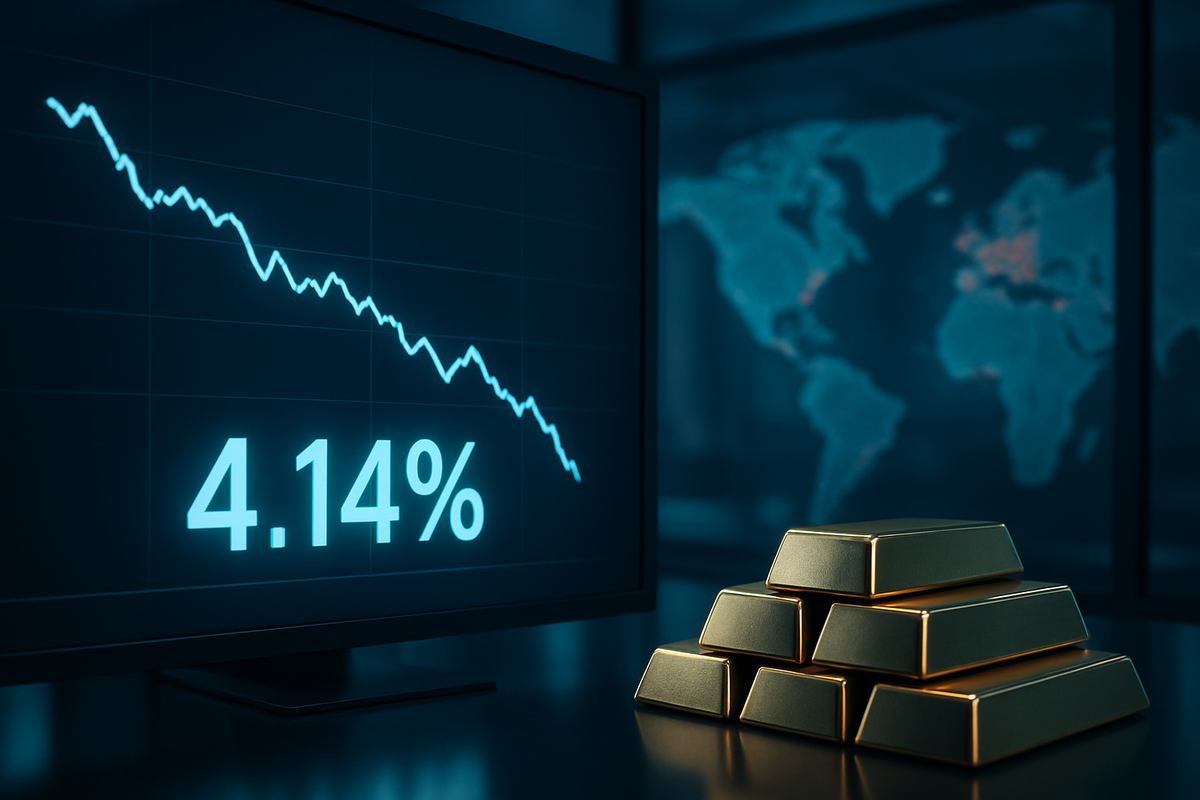
The benchmark 10-year U.S. Treasury yield, the bedrock of global borrowing costs, fell below the critical 4.15% threshold on January 16, 2026, settling at 4.14%. This decline marks a significant psychological and technical shift for financial markets, signaling a definitive departure from the "higher for longer" interest rate era that defined much of 2024 and 2025. As yields move toward a more stable equilibrium, investors are weighing whether this shift reflects a successful "soft landing" or a response to mounting global instability.
The immediate implications of this move are widespread, influencing everything from mortgage rates to the valuation of mega-cap technology stocks. While lower yields typically provide a tailwind for equities by lowering the discount rate on future earnings, the current dip is shadowed by a cooling labor market and a resurgence of geopolitical risk. Market participants are now closely monitoring whether the 4.15% level will act as a ceiling or if yields will continue to slide toward the Federal Reserve’s projected neutral rate of 3.5%.
A Confluence of Economic Cooling and Global Tensions
The descent below 4.15% was not a sudden shock but the culmination of a cooling trend that gained momentum in late 2025. Throughout the final quarter of last year, the Federal Reserve executed a series of three consecutive 25-basis-point "insurance cuts," bringing the federal funds rate into the 3.50%–3.75% range. This policy pivot was driven by significant progress on the inflation front; the Personal Consumption Expenditures (PCE) price index, the Fed's preferred metric, moderated from 3.1% in mid-2025 to 2.4% by early 2026. This disinflationary trend has effectively stripped the "inflation premium" out of long-term bonds, allowing yields to settle lower.
Simultaneously, the U.S. labor market has shown signs of fatigue. While the unemployment rate remains historically low at 4.4%, monthly job gains have slowed to a modest 50,000. This data suggests that the era of aggressive "labor hoarding" by corporations has ended, replaced by a more cautious approach to hiring. The cooling labor market, combined with the Fed’s dovish stance, provided the fundamental backdrop for the yield's slide. However, it was a sudden spike in safe-haven demand that provided the final push below 4.15%.
Geopolitical volatility reached a boiling point in the first two weeks of 2026. Renewed hostilities in the Middle East between Israel and Iran, coupled with the dramatic capture of Venezuelan President Nicolás Maduro by U.S. special forces, sent shockwaves through global markets. As uncertainty spiked, institutional investors fled to the safety of U.S. Treasuries, driving prices up and yields down. This "flight-to-quality" move underscores the Treasury's continued role as a global refuge, even as emerging concerns regarding the $38 trillion national debt linger in the background.
Winners and Losers in the Sub-4.15% Environment
The shift in yields is creating a distinct divergence in performance across various sectors. The banking sector is facing the most immediate pressure. JPMorgan Chase & Co. (NYSE: JPM) saw its shares decline approximately 4% as the bank warned of narrowing Net Interest Margins (NIM). With long-term yields falling, the gap between what the bank earns on loans and what it pays on deposits is shrinking, threatening revenue growth. Similarly, Bank of America Corp. (NYSE: BAC) reported that while fixed-rate asset repricing provides some cushion, sustaining record net interest income will be increasingly difficult if the 10-year yield remains suppressed.
Conversely, the real estate sector has emerged as a primary beneficiary. Real Estate Investment Trusts (REITs) like Prologis, Inc. (NYSE: PLD) and American Tower Corp. (NYSE: AMT) are highly sensitive to the cost of capital. For Prologis, the leader in industrial real estate, falling yields reduce the interest expense on the massive debt loads used to fund warehouse expansions. For investors, the lower yield environment makes the dividend yields of these REITs more attractive by comparison, driving renewed interest in the sector after years of underperformance.
The technology sector presents a more complex picture. Historically, lower yields support the high valuations of growth companies like Apple Inc. (NASDAQ: AAPL) and Microsoft Corp. (NASDAQ: MSFT) by increasing the present value of their future cash flows. However, the positive impact of the yield drop has been partially muted by sector-specific hurdles. Apple, for instance, has faced relative underperformance as Alphabet Inc. (NASDAQ: GOOGL) recently surpassed it in market capitalization, driven by a perception that Alphabet is better positioned to monetize its 2025 AI investments. While lower rates help, the market is now demanding tangible productivity gains from the billions spent on artificial intelligence over the past 24 months.
Broader Significance and Historical Context
This move below 4.15% fits into a broader industry trend of "normalization." After the extreme volatility of the post-pandemic years, the market is attempting to find a "neutral" yield that balances growth and inflation. This environment is reminiscent of the "mid-cycle adjustments" seen in the late 1990s, where the Fed successfully navigated a cooling economy without triggering a recession. However, the current situation is complicated by a historical precedent: the rise of gold as a competing safe haven.
In early 2026, gold reached record highs above $4,600 per ounce, challenging the 10-year Treasury’s status as the world’s premier "risk-off" asset. Central banks in China and other emerging markets have been aggressively diversifying away from U.S. debt, citing concerns over the rising national deficit and the weaponization of the dollar via sanctions. This diversification creates a paradoxical situation where yields fall due to safe-haven buying from domestic investors, while foreign selling creates an upward "floor" that prevents yields from returning to the ultra-low levels seen in the 2010s.
Furthermore, the current yield environment reflects a shift in regulatory and policy expectations. With the national debt approaching $40 trillion, there is growing concern that fiscal policy will eventually force the Fed’s hand. If the government’s interest payments become unsustainable, the market may begin to price in "fiscal dominance," where the Fed is forced to keep rates low to facilitate government borrowing, regardless of inflation targets. The drop below 4.15% may be the first sign that investors are preparing for this long-term reality.
The Road Ahead: Potential Scenarios and Strategic Pivots
Looking forward, the short-term trajectory of the 10-year yield will likely be dictated by the Fed’s next meeting and the upcoming February jobs report. If employment data continues to soften, we could see the yield test the 4.0% support level. This would likely trigger a strategic pivot among institutional investors, shifting from defensive "cash-heavy" positions toward long-duration bonds and high-dividend equities. Corporations are also likely to take advantage of the dip by accelerating bond issuances to refinance debt that was taken on during the 2023-2024 peak.
In the long term, the market faces a "fork in the road." In a positive scenario, the lower yield environment facilitates a housing market recovery and fuels a new cycle of corporate investment in AI-driven automation, leading to a period of non-inflationary growth. In a negative scenario, the drop below 4.15% could be a "canary in the coal mine," signaling that the global economy is cooling faster than anticipated. If consumption slows significantly, the Fed may be forced to cut rates more aggressively, potentially re-igniting inflation if supply-side constraints—such as geopolitical trade barriers—remain in place.
Investors should prepare for increased volatility. While the current 4.14% yield offers some relief to borrowers, the underlying reasons for the drop—geopolitical strife and a slowing labor market—are not inherently "bullish." A successful navigation of this landscape will require a focus on high-quality companies with strong balance sheets that can withstand both NIM compression in banking and the high-stakes execution required in the tech and real estate sectors.
Summary and Final Thoughts
The fall of the 10-year Treasury yield below 4.15% is a watershed moment for the 2026 financial landscape. It confirms that the inflationary shocks of the mid-2020s have largely been contained, but it also highlights the growing risks of a global slowdown and geopolitical fragmentation. The market has moved from a period of "inflation fear" to one of "growth concern," with Treasuries once again serving as the primary barometer for investor sentiment.
Moving forward, the market’s health will depend on whether this lower cost of capital can stimulate real-world economic activity. Investors should keep a close watch on the spread between short-term and long-term yields, as well as the performance of "yield-sensitive" sectors like utilities and real estate. The shift below 4.15% is a welcome sign for many, but in an environment characterized by $38 trillion in debt and global conflict, stability remains a fragile prospect.
This content is intended for informational purposes only and is not financial advice.