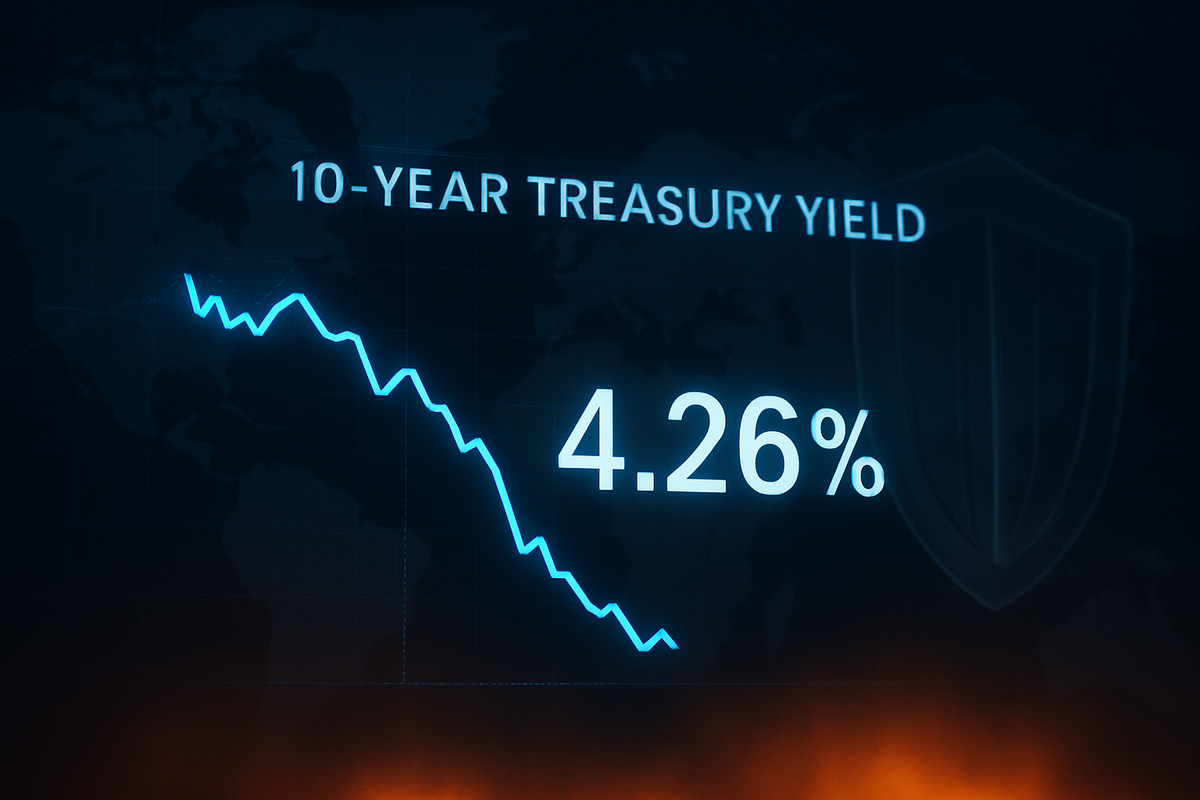
As the markets reopened following the Martin Luther King Jr. Day holiday on January 20, 2026, the financial world found itself gripped by a paradoxical tug-of-war. The yield on the US 10-year Treasury note—a global benchmark for borrowing costs—settled at 4.26%, a level that reflects a complex intersection of aggressive trade policy and a desperate search for stability. Despite the inherently inflationary nature of the administration's latest tariff escalations, which would typically drive yields higher, a significant "flight to safety" has emerged, as investors hedge against the potential for a global economic slowdown triggered by a renewed trade war.
This recent stabilization at 4.26% comes in the wake of President Trump’s January 17 announcement of a 10% tariff on eight NATO members—a move aimed at pressuring allies over the proposed purchase of Greenland. While the market is pricing in the "Protectionist Premium" of higher consumer prices, the sheer scale of the geopolitical uncertainty has forced capital into the perceived security of U.S. government debt. This dynamic has temporarily capped a yield surge that many analysts feared would breach the 5% mark, highlighting a market that is simultaneously terrified of inflation and even more afraid of a hard landing.
The 'Greenland Pivot' and the 4.26% Equilibrium
The road to the 4.26% yield has been paved with policy shocks and strategic "jawboning" from the Treasury Department. Throughout late 2025, the 10-year yield had been volatile, peaking near 5.0% during the summer before cooling toward 4.1% following three "insurance cuts" by the Federal Reserve. However, the equilibrium was shattered on January 17, 2026, when the administration announced its most audacious trade move yet: the "Greenland Tariffs." By imposing a 10% duty on key NATO allies, including Germany, France, and the UK, the U.S. has effectively opened a secondary front in a trade war that already includes 25% duties on Mexican and Canadian imports.
The immediate reaction was a spike in yields as bond vigilantes prepared for a second wave of inflation. However, as the holiday weekend progressed, the narrative shifted. Large institutional players, fearing that these tariffs would cripple European growth and disrupt global supply chains, began a massive reallocation. This "flight to safety" saw investors buying Treasuries not because they are "safe" from inflation, but because they remain the most liquid asset in a world where equities are plummeting. This buying pressure successfully pulled the yield back down to the 4.26% handle by the morning of January 20.
Central to this movement is Treasury Secretary Scott Bessent and his "3-3-3" policy. Bessent has spent the last several weeks attempting to reassure markets that the administration's goal is to lower the "long end" of the yield curve through energy dominance and deficit reduction. By promising to increase U.S. oil production by 3 million barrels a day, Bessent argues that the deflationary pressure of cheap energy will eventually offset the inflationary impact of tariffs. On January 20, his department actively dismissed market volatility as "short-term adjustment," further encouraging the safety bid that kept yields from spiraling out of control.
Winners and Losers in a High-Tariff Environment
The fluctuation in yields and the imposition of the Greenland Tariffs have created a stark divide in the corporate landscape. Multinational giants with heavy reliance on European and North American supply chains are bearing the brunt of the "Sell America" sentiment. Apple Inc. (NASDAQ: AAPL), for instance, faces a double-edged sword: rising component costs from renewed Chinese levies and potential retaliatory measures in European markets. Similarly, Ford Motor Co (NYSE: F) has seen its shares pressured as the 25% duty on Mexican-made parts begins to eat into margins, despite the temporary relief of a 4.26% borrowing benchmark.
Retailers are also in the crosshairs. Walmart Inc. (NYSE: WMT), which had managed to maintain price stability through most of 2025, now faces a "tariff tax" that could alienate its core consumer base. While lower yields (compared to the 5% highs) offer some relief for the company’s massive financing needs, the threat of stagflation—stagnant growth paired with rising prices—remains a significant headwind for the retail sector.
On the winning side of the ledger, domestic energy producers and safe-haven assets are thriving. Exxon Mobil Corp (NYSE: XOM) stands to benefit directly from the Bessent "3-3-3" plan, as deregulation and incentives for increased production take center stage. Meanwhile, the flight to safety hasn't just benefited Treasuries; it has catalyzed a massive rally in precious metals. Newmont Corporation (NYSE: NEM) has seen its valuation surge as gold prices reached record highs, serving as a secondary haven for investors who are beginning to doubt the long-term reliability of the U.S. dollar. Financial institutions like JPMorgan Chase & Co. (NYSE: JPM) face a more complex outlook; while the 4.26% yield provides a decent spread for lending, the threat of a DOJ investigation into the Federal Reserve’s independence has introduced a layer of institutional risk that makes long-term forecasting difficult.
A Fundamental Shift in the 'Safe Haven' Narrative
The current situation is more than just a momentary market fluctuation; it represents a potential breakdown of the traditional "flight to safety" framework. Historically, when global risks rise, the U.S. dollar and Treasuries rally in tandem. However, in January 2026, we are witnessing the emergence of a "Sell America" trade. Many international investors are increasingly wary of the institutional stability of the United States, citing the administration’s use of the International Emergency Economic Powers Act (IEEPA) to bypass Congress on trade policy and the ongoing legal challenges to the Fed’s autonomy.
This event mirrors the stagflationary periods of the 1970s, where traditional relationships between asset classes decoupled. In 2026, the fact that yields are settling at 4.26% despite the threat of 25% tariffs on Mexico and Canada suggests that the market is essentially pricing in a global recession. Investors are betting that the tariffs will be so destructive to demand that inflation will be secondary to a collapse in economic activity. This "recession hedge" is what is currently keeping the 10-year yield from reaching the 5.5% or 6.0% levels that a pure inflation model would suggest.
Furthermore, the Greenland dispute has introduced a "Geopolitical Risk Premium" that is usually reserved for emerging markets. By targeting NATO allies, the U.S. is signaling a shift toward a more isolationist and unpredictable foreign policy. This has led to a noticeable diversification by foreign central banks away from the greenback and into the Japanese yen and Swiss franc, suggesting that the "safety" of the 4.26% Treasury yield may be more fragile than it appears on the surface.
The Road Ahead: 5% Yields or a Policy Pivot?
Looking forward, the market’s focus will remain squarely on the "Greenland Tariffs" deadline. If no deal is reached by February 1, the 10% levy goes into effect, with a jump to 25% scheduled for June. This timeline provides a narrow window for the Bessent-led Treasury to prove that their "3-3-3" strategy can provide enough of a growth buffer to prevent a full-scale bond market revolt. Short-term, the 10-year yield is expected to remain range-bound between 4.15% and 4.40% as the market waits for the next set of CPI data.
A potential strategic pivot may come from the judicial branch. A Supreme Court challenge to the administration’s use of the IEEPA is currently pending, and a ruling against the executive branch could lead to a massive unwinding of the tariff-related "Safety Flight." In such a scenario, yields could drop precipitously as the "inflation tax" is removed from the equation. Conversely, if the tariffs are upheld and the DOJ investigation into Fed Chair Jerome Powell intensifies, the "Sell America" sentiment could overwhelm the safety bid, pushing yields well beyond 5% as investors demand a higher risk premium for holding U.S. debt.
Investors should also watch for signs of "Strategic Volatility"—a theory that the administration is intentionally creating market chaos to drive capital back into bonds to help fund the growing deficit. If this is indeed the play, we may see a series of "mini-crises" designed to keep the 10-year yield near the 4% level, even as the real economy grapples with the costs of protectionism.
Conclusion and Market Outlook
The current 4.26% yield on the US 10-year Treasury is a symptom of a market caught between two extreme fears: a "tariff-induced" inflationary spike and a "policy-induced" global recession. While the flight to safety has provided a temporary ceiling on interest rates, the underlying drivers of this volatility—aggressive trade mandates and institutional uncertainty—remain unresolved. The success of the "3-3-3" policy depends on its ability to produce tangible results in energy and growth before the inflationary weight of the Greenland Tariffs becomes too heavy for the bond market to carry.
Moving forward, the primary takeaway for investors is that the old rules of "safety" are being rewritten. The correlation between a strong dollar and rising yields has weakened, and the "Safe Haven" status of Treasuries is being tested by a "Sell America" narrative. In the coming months, the crucial indicators to monitor will be the June tariff escalation, the Supreme Court’s stance on executive trade power, and the ability of domestic energy production to act as a deflationary anchor. For now, 4.26% is the line in the sand—but in the volatile climate of early 2026, the ground beneath that line is shifting rapidly.
This content is intended for informational purposes only and is not financial advice.