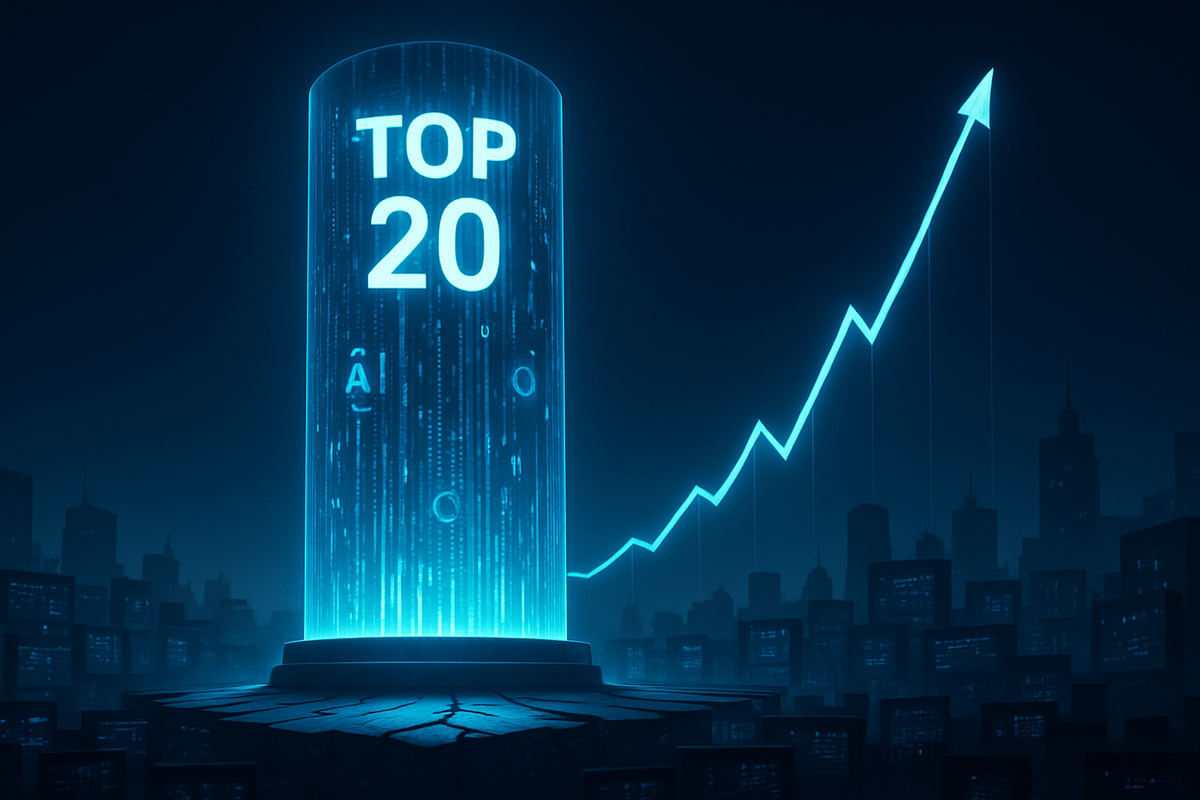
As the opening bell rang on January 26, 2026, the equity markets found themselves at a historic crossroads. J.P. Morgan Global Research has issued a stark warning regarding the unprecedented concentration of the S&P 500, revealing that the top 20 stocks now command a staggering 50.8% of the index’s total market capitalization. This "winner-takes-all" dynamic, fueled by an insatiable appetite for Artificial Intelligence infrastructure, has pushed market density to levels unseen in over half a century, creating what analysts describe as a "multidimensional polarization" of the American economy.
The immediate implications of this concentration are profound. With more than half of the world's most-followed benchmark tied to the fortunes of just twenty companies, the traditional benefits of index diversification have effectively vanished. J.P. Morgan strategists warn that this creates a systemic risk factor where a single earnings miss or a shift in AI sentiment among the "Top 20" could trigger a de-leveraging event capable of pulling down the entire market, regardless of the health of the remaining 480 companies.
The AI Supercycle and the Road to 50%
The path to this historic concentration began in earnest during the "AI Spring" of 2023, but it reached its zenith in late 2025 as the "AI 30"—a group of companies providing the backbone of the generative era—began to pull away from the rest of the market. According to Dubravko Lakos-Bujas, Head of Global Markets Strategy at J.P. Morgan, the market has moved beyond the "Magnificent Seven" era into a broader but more intensive "AI Backbone" phase. This shift saw capital flood into companies that control the physical and digital infrastructure of AI, from high-end semiconductors to the utility companies providing the massive amounts of power required by data centers.
Timeline analysis shows that the concentration accelerated sharply in the second half of 2025, as hyperscaler capital expenditure (capex) projections for 2026 were revised upward to an eye-watering $600 billion to $700 billion. This massive deployment of capital created a "circular economy" within the tech sector, where the largest players became each other’s biggest customers and investors. By the end of 2025, the top 10 stocks alone accounted for nearly 40% of the index weight, a level that has historically preceded periods of high volatility and "mean reversion."
Key stakeholders, including institutional pension funds and passive index investors, are now grappling with the reality that "buying the index" is no longer a bet on the broad U.S. economy, but rather a concentrated wager on the continued success of a small tech oligarchy. Market reactions to the J.P. Morgan report have been characterized by a "rotation of anxiety," as investors weigh the undeniable earnings power of the leaders against the mathematical fragility of such a top-heavy structure.
The 'AI-Haves' vs. the 'AI-Have-Nots'
In this highly polarized environment, J.P. Morgan identifies a clear divide between the winners and those left behind. The primary beneficiaries continue to be the "Hyperscalers" and their essential suppliers. Companies like NVIDIA (NASDAQ: NVDA), Microsoft (NASDAQ: MSFT), and Alphabet (NASDAQ: GOOGL) remain at the center of the orbit, bolstered by massive cash reserves exceeding $450 billion combined. However, the "Winner-Takes-All" dynamic has expanded to include "AI Utilities" such as NextEra Energy (NYSE: NEE) and Vistra (NYSE: VST), which have seen their valuations soar as data center power demands became the primary constraint on growth.
Conversely, the "AI-Have-Nots" are facing a bleak 2026. J.P. Morgan warns that the traditional Software-as-a-Service (SaaS) sector is under threat from "Agentic AI," which automates tasks that previously required expensive software licenses. Furthermore, companies in the "K-shaped" consumer economy, such as Dollar General (NYSE: DG), are struggling as lower-income households face sticky inflation and a softening labor market, contrasting sharply with the wealth effect felt by those invested in the tech boom.
The industrial sector also shows a widening gap. While electrical infrastructure giants like Eaton (NYSE: ETN) are thriving, legacy manufacturers that failed to pivot toward the AI supply chain are lagging behind. Boeing (NYSE: BA), for instance, continues to struggle as a "legacy beacon," finding it difficult to attract the capital now being vacuumed up by high-growth tech and energy firms. This divergence suggests that the "Other 480" stocks in the S&P 500 may continue to face a "liquidity desert" as capital remains concentrated at the top.
Historical Echoes and Systemic Fragility
The current market structure draws uncomfortable comparisons to the "Nifty Fifty" era of the 1970s and the Dot-com bubble of 2000. J.P. Morgan’s research points out that today’s market is actually more top-heavy than during the 1972 peak, when the top five stocks held a 23% weight. While today’s leaders are arguably higher-quality businesses with real profits—unlike many 1999-era startups—the sheer scale of their dominance creates a different kind of risk: a liquidity crunch.
This "systemic crowding" means that even minor institutional rebalancing can lead to outsized price swings. The firm warns of an "earnings-valuation gap," noting that while the top 20 companies account for half the market value, their contribution to total index earnings, while substantial, does not always justify the extreme premiums. If the Return on Investment (ROI) for the $700 billion in AI capex begins to show signs of stagnation in 2026, the "circularity" of the AI economy could rapidly turn into a downward spiral of reduced spending and falling valuations.
Furthermore, the broader industry trend toward passive investing has exacerbated this issue. As more money flows into S&P 500 index funds, it is automatically funneled into the largest names regardless of valuation, creating a feedback loop that has pushed the forward P/E ratio of the index toward 23x—not far from the 2000 peak. Regulatory scrutiny is also mounting, as the "winner-takes-all" dominance of these few firms begins to raise antitrust concerns that could serve as a catalyst for a forced de-concentration of the market.
The Path Forward: Scenarios for 2026
Looking ahead, J.P. Morgan outlines two primary scenarios for the remainder of 2026. The "Soft Landing" scenario assumes that AI capex begins to translate into broad-based productivity gains across the "Other 480" stocks, leading to an organic broadening of the market and a gradual reduction in concentration. In this case, the S&P 500 could reach the bank's target of 7,500 by year-end, supported by a rotation into mid-cap tech and traditional industrials that have successfully integrated AI.
However, the "Concentration Collapse" scenario—to which the bank assigns a 35% probability—involves a global recession triggered by a slowdown in AI spending. If the hyperscalers begin to pull back on their $600 billion spending spree, the ripple effects would be catastrophic for the semiconductor and energy sectors. This would likely force a rapid and painful deleveraging of the index as passive funds are forced to sell their largest holdings into a falling market, potentially leading to a period of protracted underperformance for U.S. equities compared to international markets.
Summary and Investor Outlook
The J.P. Morgan warning serves as a sobering reminder that the S&P 500 has evolved into a highly concentrated instrument of the technology sector. The "Top 20" stocks, led by the AI infrastructure giants, now dictate the direction of the entire market, leaving traditional diversification strategies in the rearview mirror. While the fundamental quality of these leaders is high, the mathematical reality of 50.8% concentration creates a fragile equilibrium that is highly sensitive to changes in sentiment and capital expenditure.
Moving forward, investors should closely monitor quarterly capex reports from the hyperscalers and signs of AI "fatigue" in corporate earnings. The "K-shaped" divergence between the AI-haves and have-nots is likely to widen, making stock selection—rather than index tracking—increasingly vital for risk management. As we navigate the complexities of 2026, the key question remains: can the "Other 480" catch up, or will the weight of the Top 20 eventually become too heavy for the market to bear?
This content is intended for informational purposes only and is not financial advice.