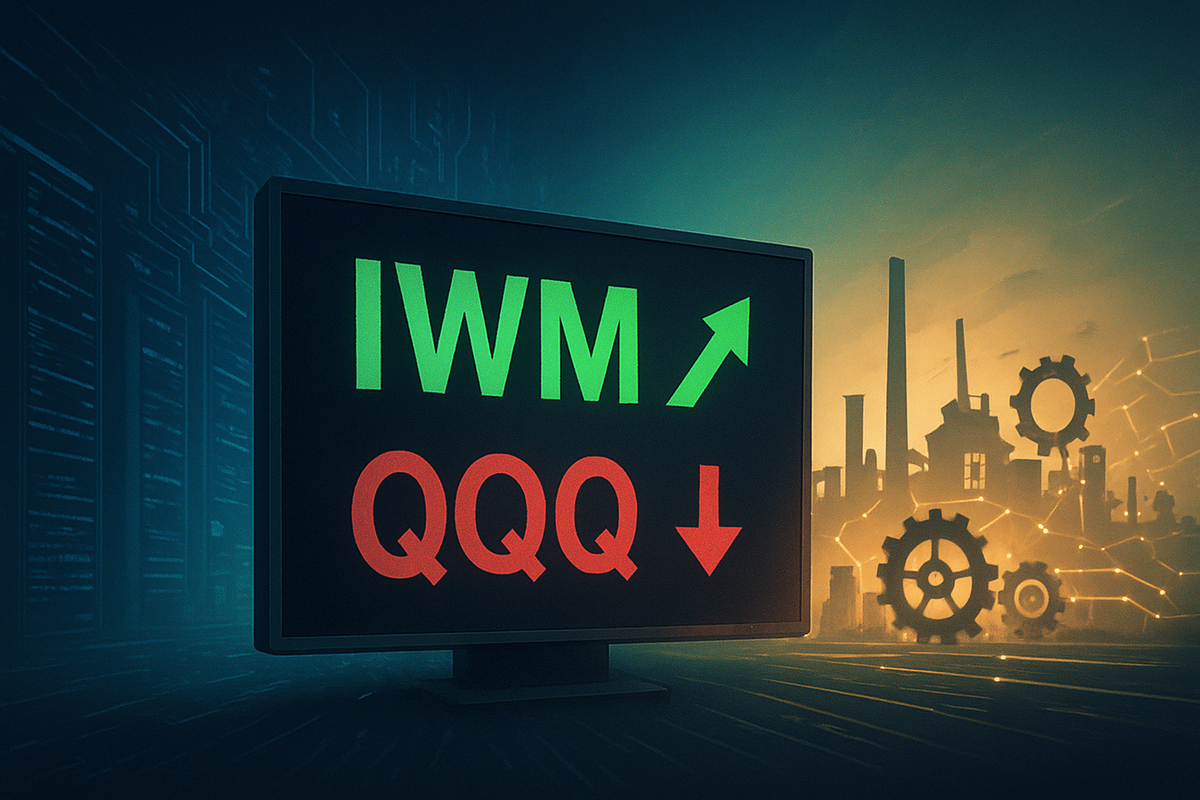
The opening weeks of 2026 have witnessed a seismic shift in the financial landscape, as the multi-year hegemony of mega-cap technology stocks finally buckles under the weight of historic valuation gaps and a shifting macroeconomic tide. In what market participants are calling "The Great Rotation," capital is aggressively fleeing the crowded corridors of Silicon Valley giants and seeking refuge in the long-neglected corners of the small-cap and mid-cap sectors. The divergence is stark: as of January 26, 2026, the iShares Russell 2000 ETF (NYSEARCA: IWM) has rocketed to an 8% year-to-date gain, while the tech-heavy Invesco QQQ Trust (NASDAQ: QQQ) has retreated into negative territory, posting a slight loss for the same period.
This migration represents more than a mere tactical adjustment; it is a fundamental revaluation of risk. For the better part of the last decade, investors treated mega-cap tech as a "safe haven" with near-infinite growth potential. However, the combination of a normalizing interest rate environment, aggressive new fiscal incentives for domestic industry, and a "growth handoff" where smaller firms are now projected to outpace their larger peers has created a perfect storm for the Russell 2000. As the "Magnificent Seven" trade shows signs of exhaustion, the broader market is finally participating in a rally that many analysts believe is long overdue.
A New Era of Breadth: The January Surge
The catalysts for this rotation began to coalesce in the final quarter of 2025, but the movement reached a fever pitch in early January 2026. After years of high-interest rates squeezing smaller companies with floating-rate debt, the Federal Reserve’s pivot toward a 3.5% federal funds rate in late 2025 provided the necessary oxygen for a small-cap revival. The immediate market reaction saw the Russell 2000 break out of a three-year consolidation phase, surging 8% in just twenty-six days. Conversely, the Nasdaq, burdened by stretched valuations and slowing year-over-year earnings comparisons, has struggled to find buyers, as the heavyweights like Microsoft (NASDAQ: MSFT) and Nvidia (NASDAQ: NVDA) face the "law of large numbers" in their AI-driven expansion.
The timeline of this shift is inextricably linked to the "One Big Beautiful Bill Act" (OBBBA), a landmark fiscal package signed into law last year. The OBBBA significantly altered the tax landscape by shifting interest deductibility limits from 30% of EBIT to 30% of EBITDA, a move that disproportionately benefited capital-intensive small and mid-sized firms. Furthermore, the act’s immediate R&D expensing provisions have sparked a "manufacturing renaissance" that favors domestic players over globalized tech conglomerates. As the first corporate earnings reports of 2026 trickled in during the third week of January, the data confirmed the trend: small-cap earnings growth is now projected to hit 25% this year, effectively doubling the projected growth rate of the S&P 500's top ten components.
Winners and Losers: From Silicon Valley to Main Street
The clear losers in this rotation are the previous market darlings. Apple (NASDAQ: AAPL) and Alphabet (NASDAQ: GOOGL) have seen institutional selling pressure as fund managers rebalance portfolios to avoid over-concentration. For these giants, the primary challenge is no longer innovation, but the sheer difficulty of maintaining double-digit growth on a multi-trillion-dollar base. In contrast, the winners are found in the "real economy." Small-cap industrials like The Gorman-Rupp Company (NYSE: GRC) and Willdan Group (NASDAQ: WLDN) have benefited immensely from infrastructure spending and the OBBBA’s tax incentives, seeing their share prices outperform the broader market significantly in January.
The financial sector, particularly regional players, has also emerged as a primary beneficiary. HCI Group (NYSE: HCI) and other insurance and property-focused firms have capitalized on the stabilizing interest rate environment, which has lowered their cost of capital while maintaining healthy margins. Even the long-suffering real estate sector has seen a resurgence; Postal Realty Trust (NYSE: PSTL) and DiamondRock Hospitality (NYSE: DRH) have led a charge in REITs as investors hunt for yield in an environment where tech dividends remain negligible. This rotation is not just about size, but about the transition from "growth at any price" to "value and domestic resilience."
The Macro Significance: Breaking the AI Monopoly
This event marks a critical turning point in the post-pandemic economic narrative. Since 2023, the market was essentially a two-tiered system: the AI-adjacent mega-caps and everyone else. The Great Rotation of 2026 signals the end of this AI monopoly on capital. Historically, such rotations occur when the valuation gap between large and small caps becomes untenable; at the start of this year, the S&P 500 traded at 22.6 times forward earnings, while the Russell 2000 sat at a lowly 15.6 times. This 31% discount provided a "margin of safety" that eventually became too attractive for institutional desks to ignore.
Moreover, the regulatory environment has begun to favor the "underdog." With increased antitrust scrutiny on Big Tech and a legislative push to repatriate supply chains, the tailwinds have shifted toward domestic small-caps. This mirrors the post-dot-com bust of the early 2000s, where after years of tech outperformance, small-cap "value" stocks dominated for the subsequent seven years. Analysts are drawing parallels to 2001, suggesting that we may be entering a multi-year cycle where "Main Street" stocks outshine "Sand Hill Road" investments.
Looking Ahead: Can the Small-Cap Momentum Hold?
The immediate question for investors is whether this 8% surge is a "flash in the pan" or the start of a sustained bull market for small caps. In the short term, much will depend on the Federal Reserve's next move in May 2026, when Chairman Jerome Powell’s term concludes. If the Fed continues its normalization path toward 3%, the interest-rate-sensitive Russell 2000 could see further expansion. However, a potential risk remains in the form of "sticky" inflation, which could halt rate cuts and put pressure back on the leveraged balance sheets of smaller firms.
Strategically, the Great Rotation may force a pivot from "passive" tech-heavy indexing toward "active" management. As market breadth expands, the ability to pick winners in the industrial, material, and regional banking sectors will likely become more valuable than simply holding the Nasdaq 100. Companies that failed to invest in domestic capacity over the last decade may find themselves at a disadvantage as the OBBBA incentives continue to roll out, creating a divergence even within the small-cap space between "innovators" and "laggards."
The Investor’s Takeaway: A Balanced Horizon
The Great Rotation of 2026 serves as a potent reminder that market leadership is never permanent. The 8% year-to-date surge in the Russell 2000 against the Nasdaq’s malaise highlights a fundamental shift in investor psychology: a move from "speculative growth" to "tangible value." While Big Tech remains a cornerstone of the global economy, its role as the sole engine of stock market returns has clearly ended. Investors who have been overweight in mega-cap tech for years are now facing the reality of a broader, more diversified market where domestic manufacturing, regional finance, and infrastructure are the new leaders.
Moving forward, the key metrics to watch will be the Q1 2026 earnings results for small-cap firms and the trajectory of the 10-year Treasury yield. If small-cap earnings continue to outpace the S&P 500, the "Great Rotation" could very well define the rest of the decade. For the average investor, this is a signal to check portfolio allocations; the era of "set it and forget it" with mega-cap tech is giving way to a more nuanced, diversified landscape where the "average" stock is finally getting its day in the sun.
This content is intended for informational purposes only and is not financial advice.