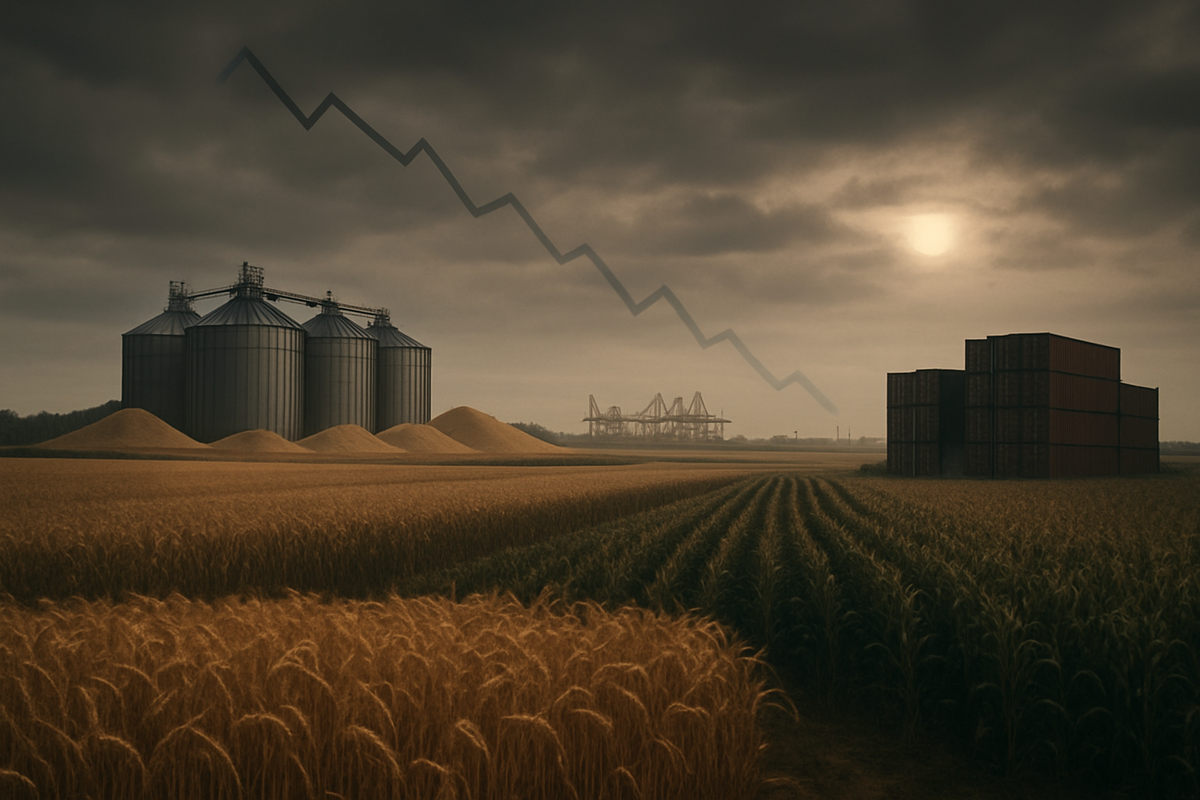
The global agricultural market is grappling with a profound correction as the "commodities super-cycle" of the early 2020s appears to have hit a definitive wall. In a stunning reversal of the record highs seen throughout 2025, prices for essential staples—including corn, wheat, and coffee—have tumbled by as much as 29% from their peaks. This sharp downturn marks one of the most significant agricultural price collapses in recent memory, leaving producers and traders scrambling to adjust to a new reality of oversupply and geopolitical friction.
The primary catalyst for this deflationary spiral is a dramatic retreat by China, the world’s largest agricultural consumer, whose imports of U.S. grains have plummeted by over 80% in the last year. Coupled with record-breaking global harvests and shifting trade alliances that favor South American suppliers, the market is currently overwhelmed by a "grains glut" that shows few signs of clearing. Analysts at CommTrendz Research have noted that the aggressive overbought conditions of 2025 left the sector vulnerable to this "violent correction," which has now fundamentally reshaped the 2026 economic landscape.
The Perfect Storm: Record Harvests Meet Trade Isolation
The seeds of the current slump were sown during the first half of 2025, when agricultural prices surged to historic levels. Arabica coffee futures reached a staggering $4.41 per pound in February 2025, driven by acute supply shortages in Brazil and Vietnam. Similarly, corn and wheat prices were buoyed by low global inventories and lingering concerns over Black Sea exports. However, the tide turned in late 2025 as the northern hemisphere began harvesting what has become a record-breaking crop. U.S. corn production alone reached an unprecedented 432 million tonnes for the 2025/26 marketing year, an 12% year-over-year increase that effectively saturated the market.
As supply swelled, demand from the East evaporated. China’s pivot toward agricultural self-sufficiency and its strategic decision to redirect purchases to Brazil and Argentina has left a massive vacuum in the U.S. export market. According to recent trade data, Chinese corn imports fell by 86% in 2025, while wheat imports dropped by 70%. This shift was exacerbated by the introduction of retaliatory tariffs and a hardening of trade relations that made U.S. products less competitive on the global stage. By the time the market entered early 2026, the lack of support from Chinese buyers became the defining bearish factor.
Gnanasekar Thiagarajan, Director at CommTrendz Research, has highlighted that the current 29% decline in certain commodity segments reflects a lack of "supportive demand factors" to balance the massive influx of supply. The initial market reaction was one of disbelief, as futures prices for Chicago corn tumbled below the $4.00 per bushel mark in January 2026, a level not seen since the pre-pandemic era. Stakeholders ranging from Midwestern family farms to global shipping conglomerates are now dealing with the fallout of a market that is fundamentally "out of balance."
Giants of the Field: Who Wins and Who Loses in the Slump
The impact of this commodity crash is being felt acutely by major public companies across the agricultural value chain. Archer-Daniels-Midland (NYSE: ADM) and Bunge Global SA (NYSE: BG) have both reported significant earnings misses as the fat processing margins of previous years have evaporated. ADM recently disclosed that its Ag Services and Oilseeds segment operating profit dropped by 31% in late 2025, leading to a 2026 earnings forecast that fell well short of Wall Street's expectations. These firms, which thrive on market volatility and high trade volumes, are now navigating a "low-margin environment" where the massive global grains glut has limited their ability to arbitrage price differences between regions.
The equipment sector is perhaps the hardest hit. Deere & Co (NYSE: DE) has seen its shares pressured as farmers, facing lower revenues from their crops, have slashed capital expenditures. The company has projected that 2026 will be the "bottom of the cycle," with sales of large tractors and combines expected to drop by as much as 45% in some markets. For equipment manufacturers, the slump in corn and wheat prices translates directly into fewer sales, as the "replacement cycle" for aging machinery is being deferred by cash-strapped producers.
Conversely, some consumer-facing companies are beginning to find relief in the lower input costs. After years of battling inflation, coffee retailers like Starbucks Corp (NASDAQ: SBUX) stand to benefit from the correction in Arabica coffee prices. As the historic highs of early 2025 recede, margins for high-volume coffee sellers are expected to expand throughout 2026. Similarly, large-scale food processors like Tyson Foods Inc (NYSE: TSN), which rely on corn and soy for animal feed, are seeing their cost of goods sold decrease significantly, potentially providing a boost to their bottom line after a turbulent several years.
Industry Shifts and the New Geopolitical Reality
This commodity slump is more than just a temporary price correction; it is an indicator of a structural shift in how agricultural trade functions in a fragmented global economy. For decades, the "China-U.S. trade axis" was the cornerstone of agricultural growth. The current "buyer’s strike" from Beijing signifies a decoupling that has long-term implications for U.S. trade policy and rural economics. The shifting trade-related issues mentioned by CommTrendz suggest that the reliance on a single massive buyer is no longer a sustainable strategy for the Western agricultural sector.
The ripple effects are also being felt in the biofuel industry. Uncertainty regarding 2026 blending mandates in the U.S. has discouraged domestic processors from absorbing the excess corn and soy supply. Historically, when export markets cooled, the biofuel sector provided a reliable safety net for grain prices. However, with policy shifts favoring electric vehicles and a lack of clarity on sustainable aviation fuel incentives, that safety net has frayed. This lack of a "floor" under the market is a historical precedent that mirrors the agricultural recessions of the 1980s, where oversupply and trade wars combined to create a multi-year stagnation period.
The Road Ahead: Navigating the 2026 Trough
In the short term, the market remains in a state of "discovery," as traders look for any sign of a bottom. Analysts at CommTrendz believe that the 29% slump has brought prices close to the cost of production for many farmers, which could eventually lead to a reduction in planted acreage for the 2027 season. This potential supply contraction is the first step toward a market recovery, though it often takes 12 to 18 months to manifest in futures prices. Strategic pivots are already underway, with major traders like Bunge diversifying their sourcing deeper into Brazil to follow the shifting flow of Chinese demand.
Long-term, the focus will likely shift toward "demand creation" outside of traditional markets. If China continues to distance itself from U.S. agricultural products, companies and trade organizations will need to aggressively pursue emerging markets in Southeast Asia and Africa to absorb the massive production capacity of the American Midwest. This pivot will require significant infrastructure investment and likely a more conciliatory approach to trade agreements than what has been seen over the past year.
Summary: A Market in Recalibration
The 29% slump in agricultural commodities serves as a stark reminder of the cyclical nature of the industry and the vulnerability of global markets to geopolitical shifts. The combination of a "global grains glut" and a vanished Chinese buyer has forced a painful but perhaps necessary recalibration of prices. While this brings relief to consumers and food retailers who have struggled with years of high inflation, it poses a severe challenge to the producers and equipment manufacturers who form the backbone of the rural economy.
Moving forward, investors should keep a close eye on the 2026 planting intentions and any shifts in U.S.-China trade rhetoric. A resolution to current trade tensions or a sudden weather event in South America could provide the spark needed for a price rebound. Until then, the market appears destined to remain in a "trough" phase, as the industry learns to navigate a world where the old rules of supply and demand are being rewritten by the hand of geopolitics.
This content is intended for informational purposes only and is not financial advice.