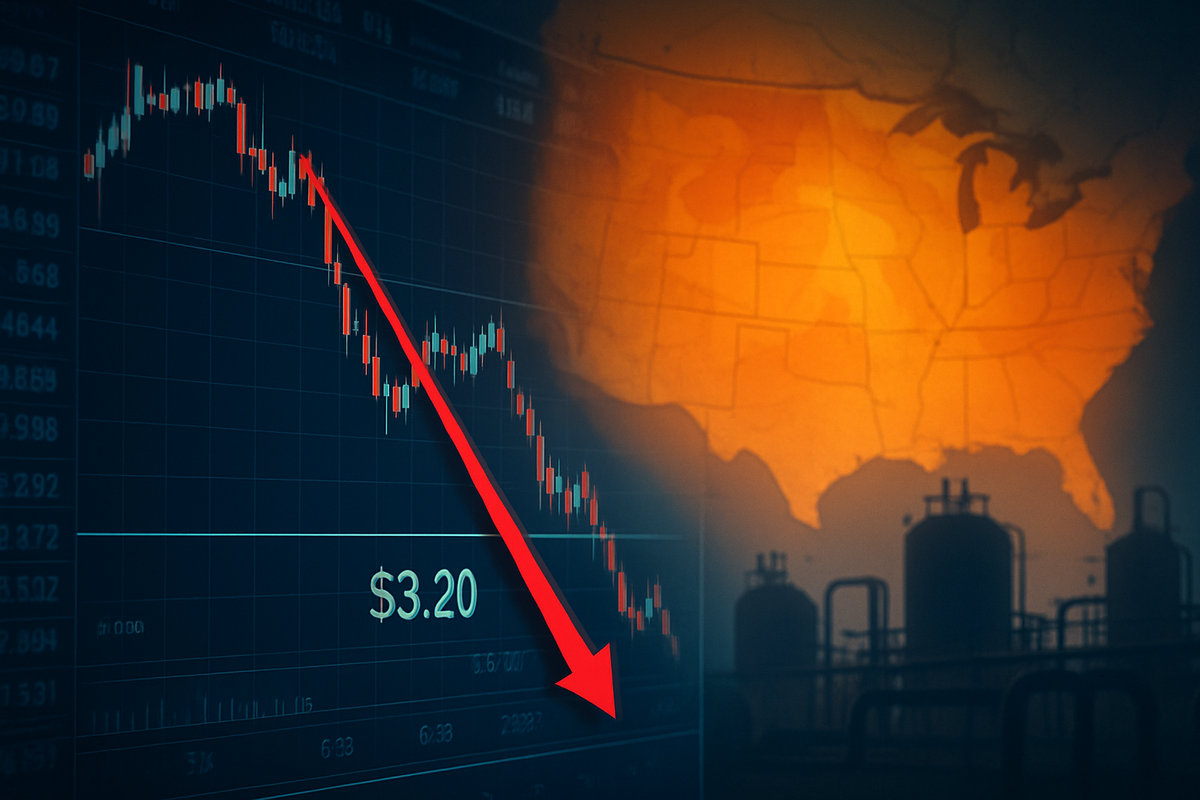
The natural gas market faced a decisive technical breakdown today, February 17, 2026, as prices officially breached the long-held $3.20 per million British thermal units (MMBtu) support level. A combination of unseasonably warm weather forecasts and a federal storage report that failed to meet market expectations has sent the Henry Hub spot price tumbling toward the $3.00 psychological floor. This sharp retreat marks a dramatic reversal from the extreme volatility seen just weeks ago during the height of the winter heating season.
The breach of the $3.20 support zone is more than a technical milestone; it signals a fundamental shift in market sentiment as traders prepare for an early transition into the "shoulder season." With the latest 6-10 and 8-14 day weather outlooks predicting significantly above-normal temperatures across the Eastern United States, the demand for residential heating has evaporated, leaving the market oversupplied despite storage levels that remain nominally below their five-year averages.
A Technical Breakdown Amidst a "Cooling Phase"
The current price action is the culmination of a rapid "unwind" that began in early February. After soaring to nearly $7.50/MMBtu in January following the disruption caused by Winter Storm Fern, the market has struggled to maintain its momentum. The $3.20 level had acted as a reliable floor throughout late 2025, but the weight of record-high domestic production—now averaging 120.8 billion cubic feet per day (Bcf/d)—finally proved too much for the bulls to hold. On February 17, 2026, the March NYMEX contract was seen trading as low as $3.09/MMBtu, effectively turning previous support into a daunting overhead resistance level.
Market participants were particularly disappointed by the most recent report from the Energy Information Administration (EIA). The data showed a withdrawal of 249 Bcf for the week ending February 6, 2026. While large by historical standards, the draw was significantly smaller than analysts had anticipated given the lingering effects of January's arctic blast. This "miss" in the withdrawal data suggested that industrial and residential demand was already tapering off faster than the market had priced in. With working gas in storage currently at 2,214 Bcf, the deficit against the five-year average narrowed, further dampening the bullish case for a late-winter rally.
The timeline leading to this breakdown has been swift. Just two weeks ago, regional spot prices in the Northeast were spiking to over $30.00/MMBtu as the grid strained under freezing conditions. However, the Climate Prediction Center’s mid-month shift toward a warmer-than-normal pattern for late February and early March has effectively ended the heating season for many major metropolitan hubs. This transition has led to a flurry of sell orders as hedge funds and speculators liquidate long positions that were banked on a sustained cold snap.
Winners and Losers: Corporate Resilience in a Low-Price Environment
The drop below $3.20 creates a stark divide between diversified energy giants and pure-play upstream producers. Expand Energy (NASDAQ: EXE), the entity formed from the high-profile merger of Chesapeake and Southwestern, is currently navigating a period of transition under interim CEO Michael Wichterich. While the company is roughly 50% hedged for 2026, the current dip toward the $3.00 handle tests its corporate breakeven points. Despite the price pressure, Expand Energy's strategic move to relocate its headquarters to Houston to align with the Gulf Coast LNG corridor suggests a long-term pivot toward international demand rather than short-term domestic price fluctuations.
In the Appalachian Basin, Antero Resources (NYSE: AR) has demonstrated notable resilience. The company recently reported a beat on its Q4 earnings, supported by a robust hedging strategy that includes floor protections near $3.24/MMBtu. This financial engineering allows AR to maintain healthy free cash flow even as spot prices drift lower. Similarly, EQT Corporation (NYSE: EQT), the largest natural gas producer in the United States, continues to benefit from its unhedged exposure to earlier price spikes and its expanding midstream capacity through projects like the Mountain Valley Pipeline. EQT’s ability to maintain steady production at 2.4 Bcfe/d while peers scale back provides them with a competitive edge in market share.
Conversely, the "losers" in this environment are primarily smaller, unhedged producers in higher-cost basins who were banking on a $4.00+ average for the first quarter. Meanwhile, midstream and export-focused firms like Cheniere Energy (NYSE: LNG) remain largely insulated from domestic spot price weakness. Cheniere is currently operating its terminals at near-full capacity, with feedgas nominations at a record 19.6 Bcf/d. For these players, lower domestic prices can actually improve margins by reducing the cost of feedgas, provided global demand for U.S. LNG remains robust in the European and Asian markets.
Wider Significance and Industry Trends
The breach of $3.20 occurs within a broader industry trend toward "manufacturing mode" in major shale plays. ExxonMobil (NYSE: XOM) has pioneered this approach in the Permian Basin, focusing on extreme cost efficiency and integrated value chains rather than aggressive volume growth. This shift has made the U.S. natural gas market structurally more resilient but also more prone to prolonged periods of low prices, as major producers can now sustain operations at levels that would have been ruinous a decade ago.
Historically, a break below such a significant support level in mid-February leads to a subdued "shoulder season," where prices drift toward the cost of production until power-burn demand for summer air conditioning kicks in. The comparison to the 2024 price slump is frequent among analysts, but 2026 differs due to the massive increase in LNG export capacity. The U.S. is now more connected to global energy prices than ever before, meaning that while domestic weather is the primary driver today, a supply disruption in the Middle East or an early heatwave in Europe could still spark a sudden recovery.
Furthermore, the regulatory landscape is shifting. With the expansion of the Mountain Valley Pipeline and new LNG export permits finally moving through the pipeline, the industry is preparing for a future where domestic oversupply can be more easily diverted to international markets. This structural change may eventually establish a higher "floor" for prices, but for now, the lack of immediate heating demand is the only metric that seems to matter to the trading desks in New York and Houston.
The Path Forward: What Comes Next?
In the short term, all eyes are on the $3.00 psychological handle. If the 8-14 day weather outlook continues to trend warm, a test of the $2.70 to $2.80 range is highly probable by early March. This would likely trigger a wave of "shut-ins" or deferred completions among smaller producers, eventually tightening the market toward the second half of the year. Investors should expect increased volatility as the market searches for a new equilibrium in a world of record production and record exports.
The long-term outlook remains cautiously optimistic for the major players. As Cheniere Energy (NYSE: LNG) and others expand their footprints, the "glut" of gas currently depressing prices is expected to be absorbed by international demand by late 2026 and early 2027. Strategic pivots, such as Expand Energy’s (NASDAQ: EXE) relocation to Houston, underscore the industry's belief that the future of natural gas is global. Companies that can survive the current sub-$3.20 environment through hedging and operational efficiency will be well-positioned to capitalize on the next structural upswing.
Wrap-up: Key Takeaways for Investors
The fall of natural gas below $3.20 marks a turning point for the first quarter of 2026. The combination of a bearish EIA report and "spring-like" February weather has stripped the market of its winter premium. While storage remains tight relative to the five-year average, the immediate lack of demand is the dominant force in current price discovery.
Moving forward, investors should watch for two key indicators: the rate of production growth in the Permian and Appalachian basins and any shifts in the global LNG arbitrage. If domestic prices remain depressed near $3.00 while international prices stay high, the incentive for export-oriented growth will only intensify. For now, the "shoulder season" has arrived early, and the market is likely to remain in a defensive posture until the first signs of summer cooling demand emerge.
This content is intended for informational purposes only and is not financial advice.