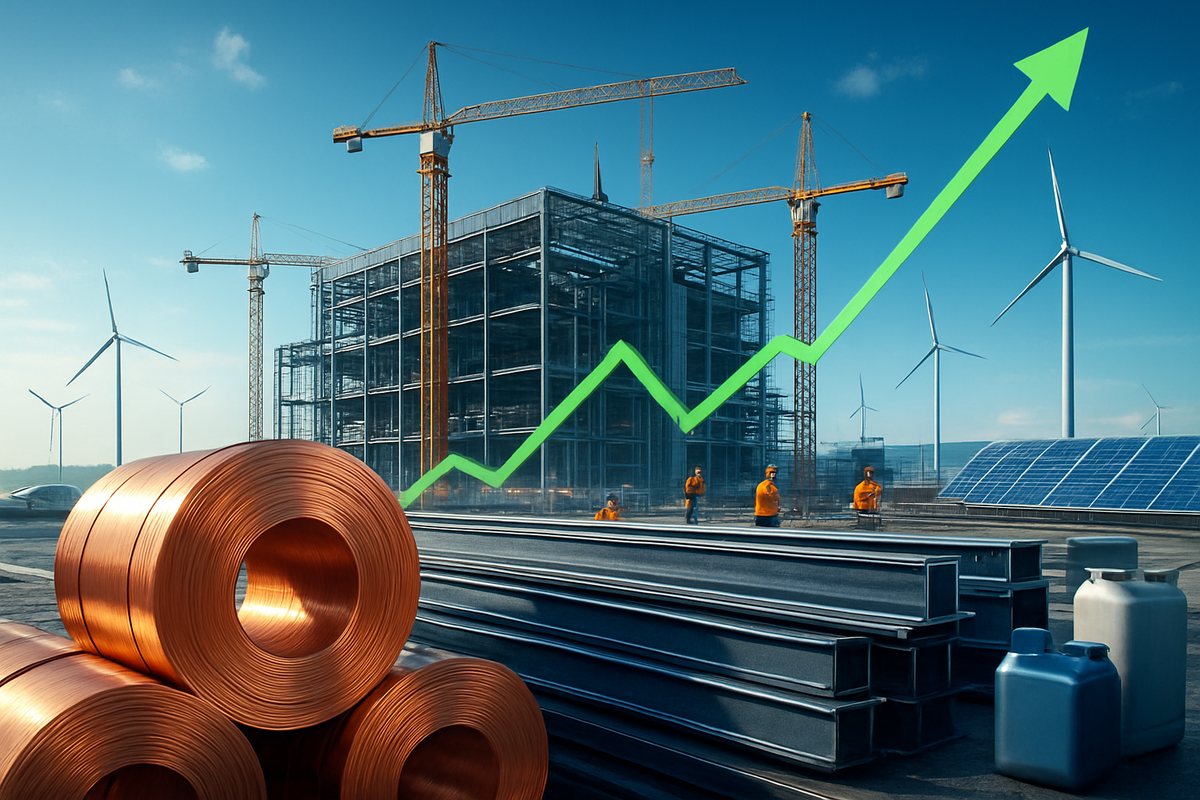
In a striking reversal of the growth-at-any-price narrative that dominated much of the early 2020s, the Materials sector emerged as a primary safe haven this week. The Materials Select Sector SPDR Fund (NYSE Arca: XLB) posted a notable 0.9% gain on February 18, 2026, even as high-multiple technology indices continued to struggle under the weight of valuation concerns and shifts in the artificial intelligence landscape. This movement underscores a broader market "value rotation," where investors are increasingly prioritizing the tangible economy—metals, chemicals, and construction materials—over the volatile fluctuations of the software and services space.
The immediate implications of this shift are profound for the S&P 500's performance. As capital flows out of the technology-heavy XLK and into the XLB, market breadth is beginning to confirm a transition into what analysts are calling the "Physical Reality" phase of the 2026 market cycle. With industrial demand remaining resilient and government-backed infrastructure projects finally reaching peak deployment phases, the materials sector is providing a necessary floor for large-cap equities amidst broader macroeconomic uncertainty.
The Great Rotation: From Digital Dreams to Tangible Assets
The 0.9% rise in the materials sector on February 18, 2026, was not an isolated event but rather the culmination of a trend that has been building since the start of the year. Throughout January and early February, the technology sector faced what some commentators have dubbed "Software Armageddon"—a sharp repricing of Software-as-a-Service (SaaS) business models. This was triggered by the rapid adoption of advanced AI agents, which many investors fear will cannibalize traditional subscription revenues. In response, institutional capital has begun migrating toward "Old Economy" sectors that provide the literal building blocks for the future.
The timeline leading up to this moment has been defined by a steady drumbeat of industrial resilience. Despite initial fears of a 2026 slowdown, manufacturing data released earlier this month showed a surprising uptick in factory construction and specialized chemical demand. Key stakeholders, including major pension funds and sovereign wealth managers, have been notably reallocating portfolios to favor commodities and industrial intermediates. The reaction in the market has been one of "breadth confirmation," with over 90% of materials stocks now trading above their 200-day moving averages, a signal that this rally has deep internal support.
Winners and Losers in the "Physical Pivot"
The primary beneficiary of this trend has been Linde PLC (NASDAQ: LIN), the largest holding in the XLB with a weight of approximately 13.4%. Linde recently reported a Q4 earnings beat of $4.20 per share, driven by a staggering $10 billion backlog in industrial gases. As the backbone for both healthcare and semiconductor manufacturing, Linde has become a proxy for the entire industrial recovery, hitting a new 52-week high of $487 in mid-February. Similarly, Freeport-McMoRan (NYSE: FCX) has seen its shares surge as copper prices hit record highs above $14,000 per ton. With copper increasingly viewed as the "metal of electrification" for AI data centers, FCX has moved to boost its 2026 capital expenditures to meet the growing demand for the power-hungry infrastructure required for advanced computing.
Conversely, companies traditionally insulated from market swings are seeing a divergence in performance. The Sherwin-Williams Company (NYSE: SHW) has outperformed expectations despite a sluggish residential DIY market, returning 12.5% year-to-date by early February. The win for SHW has come from its industrial coatings division, which services the very infrastructure and data center projects that are currently booming. On the other end of the spectrum, companies heavily reliant on consumer-facing retail materials may find the transition more difficult, as the "value" trade is currently dominated by industrial and commercial demand rather than the individual household.
A Structural Shift in Industry Trends
The wider significance of this event lies in the convergence of two major macro-drivers: the Infrastructure Investment and Jobs Act (IIJA) and the AI "physical bottleneck." As of February 2026, more than half of the IIJA funding is still being deployed into the American economy, providing a multi-year demand buffer for companies like Vulcan Materials Company (NYSE: VMC) and CRH plc (NYSE: CRH). This government-guaranteed demand has created a floor for materials pricing that simply did not exist in previous cycles, insulating large-cap stocks from the traditional boom-and-bust volatility of the sector.
Furthermore, the narrative surrounding Artificial Intelligence has shifted from software to hardware. The realization that AI is a "physical bottleneck"—requiring massive amounts of electricity, specialized cooling systems, and reinforced data centers—has turned the materials sector into a secondary AI play. This mirrors historical precedents like the "Gilded Age" build-out of the railroads, where the companies providing the steel and coal often saw more sustainable growth than the railroad operators themselves. By 2026, the market has finally recognized that "the cloud" actually consists of millions of tons of steel, copper, and concrete.
The Road Ahead: Potential Scenarios for 2026
In the short term, the primary risk for the materials sector is that it may become "overbought." The rapid rotation from technology into the XLB has pushed many stocks to valuation multiples that are high by historical standards, even if they remain attractive compared to the tech peaks of 2025. Investors should expect some consolidation in the coming months as the initial fervor of the rotation cools. However, the long-term outlook remains bolstered by the "reflation trade," where tangible assets are viewed as the most effective hedge against persistent industrial inflation and global supply chain re-shoring.
Strategic pivots are already underway. Many materials firms are adapting to more "green-focused" industrial demand, with companies like Air Products and Chemicals (NYSE: APD) and Ecolab Inc. (NYSE: ECL) doubling down on hydrogen and water treatment technologies. The potential for a "super-cycle" in metals and mining remains a distinct possibility, especially if global demand from emerging markets resumes its upward trajectory while the U.S. continues its domestic infrastructure overhaul. The most likely scenario is one of "sustained physicality," where the XLB continues to serve as a stabilizer for portfolios during periods of technological upheaval.
Summary and Market Outlook
The 0.9% gain in the Materials sector on February 18, 2026, marks a pivotal moment in the current market cycle. It represents a clear transition from speculative growth to tangible value, driven by the dual engines of government infrastructure spending and the physical requirements of the AI revolution. Key takeaways include the dominance of giants like Linde and Freeport-McMoRan, the resilience of industrial coatings and chemicals, and the protective floor provided by long-term federal funding.
Moving forward, the market will likely continue to reward "physicality and reliability." While the broader S&P 500 may trade sideways as the technology sector undergoes its painful restructuring, the materials space offers a pocket of predictable earnings growth. In the coming months, investors should closely watch the pace of IIJA fund deployment and copper pricing as key indicators of the sector's health. The "Physical Backbone" of the economy is no longer just a defensive play—it has become a primary driver of market leadership.
This content is intended for informational purposes only and is not financial advice.
Key Tickers and Listings Mentioned:
- Materials Select Sector SPDR Fund (NYSE Arca: XLB)
- Linde PLC (NASDAQ: LIN)
- Freeport-McMoRan Inc. (NYSE: FCX)
- The Sherwin-Williams Company (NYSE: SHW)
- Vulcan Materials Company (NYSE: VMC)
- CRH plc (NYSE: CRH)
- Air Products and Chemicals, Inc. (NYSE: APD)
- Ecolab Inc. (NYSE: ECL)
- Newmont Corporation (NYSE: NEM)
- Sterling Infrastructure, Inc. (NASDAQ: STRL)
Note to Reader: This article was published on February 18, 2026, reflecting market data and trends current as of that date.