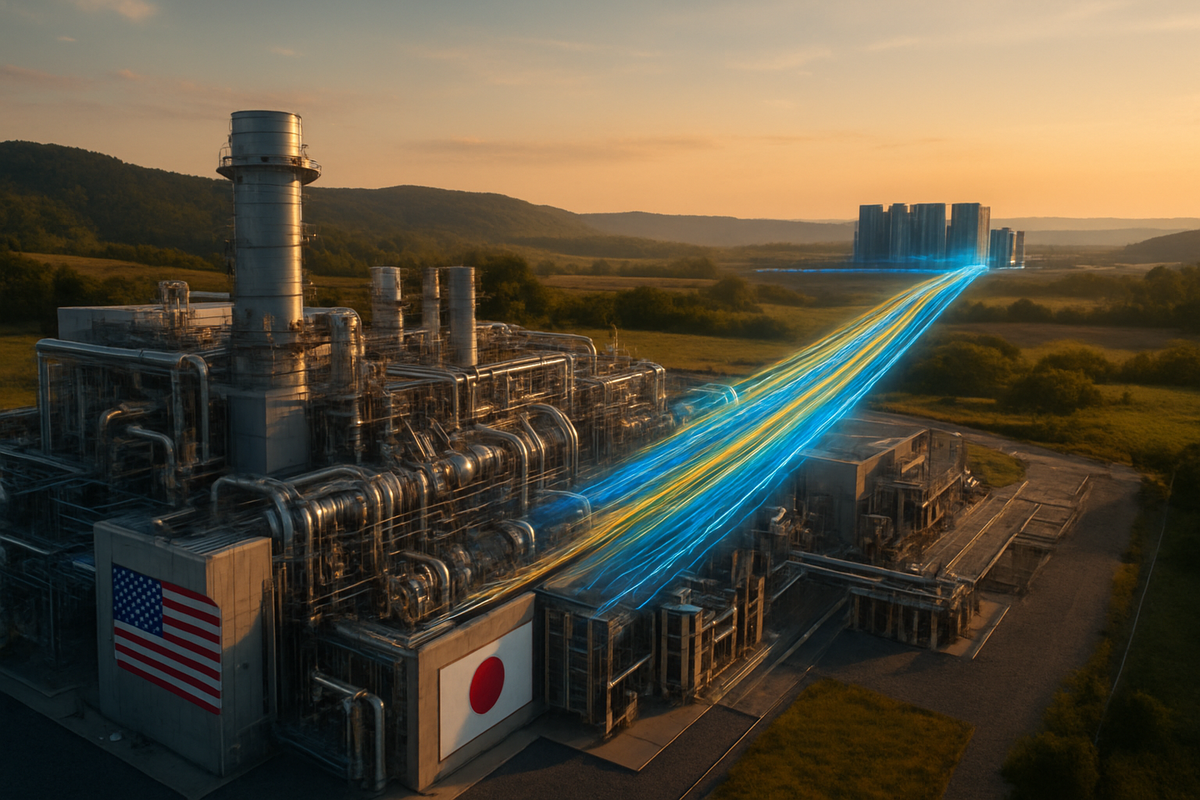
In a move that signals a tectonic shift in the American energy and industrial landscape, SB Energy, a subsidiary of the Japanese conglomerate SoftBank Group Corp. (OTCPK:SFTBY), has announced a massive $33 billion natural gas-fired power facility in Portsmouth, Ohio. Dubbed the "Portsmouth Powered Land Project," the facility is set to become the largest of its kind in U.S. history, boasting a staggering 9.2-gigawatt (GW) capacity. This investment is not merely a local utility expansion; it represents the tip of the spear in a broader $550 billion investment commitment from Japan aimed at revitalizing U.S. industrial infrastructure while securing the energy-hungry future of Artificial Intelligence.
The immediate implications are profound for both the Rust Belt and Silicon Valley. By providing a massive, reliable baseload of "dispatchable" energy, the Portsmouth project aims to solve the looming electricity shortage threatening the U.S. AI sector. As hyperscale data centers continue to proliferate across the Midwest, particularly in neighboring New Albany, the ability to provide 24/7 power—independent of weather conditions—has become the ultimate strategic asset. For the Trump administration, this project serves as a cornerstone of its "Energy Addition" policy, trading lowered tariffs for massive foreign capital injections into the American heartland.
The Portsmouth Powerhouse: A New Scale of Energy Generation
The announcement of the $33 billion facility on February 12, 2026, marks the first major execution of a landmark trade deal between President Donald Trump and Japanese Prime Minister Sanae Takaichi. The project is unprecedented in scale, with its 9.2-GW output roughly equivalent to that of nine traditional nuclear reactors. This capacity is specifically designed to feed into the PJM Interconnection, the nation's largest power grid, which has struggled to keep pace with the exponential growth of digital infrastructure. The timeline for the project is aggressive, with ground-breaking scheduled for late 2026 and the first phase of generation expected to go live by 2028.
Key stakeholders in the project extend beyond SB Energy. Japanese industrial giants such as Hitachi Ltd. (OTCPK:HTHIY) and Toshiba Corp. are expected to provide the advanced turbines and grid-integration technology required to manage such a massive load. The project follows months of quiet negotiations fueled by the "AI speed war," where tech giants have increasingly voiced concerns that the U.S. power grid would be unable to support the next generation of large language models. The initial market reaction has been optimistic, with industrial and energy sectors seeing a surge in pre-market activity following the White House announcement.
Winners and Losers in the $550 Billion Re-Industrialization
The primary winner in this deal is undoubtedly SoftBank Group Corp. (OTCPK:SFTBY), which, under the leadership of Masayoshi Son, is pivoting heavily toward the intersection of AI and physical infrastructure. By controlling the power source, SoftBank gains immense leverage over the data center operators that will rely on it. Other major winners include the trio of "hyperscalers" with a heavy Ohio presence: Amazon.com, Inc. (NASDAQ: AMZN), Alphabet Inc. (NASDAQ: GOOGL), and Meta Platforms, Inc. (NASDAQ: META). These companies have been searching for ways to secure long-term, reliable energy contracts to satisfy their carbon-neutral goals while meeting the relentless uptime demands of AI.
On the materials side, Nippon Steel Corp. (OTCPK:NISTF) stands to gain significantly, as it is slated to provide the high-grade industrial steel required for the facility’s construction and the associated pipelines. Conversely, the "losers" in this pivot appear to be the traditional renewable energy developers who have focused solely on wind and solar. Under the current administration’s "Energy Addition" framework, the prioritization of natural gas as a "bridge and baseload" fuel has cooled the market for intermittent energy sources. Environmental advocacy groups have also voiced concerns, noting that while the project solves the power crisis, it significantly increases the long-term carbon footprint of the domestic tech industry.
A Strategic Shift: Tariffs, AI, and the Trump Energy Policy
The Portsmouth project is a direct byproduct of the Trump administration’s aggressive trade and energy policies. The $33 billion investment was secured as part of a strategic bargain: Japan agreed to invest $550 billion in the U.S. through 2029 in exchange for the administration reducing threatened import tariffs from 25% to a 15% blanket rate. This "capital-for-market-access" model is a hallmark of the 2026 trade environment, where the U.S. leverages its consumer market to force the repatriation of industrial capacity and foreign direct investment.
Furthermore, the project fits perfectly into the administration’s "Energy Addition" strategy, which seeks to add new fossil fuel and nuclear capacity rather than retiring older plants. This policy shift is a reaction to the mid-2020s energy crunch, where a combination of rapid AI growth and aggressive green energy transitions led to grid instability in several regions. By streamlining federal permitting through the 2025 Deregulation Act, the administration has shortened the approval time for the Portsmouth project from a decade to less than two years, a move that critics argue bypasses environmental safeguards but supporters claim is essential for national security.
The Path Ahead: From Construction to Grid Dominance
Looking forward, the success of the Portsmouth Powered Land Project will depend on the seamless integration of the "Emergency Capacity Auctions" introduced by the Department of Energy. These auctions will require tech companies to enter "take-or-pay" contracts, effectively guaranteeing the revenue for SB Energy while ensuring that residential electricity rates remain stable. In the short term, we can expect a flurry of secondary investments in the Ohio Valley, including pipeline expansions and high-voltage transmission line upgrades, many of which will also likely involve Japanese partners as part of the $550 billion pledge.
Over the long term, this project may serve as a blueprint for other "Energy Hubs" across the United States. Scenarios are already being discussed for similar 5+ GW gas and modular nuclear facilities in Texas and Georgia. The primary challenge will be the logistical hurdle of constructing a project of this magnitude in record time. Any delays in the supply chain—particularly for specialized Japanese-made turbines—could create bottlenecks that ripple through the AI sector’s expansion plans, potentially stalling the very growth this energy is meant to fuel.
The Bottom Line: Investors Must Watch the Grid
The $33 billion Portsmouth project is more than an infrastructure development; it is a manifestation of the new global order where energy security and AI dominance are inextricably linked. For investors, the takeaway is clear: the "picks and shovels" of the AI revolution are no longer just semiconductors and cooling systems; they are the massive baseload power plants and the regulatory frameworks that allow them to be built. The collaboration between SoftBank and the U.S. government highlights a trend toward "national-interest capitalism," where large-scale projects are driven as much by geopolitical strategy as by market demand.
In the coming months, investors should closely monitor the quarterly filings of SoftBank Group Corp. (OTCPK:SFTBY) and the construction updates from SB Energy. Any legislative pushback regarding the tariff trade-offs or the environmental impact of the gas facility could introduce volatility. However, with the backing of both the U.S. and Japanese governments, the Portsmouth project is positioned to be the defining industrial achievement of the late 2020s, cementing Ohio’s role as the "Silicon Heartland."
This content is intended for informational purposes only and is not financial advice.