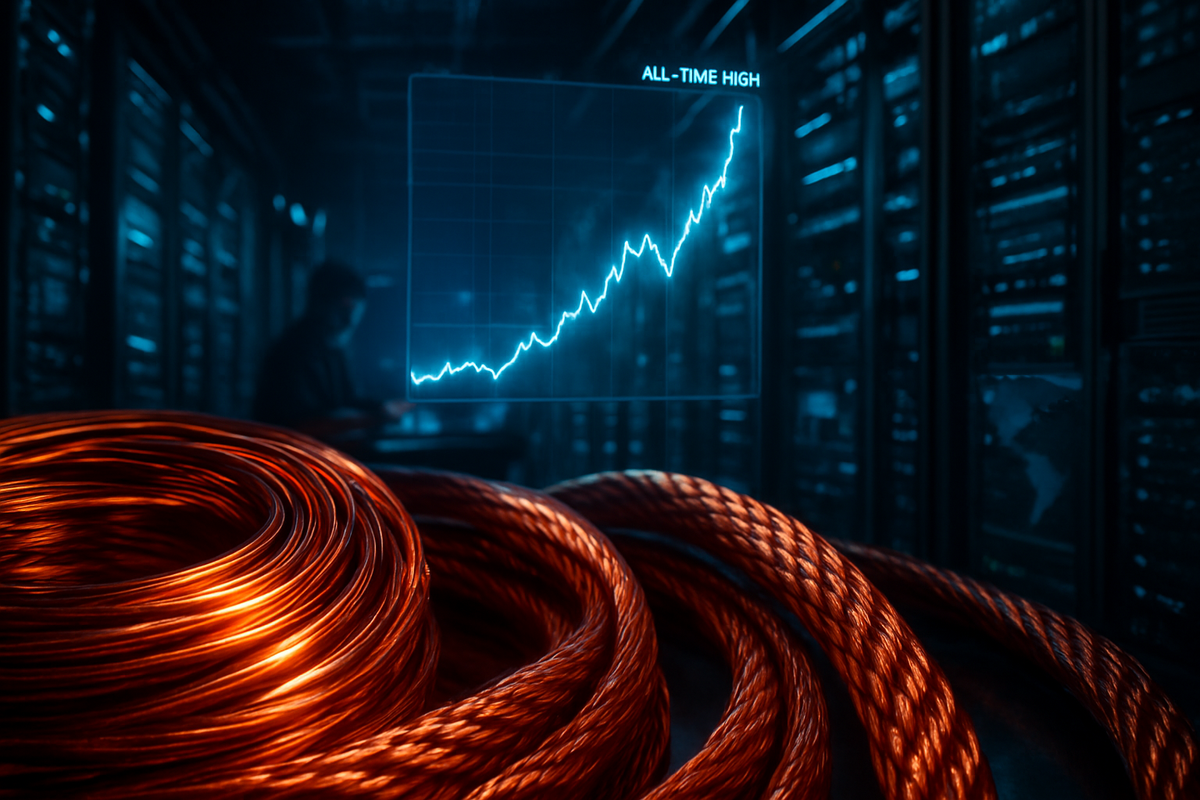
The global commodities market reached a historic inflection point this month as copper prices surged more than 8% to reach all-time highs, signaling a tectonic shift in the industrial landscape. On January 29, 2026, the London Metal Exchange (LME) saw copper futures peak at an unprecedented $14,500 per metric ton, while COMEX futures in the United States settled near $6.20 per pound. This rally, which has sustained its momentum into mid-February, marks the transition of copper from a traditional cyclical industrial metal into a "strategic material" essential for the digital and green revolutions.
The immediate implications of this "Red Gold" rush are profound, affecting everything from the cost of global electrical grid modernization to the capital expenditure budgets of the world’s largest technology firms. As of February 18, 2026, the market is grappling with a "perfect storm" of demand: a massive build-out of Artificial Intelligence (AI) infrastructure, combined with aggressive shifts in U.S. trade policy that have created artificial scarcities and a premium on domestic supply.
The Perfect Storm: AI Infrastructure and Trade Protectionism
The catalyst for the most recent 8% jump was a series of reports detailing the sheer volume of copper required to sustain the current AI "arms race." Unlike traditional data centers, AI-specific facilities require significantly higher power densities, necessitating massive upgrades to electrical conductors, transformers, and cooling systems. Industry data suggests that a single large-scale AI data center can consume between 40,000 and 50,000 tons of copper. With J.P. Morgan projecting that copper usage in data center installations will reach 475,000 metric tons in 2026—a 30% increase over 2025—investors have rushed to secure positions in the physical metal.
This technological demand was met with a volatile geopolitical backdrop. Throughout late 2025 and early 2026, the U.S. government intensified its trade interventions under Section 232, imposing 50% tariffs on semi-finished copper products. While raw copper was initially spared, the looming threat of a 15–30% tariff on refined copper starting in 2027 triggered a wave of "front-loading" and aggressive stockpiling by U.S. industrial giants. This created an "inventory paradox" where U.S. copper inventories surged to over 590,000 tonnes—the highest in years—as traders locked supply in COMEX warehouses to capture a domestic price premium, effectively starving the international spot market.
The timeline leading to this peak was marked by a steady tightening of supply. In mid-2025, major mining disruptions in South America and a force majeure event at the Grasberg mine in Indonesia began to thin global buffers. By the time China’s State Grid announced a massive 4 trillion yuan ($550 billion) investment plan for 2026–2030, the market was already on edge. The January 29 surge was the final breakout, as algorithmic trading and institutional hedging converged to push the metal into record territory.
The Corporate Landscape: Mining Giants Ascendant
The primary beneficiaries of this price surge are the global diversified miners who have spent the last two years pivoting their portfolios toward "electrification metals." BHP Group (NYSE: BHP) reported in its February 2026 half-year results that copper earnings reached $7.95 billion, surpassing iron ore as the company's largest profit driver for the first time in its history. This internal flip highlights how the world's largest miner is rebalancing away from traditional steelmaking inputs toward the metals of the future.
Similarly, Freeport-McMoRan (NYSE: FCX) has seen its domestic U.S. operations become a crown jewel. Despite production hiccups at its international sites, Freeport’s U.S.-based operating income was 3.5 times higher than 2024 levels, largely due to its ability to sell refined copper at a premium within the tariff-protected American market. Southern Copper (NYSE: SCCO) has also seen its market valuation skyrocket, recently overtaking Rio Tinto (NYSE: RIO) as the world's second-largest copper producer by market value, thanks to its low-cost operations in Peru and Mexico which are now generating record margins.
On the losing side of this equation are downstream manufacturers and renewable energy developers. Companies like Tesla (NASDAQ: TSLA) and other electric vehicle manufacturers are facing rising bill-of-materials costs that threaten to squeeze margins or force further price hikes for consumers. Furthermore, utility providers tasked with grid expansion are seeing the cost of transformers and high-voltage wiring double, potentially slowing the pace of the global energy transition unless government subsidies are increased to offset the "copper tax."
A New Era for "Dr. Copper": Wider Market Significance
Historically, copper was nicknamed "Dr. Copper" because its price was viewed as a reliable indicator of the health of the global economy—specifically in construction and manufacturing. In 2026, the metal’s significance has evolved. It is no longer just a barometer of cyclical growth; it is now a leading indicator of "industrial digitalization" and "inflationary pressure." The 8% surge is being interpreted by many economists as a sign of an impending "green transition bottleneck," where the physical limits of mining cannot keep pace with the ambitions of the digital age.
The event also highlights a broader trend of "resource nationalism." The U.S. trade policies that helped fuel this surge represent a shift away from globalized commodity markets toward fragmented, regional hubs. The fact that U.S. inventories are rising while global prices soar suggests that the "one-price-fits-all" model for commodities is fracturing. This trend of geopolitical fragmentation is forcing competitors to rethink their supply chains, with many moving toward "near-shoring" or direct equity investments in mining projects to guarantee supply.
Comparison to the 2004–2011 commodities supercycle is inevitable, but 2026 differs in one crucial way: the demand is not just coming from emerging market urbanization, but from a fundamental shift in how the developed world computes and powers itself. This "Electrification Supercycle" is less about building cities and more about building the "brains" of the global economy—AI and high-speed data networks.
The Road Ahead: Scarcity as the New Normal
In the short term, the market is bracing for a projected 330,000-ton refined copper deficit for the remainder of 2026. This deficit is expected to keep prices elevated, forcing a "strategic pivot" from major industrial players. We are already seeing signs of M&A activity heating up, with rumors circulating that Rio Tinto (NYSE: RIO) is eyeing a major acquisition—possibly a tie-up with Glencore (OTC: GLNCY)—to bolster its copper reserves and catch up to BHP’s dominant position.
Over the long term, the high price of copper may trigger "demand destruction" or substitution. Engineers are increasingly looking at aluminum as a potential replacement in certain wiring applications, although aluminum’s lower conductivity and different physical properties make it a poor substitute for the high-performance needs of AI data centers. The market may also see an acceleration in copper recycling technology and urban mining as the "above-ground" value of the metal begins to rival the cost of extracting it from the earth.
Potential scenarios for the rest of the year include a possible price correction if the U.S. Department of Commerce decides to ease tariffs in its upcoming June 2026 review. However, any dip is likely to be met with aggressive buying from sovereign wealth funds and institutional investors who now view copper as a necessary hedge against inflationary "debasement trades."
Conclusion: Summary and Outlook
The ascent of copper to $14,500 per ton is more than just a price spike; it is a signal that the physical requirements of the AI era have arrived. The confluence of massive infrastructure needs and protective trade policies has created a market where supply is no longer a given. For investors, the key takeaways are clear: the era of cheap industrial inputs is over, and the "Electrification Supercycle" is the primary engine of commodity returns for the foreseeable future.
Moving forward, the market will remain highly sensitive to geopolitical shifts and the pace of AI hardware deployment. Investors should closely watch the June 2026 U.S. Commerce Department review of copper tariffs and the production status of major mines like Grasberg. As copper becomes a core component of both national security and technological progress, its role as a market indicator will only grow. In the coming months, the ability of mining companies to bring new supply online will be the ultimate test of whether this record-breaking rally is a peak or just the beginning of a long-term plateau.
This content is intended for informational purposes only and is not financial advice