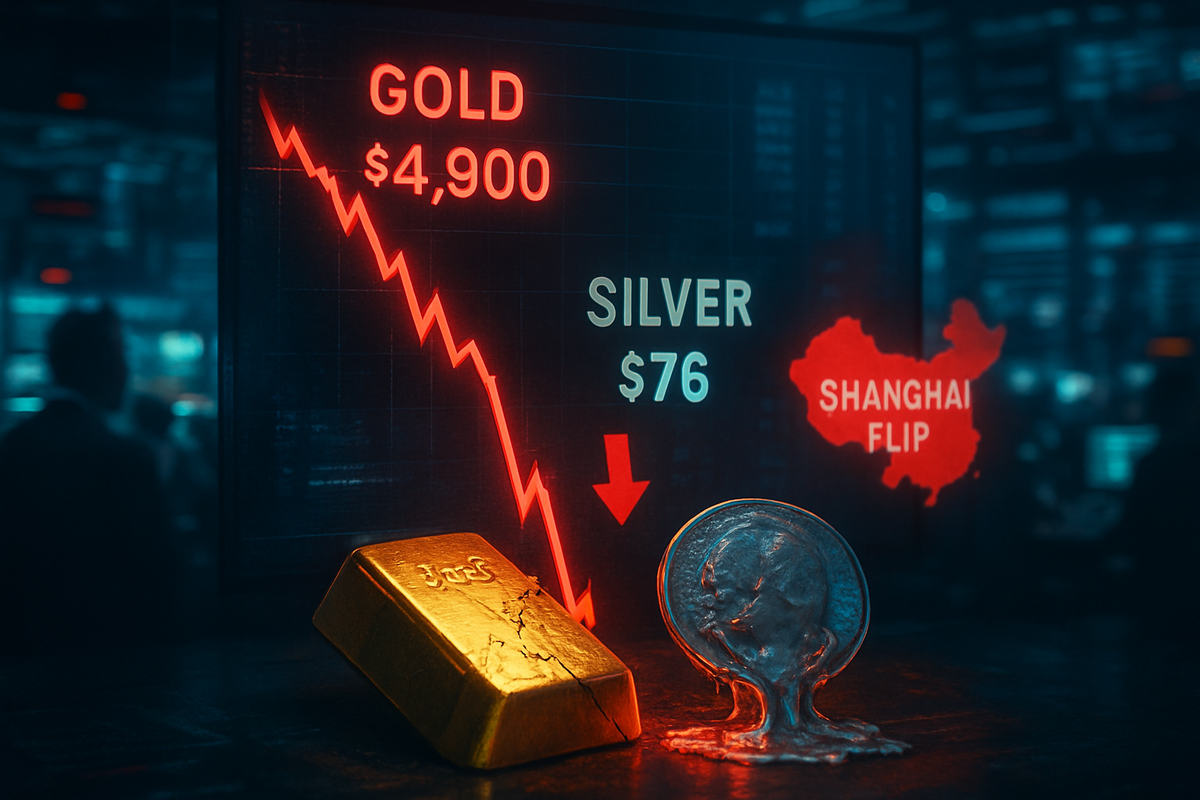
The global commodities markets were rocked this February as a violent "flash crash" erased billions in paper wealth within the precious metals sector. Gold, which had recently scaled historic heights above $5,600, experienced a gut-wrenching plunge to $4,900, while silver suffered a parabolic reset, falling 10% in a single session to settle near the $76 mark. This sudden evaporation of liquidity has sent shockwaves through trading floors from New York to London, marking a definitive end to the speculative "moonshot" rally that defined the start of the year.
The carnage was not merely a localized event but a systemic rupture fueled by a "perfect storm" of hawkish monetary shifts and a vanishing physical floor in the East. As the dust settles on this mid-February rout, analysts are pointing to a massive liquidation event where over-leveraged "weak hands"—traders who had been chasing the market during its record-breaking ascent—were forced to exit positions at any price. The immediate implication is a sober re-evaluation of the "inflation hedge" narrative as the market grapples with a stronger-than-anticipated U.S. Dollar and tightening margin requirements.
Anatomy of a Meltdown: Timeline and Triggers
The seeds of the crash were sown in late January 2026, following gold’s climb to an all-time high of $5,627 per ounce. The initial "liquidity rupture" occurred on January 30, following the nomination of Kevin Warsh as the next Federal Reserve Chair. This "Warsh Shock" immediately shifted market expectations toward a more hawkish "higher for longer" interest rate environment, strengthening the U.S. Dollar and triggering an initial wave of profit-taking. However, the true flash event arrived on February 12, 2026, during a thirty-minute window of intense selling where gold breached the psychological $5,000 support level, hitting a low of $4,900.
Simultaneously, the silver market, which had been the "meme darling" of late 2025 with prices peaking near $120, faced an even more brutal correction. On February 13, silver plummeted 10% to reach $76, a level not seen since the initial breakout phase. The CME Group’s decision to overhaul margin requirements, moving to a floating 18% notional value for silver, acted as a "margin massacre." Thousands of retail and institutional traders were caught in a feedback loop of forced liquidations as their collateral failed to cover the mounting losses in their accounts.
The key players in this drama extended beyond the trading pits of the Comex. The Shanghai Gold Exchange (SGE) played a pivotal role in signaling the top. For months, Shanghai gold had traded at a staggering $72 premium over Western prices, indicating insatiable demand from Chinese investors. In early February, this premium evaporated and flipped into a $14 discount. This "Shanghai Flip" was the ultimate warning sign that the physical floor in the East had vanished, leaving the paper markets in the West vulnerable to a total collapse.
Mining Giants Under Fire: Winners and Losers
Publicly traded mining companies, which typically act as leveraged bets on the underlying metal prices, saw their valuations decimated during the crash. Newmont (NYSE: NEM), the world’s largest gold miner, saw its shares tumble roughly 15% from their January peaks. While the company remains highly profitable even at $4,900 gold, the sudden compression in margins and the rotation out of the sector by institutional funds led to a "sell first, ask questions later" mentality among shareholders.
Barrick Gold (NYSE: GOLD) similarly faced a sharp retreat, losing nearly 13% of its market capitalization in the wake of the $4,900 dip. Analysts noted that Barrick’s dual exposure to copper and gold made it particularly sensitive to the macro-economic shift signaled by the stronger dollar. For investors who had "chased" these stocks as gold moved toward $6,000, the losses were compounded by the volatility of the mining sector's equity risk.
In the silver space, First Majestic Silver (NYSE: AG) experienced some of the most "violent and indiscriminate" selling. As a high-beta producer, its stock price is exceptionally sensitive to silver’s movements; the 10% drop in the metal to $76 translated into a significant double-digit percentage decline for the stock. While these companies retain strong balance sheets due to the high average prices of 2025, the flash crash has effectively reset expectations for dividend growth and capital expenditure in the coming fiscal year.
Technical Divergence and Historical Echoes
The technical backdrop of the crash provided a textbook case of market exhaustion. Throughout the final leg of the rally, gold’s Relative Strength Index (RSI) had hit a "stratospheric" reading of 90, a level historically associated with imminent reversals. Even as prices reached new highs, the momentum indicators began to trend lower, creating a bearish RSI divergence that signaled the rally was being driven by speculative froth rather than sustainable buying pressure.
This event bears striking similarities to the 1980 "Volcker Shock," where a shift in Federal Reserve leadership toward aggressive inflation-fighting crashed the precious metals party of that era. Furthermore, the CME’s margin hikes in 2026 mirrored the 2011 intervention that broke the back of the last major silver bull market. In both historical precedents, the transition from a "supply-driven" rally to a "leveraged-speculation" rally set the stage for a dramatic reversion to the mean.
The broader significance lies in the breakdown of the "de-dollarization" trade that had been a tailwind for metals. The sudden strength of the DXY toward the 100 mark, combined with the Shanghai discount, suggests that the global liquidity environment is tightening faster than markets anticipated. This ripple effect is likely to be felt in other hard assets and emerging market currencies, as the "hunt for cash" replaces the "flight to safety."
The Path Forward: Volatility or Value?
In the short term, the precious metals market is expected to remain in a "penalty box" as it digests the massive volume of liquidations. Traders who were "chased out" of the market at the $4,900 and $76 levels are unlikely to return until there is a clear sign that the Federal Reserve's hawkish stance has been fully priced in. Market participants should expect a period of "base building" where gold attempts to consolidate between $4,800 and $5,100, while silver seeks a new equilibrium near the $75 mark.
Strategically, the mining sector may see a shift toward consolidation. With valuations of mid-tier producers having taken a significant hit, larger players like Newmont or Barrick may look to use their still-substantial cash reserves to acquire distressed assets at a discount. The challenge for the industry will be managing shareholder expectations after a period of historic, albeit brief, windfalls. The "gold rush" of early 2026 has transitioned into a "value hunt," where disciplined cost management will be more rewarded than simple production growth.
Wrap-Up: Lessons from the Flash Crash
The Metals Flash Crash of 2026 serves as a stark reminder of the dangers of parabolic moves and the impact of systemic liquidity. The primary takeaway is the importance of monitoring physical premiums—specifically the Shanghai Gold Exchange—as a lead indicator for global price action. When the "Shanghai Flip" occurred, it signaled that the real-world demand could no longer support the inflated paper prices being traded on Western exchanges.
Moving forward, the market is likely to remain sensitive to any shifts in the Federal Reserve’s narrative and the performance of the U.S. Dollar. Investors should watch for the "gold-silver ratio" to stabilize, as silver’s higher volatility continues to offer both higher risk and higher potential reward. The era of easy gains in precious metals appears to have paused, replaced by a more nuanced, macro-driven trading environment.
For the coming months, the $4,900 floor for gold will be the most critical level in the financial world. Should it hold, the long-term bull case for metals remains intact, albeit at a more sustainable pace. If it fails, the "flash crash" may simply be the first chapter in a much larger deleveraging cycle for the global economy.
This content is intended for informational purposes only and is not financial advice.